West Highland White Terrier

- Origin
- Scotland
- Type
- Terrier
- Size
- Small
- Height
- 25–28 cm (10–11 in)
- Weight
- 6.8–9.1 kg (15–20 lb)
- Coat
- Harsh outer coat over a soft, thick undercoat
- Colors
- White
- Life span
- About 13 years
- Status
- Recognised by the FCI, AKC and The Kennel Club
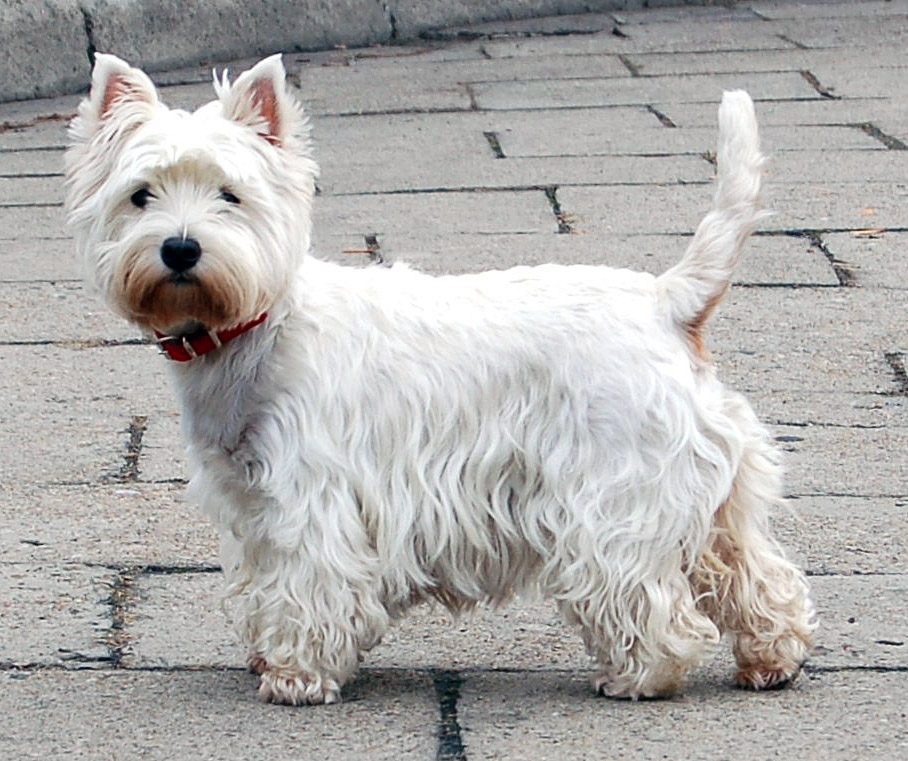
The West Highland White Terrier, or Westie, is a small Scottish terrier with a harsh white coat that fills out around the face to give it a rounded look. It was bred to hunt small rodents on farms and is still an energetic, boisterous dog with a strong prey drive. It is a cousin of the Cairn Terrier.
History
White terriers were known in Scotland as early as the reign of James VI (1567–1625), who ordered a dozen from Argyll as a gift for France. For a long time, though, white dogs were thought weaker than sandy or brindle ones.
Several lines of white terriers were bred in the 19th century. George Campbell, 8th Duke of Argyll, kept the Roseneath Terrier, and Dr. Americ Edwin Flaxman of Fife bred white Scottish Terriers he called Pittenweem Terriers. The man most closely tied to the modern breed is Edward Donald Malcolm, 16th Laird of Poltalloch. The story goes that one of his reddish-brown working terriers was mistaken for a fox and shot, and that he then set out to breed white dogs, the Poltalloch Terriers. In 1903 Malcolm declared that he did not want to be known as the breed’s creator and asked that it be renamed. The name West Highland White Terrier first appeared in print in 1908.
The first breed club was founded in 1904. The Kennel Club recognised the breed in 1907, the year it first appeared at Crufts. It reached the United States in 1907–1908, where it was at first called the Roseneath Terrier and its club was recognised by the American Kennel Club in 1908; the Canadian Kennel Club followed in 1909. Until 1924, British Westie pedigrees could still include Cairn and Scottish Terriers.
Westies won Best in Show at Westminster in 1942 and 1962, and at Crufts in 1976, 1990 and 2016. In 2001 the Westie was Britain’s most popular terrier, and it has been in the top third of all breeds in the United States since around 1960.
Appearance
Westies typically weigh 6.8 to 9.1 kg (15 to 20 lb) and stand 25 to 28 cm (10 to 11 in) at the withers, with legs longer than those of other Scottish terriers. The chest is deep, the limbs muscular and the tail short and sturdy. The eyes are dark, almond-shaped and deep-set, the ears pointed and erect, and the nose black. The paws turn out slightly, which gives a better grip on rocky ground.
The rough outer coat can grow to about 5 cm (2 in) over a soft, thick undercoat. Most Westies are pure white, though some have a light wheaten tinge. The coat is kept in shape by hand-stripping, especially for shows, or by clipping.
Temperament
Westies are independent, self-assured and confident, and are said to be the friendliest of the Scottish terriers. They are intelligent and quick to learn, loyal to their owners and good watchdogs. Temperament varies, however: some enjoy children, while others prefer to be left alone. They rarely put up with rough handling and can be possessive of food and toys, so training from a young age matters.
They can also be stubborn, and training may need refreshing over the years. They keep the instincts of an earth dog: curious, fond of chasing, and given to barking and digging. They need at least an hour of exercise a day. The breed ranks 47th in Stanley Coren’s The Intelligence of Dogs, almost exactly in the middle.
Care and health
A French study in 2015 found a life expectancy of 12.9 years and a British study in 2024 found 13.4 years.
Craniomandibular osteopathy, sometimes called “Westie jaw”, most often affects this breed. It is a recessive inherited condition in which the bone of the jaw overgrows in dogs under a year old, making it hard to chew or swallow. It often stops progressing by about one year of age.
Skin problems are common. About a quarter of Westies surveyed had atopic dermatitis, a heritable allergic skin condition, with males affected more often than females. Hyperplastic dermatosis, also known as epidermal dysplasia, is an uncommon but severe skin disease found only in Westies.
Other conditions seen in the breed include globoid cell leukodystrophy, an inherited neurological disease; white dog shaker syndrome, which causes tremors; abdominal hernias; Legg–Calvé–Perthes disease of the hip; and chronic hepatitis, which a 2021 British study found to be 3.23 times more likely in Westies than in other dogs and which copper storage disease can bring on. The breed is among the least likely to have a luxating patella.
Facts on this page were checked against Wikipedia and may have changed since.