Golden Retriever
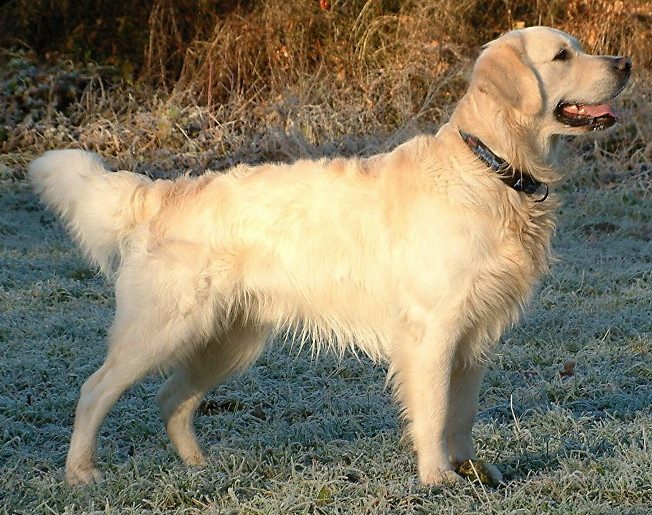

- Origin
- Scotland
- Type
- Gundog
- Size
- Large
- Height
- 51–61 cm (20–24 in)
- Weight
- 25–34 kg (55–75 lb)
- Coat
- Flat or wavy double coat with feathering and a dense, water-resistant undercoat
- Colors
- Any shade of gold or cream
- Life span
- 10–13 years
- Status
- Recognised by the FCI, AKC and The Kennel Club
The Golden Retriever is a British retriever of medium to large size, known for its gentle, affectionate nature and its golden coat. It was bred in Scotland in the 19th century as a working gundog and is now among the most often registered breeds in the United Kingdom, the United States, Canada and Australia.
History
The breed was created by Sir Dudley Marjoribanks, later Baron Tweedmouth, at Guisachan, his estate in Scotland. In the 1860s he acquired Nous, the only yellow puppy in a litter of black Flat-coated Retrievers, and in 1868 mated him to Belle, a Tweed Water Spaniel. Their yellow puppies were bred on with another Tweed Water Spaniel, a Red Setter, a black Flat-coated Retriever and a black Labrador, and later a sandy Bloodhound. Only the golden puppies were kept and bred together.
For years romantic stories circulated, including one that Nous came from a Russian circus trainer. Marjoribanks’s own stud book, covering 1868 to 1890 and now kept by the Kennel Club in London, showed otherwise when research on it was published in 1960.
The dogs were first treated as a color variety of the Flat-coated Retriever. The Kennel Club recorded the first ones in 1903, a breed club formed in 1911 and a separate register opened in 1913. The name Golden Retriever became official in 1920. Winifred Charlesworth, an early enthusiast, wrote the first standard, which is little changed today. The breed spread quickly after the First World War, with recognition in Canada in 1927 and by the American Kennel Club in 1932.
Appearance
The Golden Retriever is powerfully built. Males stand 56 to 61 cm and females 51 to 56 cm, and healthy adults weigh 25 to 34 kg. The head is broad with a clear stop, dark eyes set well apart, a wide muzzle, a large black nose and ears that hang with a slight fold. The chest is deep, the back level and the long, straight tail is carried roughly in line with the back.
The outer coat is long and flat or wavy, with feathering, over a dense undercoat that keeps out the weather. It may be any shade of cream, yellow or gold and usually pales with age. The Kennel Club standard does not allow red or mahogany. Cream has been accepted there since 1936, but North American standards do not permit it and ask for a slightly taller dog. Show dogs tend to have longer, finer coats than working dogs.
Temperament
The breed is considered intelligent, gentle and very affectionate. It is generally calm, easy to train and eager to please, very tolerant of children, and often has no guarding instinct at all. Some very aggressive dogs have been reported in certain lines. Goldens keep a keen nose and a strong urge to retrieve, and often carry toys to their owners. They are slow to mature compared with other retrievers.
Besides working as gundogs, mostly on land birds such as grouse and partridge, they are trained as guide dogs and therapy dogs and compete in obedience and other dog sports.
Care and health
The long coat needs more grooming than a Labrador’s and picks up dirt and burrs. A 2024 UK study found a median life expectancy of 13.2 years, and an Italian study 10 years.
The breed is unusually prone to cancer, especially hemangiosarcoma and lymphoma. One United States study found cancer to be the cause of death in about half of dogs, while European studies found 20 to 39 percent. Golden Retrievers are also predisposed to hypothyroidism and can inherit a skin condition called ichthyosis.
Facts on this page were checked against Wikipedia and may have changed since.