Rough Collie

- Origin
- Scotland
- Type
- Herding
- Size
- Large
- Height
- 51–66 cm (20–26 in)
- Weight
- 18–32 kg (40–70 lb)
- Coat
- Long, dense, coarse outer coat over a downy undercoat
- Colors
- Sable and white, tricolor, blue or sable merle, or white with a colored head
- Status
- Recognised by the FCI, AKC and The Kennel Club
The Rough Collie, or Long-Haired Collie, is a British herding dog of medium to large size with a long, full coat. It is the same dog as the Smooth Collie in everything but coat length. Both were bred to herd sheep in Scotland. Today the Rough Collie is mostly a companion and show dog, known around the world through Lassie.
History
Rough and Smooth Collies descend from local herding dogs of Scotland and Wales. The Scottish type was large, strong and aggressive, bred for highland sheep; the Welsh type was small, nimble and friendly, and herded goats too. The English crossed both with their own sheepdogs, which gave a mix of short- and long-haired dogs. As keeping dogs became fashionable after the Industrial Revolution, these early collies are believed to have been crossed with the Borzoi to give a longer, more “noble” head, though it is not known for certain whether that cross entered the main line of the breed.
Queen Victoria acquired a Rough Collie after seeing one at Balmoral Castle, and the breed became something of a fashion. Breeding for the show ring then changed its looks a great deal. Earlier dogs were sturdier and were said to cover up to 100 miles in a day. The Collie Club in England dates from 1881, and the Collie Club of America, founded in 1886, is one of the oldest breed clubs in the United States.
In the United Kingdom the Rough Collie is no longer used for serious herding, where the Border Collie has taken its place. In the United States and several European countries it has made something of a return as a working and performance dog.
Appearance
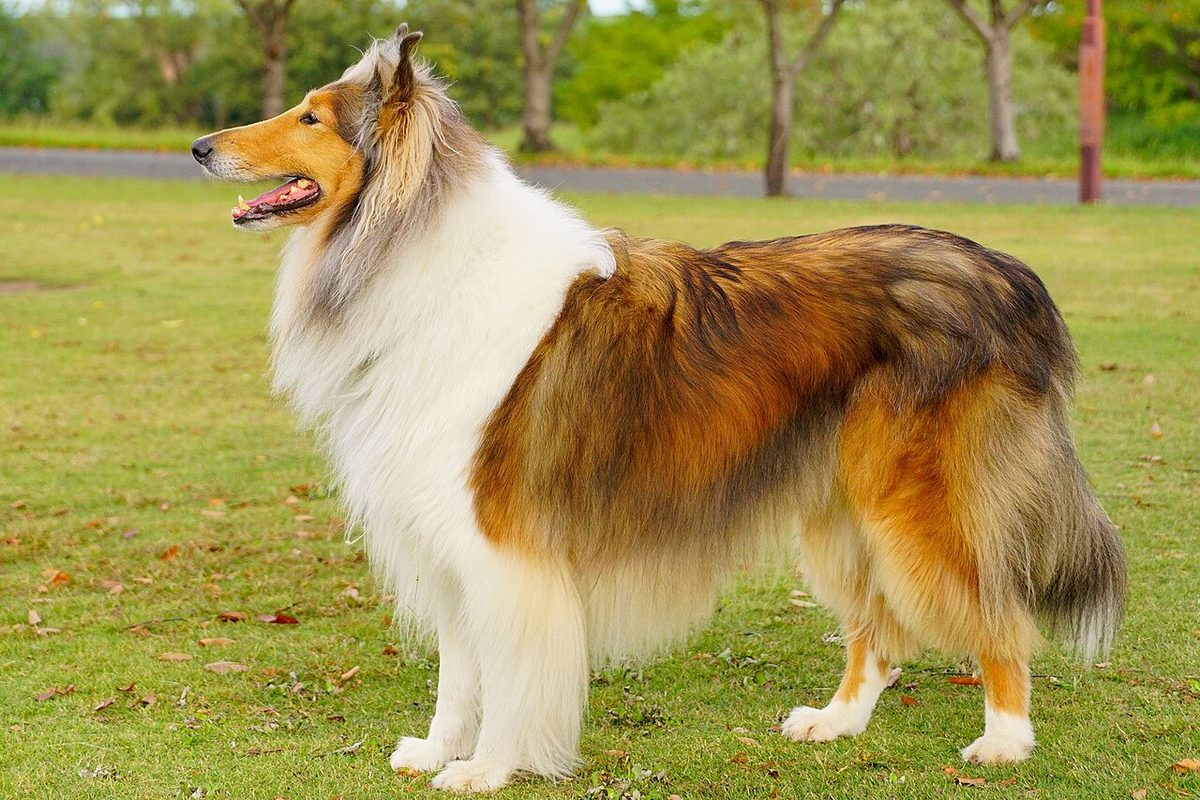
The head is the breed’s hallmark. Light for the size of the body, it forms a blunt wedge that tapers smoothly from the ears to the black nose, with a slight but distinct stop and the top of the skull parallel to the muzzle. The eyes are almond-shaped and of medium size. The ears are semi-erect, with the top third tipping forward.
A downy undercoat lies beneath a long, dense, coarse outer coat, with a marked ruff around the neck, feathering on the legs and a frill on the hindquarters. The recognised colors are sable and white, the sable running from pale tan to mahogany; tricolor, mainly black edged with tan; blue or sable merle; and color-headed white. All have white on the collar, parts of the legs and usually the tail tip.
Size depends on the standard. The UK standard gives 56 to 61 cm (22 to 24 in) for males and 51 to 56 cm (20 to 22 in) for females, and asks for a markedly smaller dog than the American one, under which males may reach 66 cm (26 in). Males usually weigh 23 to 32 kg (50 to 70 lb) and females a little less. The Shetland Sheepdog looks much like a Rough Collie in miniature.
Activities
Rough Collies take part in agility, obedience, flyball, tracking and herding events, and herding instinct tests show whether a dog that has never seen livestock still has the urge to work it. The breed has also served in search and rescue, as a therapy dog and as a guide dog for the blind.
Care and health
Rough Collies are generally healthy and resilient, but several inherited problems are known in the breed.
Collie eye anomaly, in which the eye develops abnormally and sight may be lost, is common, and puppies can be checked for it by a veterinary ophthalmologist at six to eight weeks. Progressive retinal atrophy is rarer and appears later. Canine cyclic neutropenia, or gray collie syndrome, is a blood disorder that is usually fatal to affected puppies, which are a pale gray or beige color. DNA tests can identify carriers.
Rough Collies may carry a mutant MDR1 gene that makes them sensitive to ivermectin and related drugs; a screening test shows whether a dog needs other medicines. Hip dysplasia is a possible concern but is rare in collies compared with other breeds of similar size. Epilepsy, bloat, allergies and thyroid disorders, mainly hypothyroidism, also occur and are thought to be at least partly inherited. A skin disease, ulcerative dermatosis of the Shetland Sheepdog and Rough Collie, affects the thighs, groin, armpits and belly.
Facts on this page were checked against Wikipedia and may have changed since.