Gordon Setter

- Origin
- Scotland
- Type
- Gundog
- Size
- Large
- Height
- 58–69 cm (23–27 in)
- Weight
- 20–36 kg (45–80 lb)
- Coat
- Long and silky, straight or slightly waved, with feathering
- Colors
- Black with chestnut or mahogany tan markings
- Life span
- About 12 years
- Status
- Recognised by the FCI, AKC and The Kennel Club
The Gordon Setter is a large Scottish gundog and a member of the setter family, alongside the Irish and English Setters. It was bred to find gamebirds such as grouse, partridge, ptarmigan and woodcock: birds that hide when danger nears, giving the dog time to hold its point until the hunter comes up.
History
Setters are generally agreed to descend from the old land spaniels, the setting spaniels, probably with some hound or pointer blood. Black and tan setters were kept in many kennels, but the breed takes its name from Alexander, 4th Duke of Gordon (1743–1827), who kept a kennel of them at Gordon Castle near Fochabers in Moray. Accounts from the 1860s say the Duke’s original stock came largely from Mr Coke of Norfolk, with whom he often exchanged dogs, and that he also bred with Lord Lovat’s kennel. Most of the setters at Gordon Castle in his day seem to have been tricolored, not pure black and tan.
In 1842 George Blunt and Daniel Webster brought two dogs from the Duke’s kennels, Rake and Rachel, to the United States. The American Kennel Club recognized the breed in 1892, and The Kennel Club gave it the name Gordon Setter in 1924.
Until the late 1930s most Gordons were working dogs on the moors of Scotland and northern England. As driven shooting replaced walking up game and partridge numbers fell, working setters and pointers declined, and there are no longer any large working kennels.
Appearance
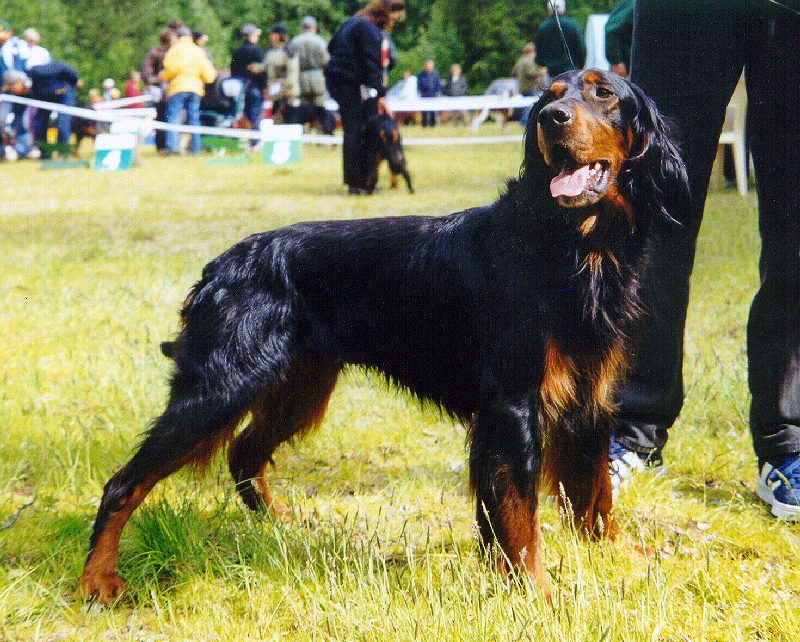
The coat is coal black with rich chestnut or mahogany markings on the paws and lower legs, throat and muzzle, a spot over each eye and two on the chest. A little white on the chest is allowed. Red puppies are occasionally born to normally colored parents but cannot be shown. The coat is long and silky, straight or slightly waved, with feathering on the chest, belly, ears, legs and tail. Gordons are the heaviest setters: males reach 69 cm at the withers and up to 36 kg.
Temperament
The AKC describes the Gordon as alert, confident, fearless and willing. Gordons are intensely loyal, affectionate and sensitive, and they are good family dogs, though their boisterousness may not suit homes with very young children. They are eager to learn and need firm, gentle handling with early socialization. The breed matures slowly, often not reaching its prime before three years of age.
Care and health
Gordons were bred to run and need 60 to 80 minutes of vigorous exercise a day. Young dogs should not be over-exercised before 18 months. They follow scents and should not roam unsupervised.
A 2024 British study found a life expectancy of 12.4 years. Health problems seen in the breed include hip dysplasia, hypothyroidism, gastric torsion (bloat), cataracts and progressive retinal atrophy. A late-onset form of the last, caused by a recessive mutation called rcd4, has had a DNA test since 2011; as many as half of Gordon Setters may be carriers.
Facts on this page were checked against Wikipedia and may have changed since.