Australian Silky Terrier
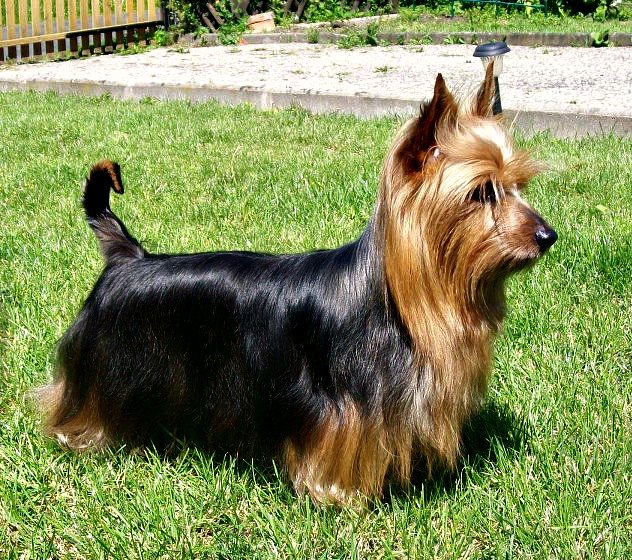

- Origin
- Australia
- Type
- Terrier
- Size
- Toy
- Height
- 23–26 cm (9–10 in)
- Coat
- Long, flat, fine, glossy and silky
- Colors
- Blue and tan
- Life span
- About 13 years
- Status
- Recognised by the FCI, AKC, UKC, ANKC and Canadian Kennel Club
The Australian Silky Terrier is a small terrier developed in Australia from types and breeds that came from Great Britain. Its closest relatives are the Australian Terrier and the Yorkshire Terrier. In North America it is called simply the Silky Terrier; in Australia and the rest of the world it keeps its full name.
History
The breed’s ancestors include the Yorkshire Terrier and the Australian Terrier, which itself descends from rough-coated terriers brought from Great Britain to Australia in the early 19th century. Few records survive, so it is unclear whether the first Silkies were Australian Terriers that happened to be born with silky hair or the result of a deliberate plan. The American Kennel Club dates the breed to the end of the 19th century, when Yorkshire Terriers were crossed with Australian Terriers.
It was first known as the Sydney Silky, because most of the dogs lived in that city. Most Australian breeds were working dogs, but this one was bred mainly as an urban pet and companion, though it also has a name for killing snakes.
Until 1929 the Australian Terrier, the Australian Silky Terrier and the Yorkshire Terrier were not clearly separated, and puppies of all three kinds could turn up in one litter, to be sorted by looks once grown. Crossbreeding was discouraged in Australia after 1932, and in 1955 the name officially became Australian Silky Terrier. The Australian National Kennel Council recognised the breed in 1958 in the Toy Group.
American servicemen stationed in Australia took a few Silkies home during and after the Second World War. Newspaper photographs in 1954 set off a wave of interest, and hundreds were imported to the United States. The American Kennel Club recognised the Silky Terrier in 1959 and the United Kennel Club in 1965. The Fédération Cynologique Internationale lists it as breed number 236. Most clubs place it in the Toy Group because of its size, though all agree that it is a terrier in type.
Appearance
This is a compact, short-legged dog standing 23 to 26 cm (9 to 10 in) at the withers, and about a fifth longer than it is tall. Since it once hunted rodents and snakes, it should have enough substance for that work.
The coat is the breed’s mark: long, flat, fine and glossy, hanging straight with a parting along the back, in blue and tan. It should be long but not reach the floor, and the hair on the face and ears is usually trimmed. The head is strong and wedge-shaped, with small almond-shaped eyes and small erect ears. Light eyes are a fault. The tail is set high and the feet are small and almost catlike.
Temperament
The standard asks for a keenly alert and active dog. Silkies are energetic, though somewhat less busy than other terriers, and more independent than most toy breeds while staying affectionate and loyal to their owners. They learn quickly but can be stubborn and willful, which makes training harder. They bark readily, especially at strangers.
Care and health
The coat needs regular grooming to keep it silky and free of tangles. A 2024 study in the United Kingdom found a life expectancy of 13.3 years for the breed, based on 45 deaths, against an average of 12.7 years for purebred dogs.
Facts on this page were checked against Wikipedia and may have changed since.