Scottish Terrier

- Origin
- Scotland
- Type
- Terrier
- Size
- Small
- Height
- 25–28 cm (10–11 in)
- Weight
- 8–10 kg (18–22 lb)
- Coat
- Hard, wiry outer coat with a soft, dense undercoat
- Colors
- Black, brindle or wheaten
- Life span
- About 12–13 years
- Status
- Recognised by The Kennel Club, the UKC and the FCI
The Scottish Terrier, widely called the Scottie and once known as the Aberdeen Terrier, is one of five terrier breeds that come from Scotland; the others are the Skye, Cairn, Dandie Dinmont and West Highland White. It was bred to kill vermin on farms and to hunt foxes and badgers in the Highlands.
History
The breed’s early history is obscure, partly because several Highland terriers were long lumped together under the name Skye Terrier. The Scottie and the West Highland White are certainly close relatives, both tracing to the Blackmount district of Perthshire and the Moor of Rannoch.
Toward the end of the 19th century breeders began to separate the Highland terriers into distinct breeds, and the rise of dog shows in the late 1870s meant that the Scottie’s looks were written down for the first time. In those years it went by several names, most often Aberdeen Terrier, since the dogs were plentiful around that city. All pedigrees go back to four early show winners, and above all to one bitch, Splinter II.
The first standard was published in 1880, and the Scottish Terrier Club of England was founded in 1881, seven years before its Scottish counterpart. Years of argument over the standard ended with a revised version around 1930, based on four influential dogs that gave the breed a longer head, a lower build and a squarer body. Black, now the typical color, became fashionable only in the 20th century.
Scotties reached America in the early 1890s and were the third most popular breed there by 1936. The breed has won Best in Show at Westminster nine times, more than any breed except the Wire Fox Terrier.
Appearance
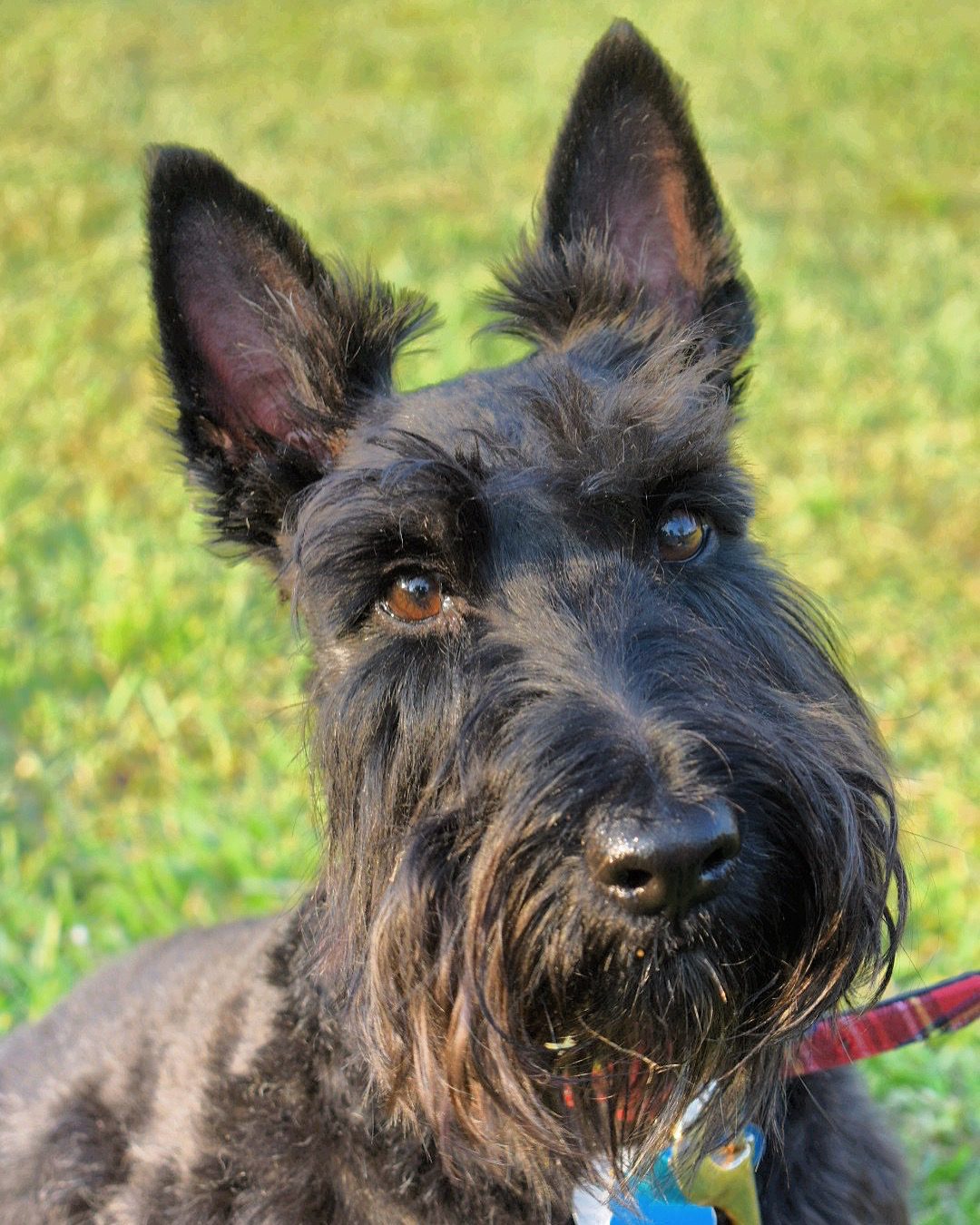
The Scottie is a small, compact, heavy-boned terrier with a thick-set body slung between short legs. It stands about 25 to 28 cm (10 to 11 in) at the withers. Males weigh 8.5 to 10 kg (19 to 22 lb) and females 8 to 9.5 kg (18 to 21 lb). The eyes are small, bright and almond-shaped, and the small pointed ears stand erect, as does the tail.
The outer coat is hard, wiry and weatherproof, over a soft, dense undercoat. It is left longer on the beard, legs and lower body. Colors run from dark gray to jet black and brindle; wheaten, from straw to almost white, also occurs.
Temperament
Scotties are alert, quick, territorial and feisty, perhaps more so than other terriers, and also independent, self-assured, playful and intelligent. Their determination earned them the nickname “Diehard”. They are loving but stubborn, can seem aloof, and tend to attach themselves to one or two people. They are reserved with strangers and bark only when needed, which makes them good watchdogs.
They may be aggressive toward other dogs unless introduced young, and they dig and chase small animals, so keeping them with cats, rabbits or similar pets is not advised. They are not recommended for homes with small children.
Care and health
The long hair on the legs and underside should be brushed daily to prevent mats.
Two inherited conditions seen in the breed are von Willebrand disease, a bleeding disorder, and craniomandibular osteopathy, an overgrowth of the jawbone in puppies. Scottie cramp, an inherited disorder that briefly affects a stressed dog’s walking, is not painful. Patellar luxation and cerebellar abiotrophy are also sometimes seen.
Scottish Terriers are more prone to some cancers than other purebreds, especially bladder cancer, which research suggests they are 20 times more likely to develop. A 2024 British study found a life expectancy of 12.7 years, the same as the average for purebred dogs.
Facts on this page were checked against Wikipedia and may have changed since.