Tibetan Spaniel
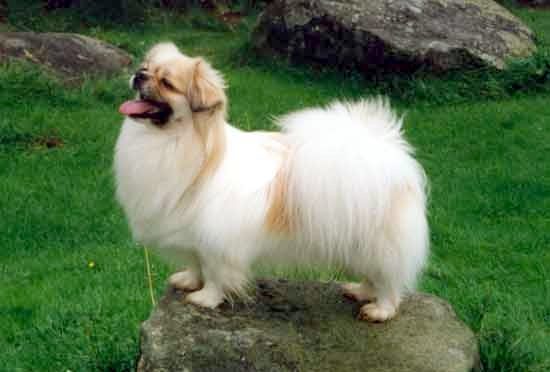

- Origin
- Tibet
- Type
- Toy and companion
- Size
- Small
- Height
- About 25 cm (10 in)
- Weight
- 4.1–6.8 kg (9–15 lb)
- Coat
- Silky double coat of medium length, with a mane and feathering
- Colors
- Any color
- Life span
- About 15 years
- Status
- Recognised by the FCI and AKC
The Tibetan Spaniel is a small, assertive companion dog from Tibet. It is not a true spaniel, since spaniels are gun dogs and this breed was never one. The name may have come from its likeness to the lap-dog versions of hunting spaniels, such as the Cavalier King Charles Spaniel.
History
Small monastery dogs, thought to be early Tibetan Spaniels, followed their lama masters about and were called little lions for their likeness to the Snow Lions of Buddhist tradition. That gave them great prestige. They were sent as gifts to the palaces of China and other Buddhist countries, and lion dogs came back to Tibet in return, as late as 1908. Because of these exchanges the breed probably shares ancestors with the Pekingese and the Japanese Chin.
In the monasteries the dogs were workers as well as pets. They sat on the walls and watched the countryside, and their keen eyesight made them good lookouts. They barked to warn the monks and the Tibetan Mastiffs below. They were also trained to turn prayer wheels, and they slept beside the monks to keep them warm.
Tibetan Spaniels were being bred in the United Kingdom by the 1890s. The first known litter in the United States was born in 1965 to two dogs imported from a Tibetan monastery. The American Kennel Club accepted the breed in its Non-Sporting group from January 1, 1984, and the Fédération Cynologique Internationale recognized it in 1987.
Appearance
By the American Kennel Club standard the dog stands about 25 cm (10 in) at the shoulder and weighs 4.1 to 6.8 kg (9 to 15 lb). Slightly bigger dogs are common outside the show ring.
The head is domed and small for the body, with a short, blunt muzzle free of wrinkles and a black nose. The ears hang to cheek level and are feathered. The richly feathered tail is set high and carried over the back.
The coat is a silky double coat that lies flat. It is short and smooth on the face and the front of the legs and of medium length on the body, with feathering on the ears, toes and tail and a mane around the neck that is fuller in males. All colors occur, solid, shaded or mixed, often with white on the feet.
Temperament
This is a social dog that needs regular contact with its people and does poorly when left alone for long. It is devoted and protective at home, but usually aloof with strangers, and it barks loudly when startled or uneasy. It is also independent and stubborn, and inclined to wander off and explore when called.
Care and health
A British study in 2024 found a life expectancy of 15.2 years, well above the average for purebred dogs.
Progressive retinal atrophy, an inherited and painless form of blindness, occurs in the breed. It begins as night blindness, usually between one and a half and four years of age. A DNA test has been available since 2013. Portosystemic shunt, or liver shunt, is a rare condition in the breed. Tibetan Spaniels can also have allergies, cherry eye and weeping eye.
Facts on this page were checked against Wikipedia and may have changed since.