Tibetan Mastiff
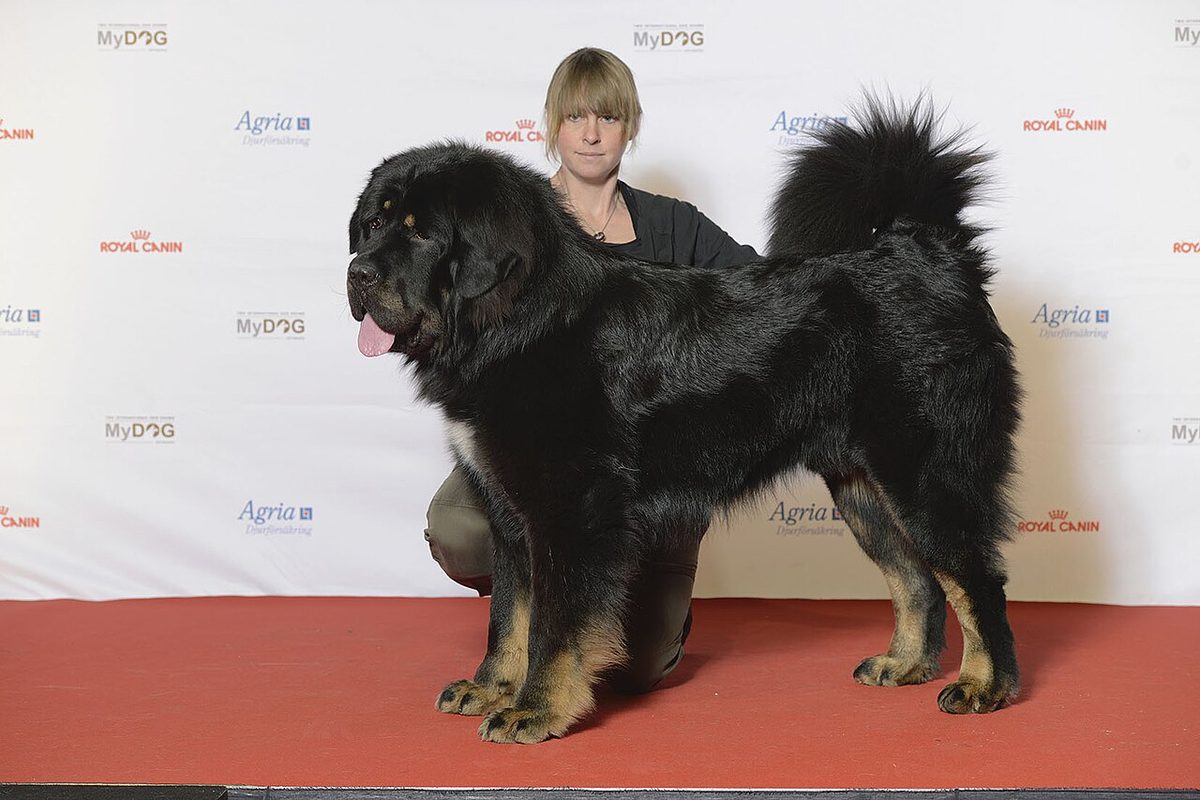

- Origin
- Tibet
- Type
- Livestock guardian
- Size
- Giant
- Height
- 61–66 cm (24–26 in)
- Weight
- 30–70 kg (70–150 lb)
- Coat
- Medium to long double coat
- Colors
- Black, black and tan, red or bluish-gray, sometimes with white markings
- Status
- Recognised by the FCI and AKC
The Tibetan Mastiff is a large dog from the Tibetan Plateau, bred as a flock guardian at high altitude in Tibet and the Himalayas. It was also used to protect Buddhist monasteries and their monks from bears, wolves and snow leopards.
The name is a Western one: Europeans who first reached Tibet called nearly every large dog a mastiff.
History
A nineteenth-century account describes the dogs of Tibet as twice the size of those in India, with large heads and hairy bodies, chained by day and let loose at night to guard their masters’ houses.
In the early 20th century the Prince of Wales, later George V, brought a pair to the United Kingdom. By 1906 there were enough in England for the breed to be shown at the Crystal Palace, but it lost favor during the war years and nearly died out there.
The breed has been gaining ground worldwide since 1980, and registries including the FCI and the AKC came to recognize it. It first competed at the Westminster Kennel Club Dog Show in 2008. Popularity brought over-breeding, and many puppies were heavily inbred.
A 2011 DNA study found the Tibetan Mastiff related to the Great Pyrenees, Bernese Mountain Dog, Rottweiler and Saint Bernard, which are probably partly descended from it. A 2020 genomic analysis traced the breed’s ability to cope with thin air to ancient interbreeding with an unknown wolf-like canid.
Appearance
The FCI standard gives heights of 66 cm (26 in) for males and 61 cm (24 in) for females. According to the AKC, males weigh 40–70 kg (90–150 lb) and females 30–55 kg (70–120 lb).
The double coat is medium to long, depending on climate. Colors include solid black, black and tan, shades of red from pale gold to deep red, and bluish-gray, sometimes with white on the neck, chest and legs. The coat sheds dirt and lacks the strong smell of many big dogs. There is usually one heavy molt in late winter or early spring.
Unlike most dogs, females usually come into season only once a year, in late fall, so most puppies are born in December and January.
Temperament
As a flock guardian the Tibetan Mastiff warns predators off by barking and scent-marking its boundaries. It is a night sentry by long breeding: it often sleeps by day and is most alert after dark, barking at unfamiliar sounds through the night.
It is intelligent, strong-willed and stubborn, and reserved with strangers. Obedience training is recommended, though it works only moderately well with some dogs, and socialization is essential. The breed can live happily in a large fenced yard with another dog, but it is not suited to apartments or to first-time owners.
Care and health
Breeders often claim a lifespan of 10–16 years, but these claims are unsubstantiated; some lines are long-lived, while closely inbred ones are not. The breed has fewer genetic problems than many. Conditions that do occur include hypothyroidism, which is fairly common, entropion, ectropion, skin problems and allergies, heart problems, epilepsy, progressive retinal atrophy, cataracts, ear infections, and elbow or hip dysplasia.
Facts on this page were checked against Wikipedia and may have changed since.