Bolognese
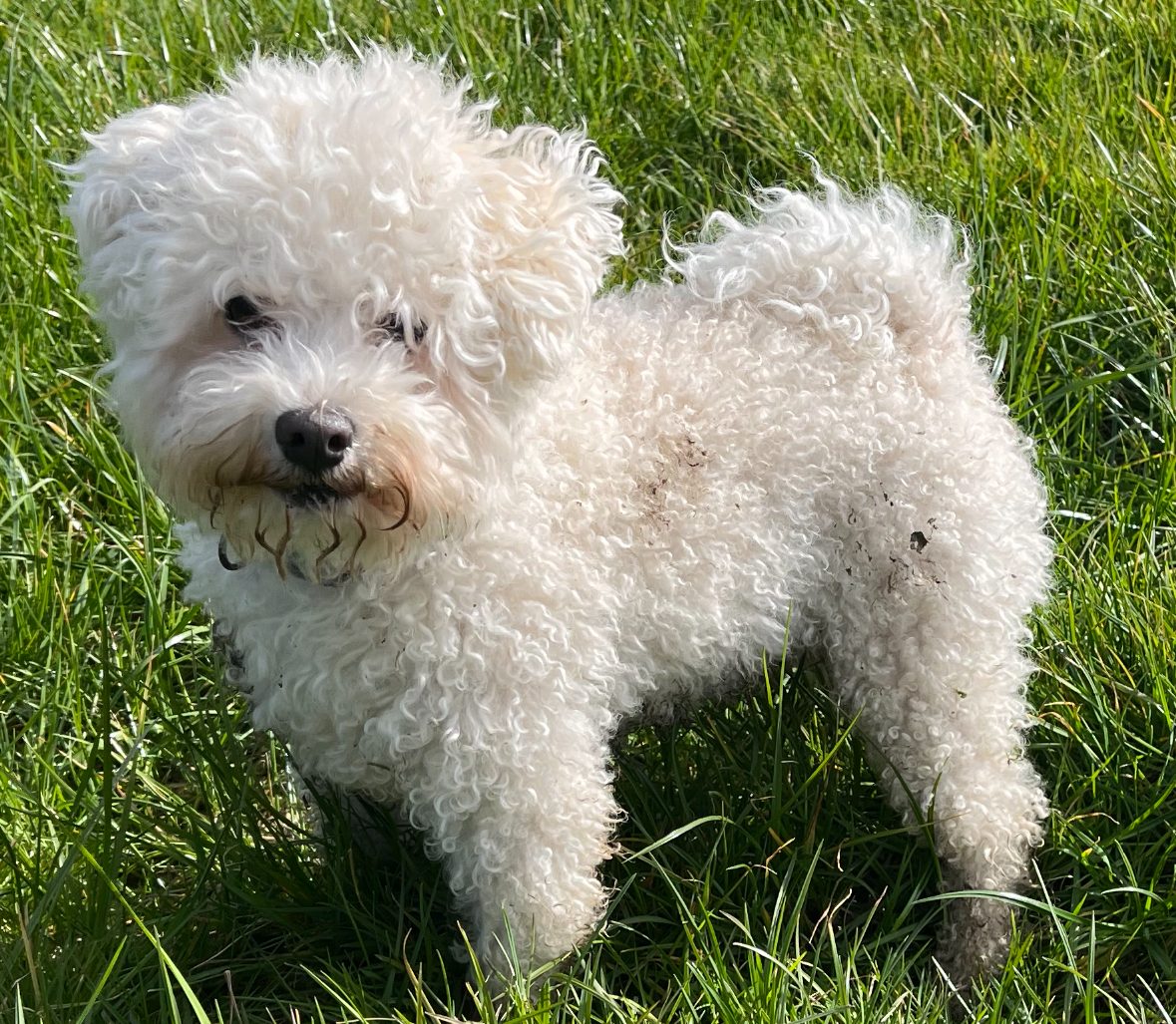

- Origin
- Italy
- Type
- Toy and companion
- Size
- Toy
- Height
- 25–30 cm (10–12 in)
- Weight
- 2.5–4 kg (6–9 lb)
- Coat
- Long, fluffy and woolly, in loose ringlets
- Colors
- White
- Life span
- 12–14 years
- Status
- Recognised by the FCI
The Bolognese is a small Italian dog of Bichon type, placed in the toy group and mostly kept as a companion. It takes its name from the city of Bologna in Emilia-Romagna.
History
The Bolognese belongs to the Bichon family, along with the Bichon Frisé, the Maltese, the Löwchen, the Havanese and the Coton de Tuléar. Its origins and ancestry are not known.
Dogs of this kind appear in Flemish tapestries going back as far as the seventeenth century. Titian painted Duke Federico Gonzaga with one, and others can be seen in works by Goya, Gosse and Watteau. Owners of such dogs included Catherine the Great of Russia, Madame de Pompadour and Empress Maria Theresa of Austria.
Liz Stannard brought the breed into England in 1990, and it was first shown there that year. From 2001 it could be entered at all shows with classes of its own, and it appeared at Crufts for the first time in 2002.
Appearance
This is a small dog. Males stand 27–30 cm and females 25–28 cm, and the weight is 2.5–4 kg.
The coat is pure white or pale ivory. It is a single coat with no undercoat, falling in loose, open ringlets or flocks all over the body, with shorter hair on the face. The texture is woolly rather than silky. The coat is not trimmed or clipped for the show ring, though pet dogs are sometimes clipped.
Care and health
The Bolognese is described as a non-shedding breed. Life expectancy is given as 12 to 14 years. A 2024 study in the United Kingdom, based on 32 dogs, found a median lifespan of 14.9 years, against an average of about 12.5 years for dogs in general.
Facts on this page were checked against Wikipedia and may have changed since.