Shetland Sheepdog
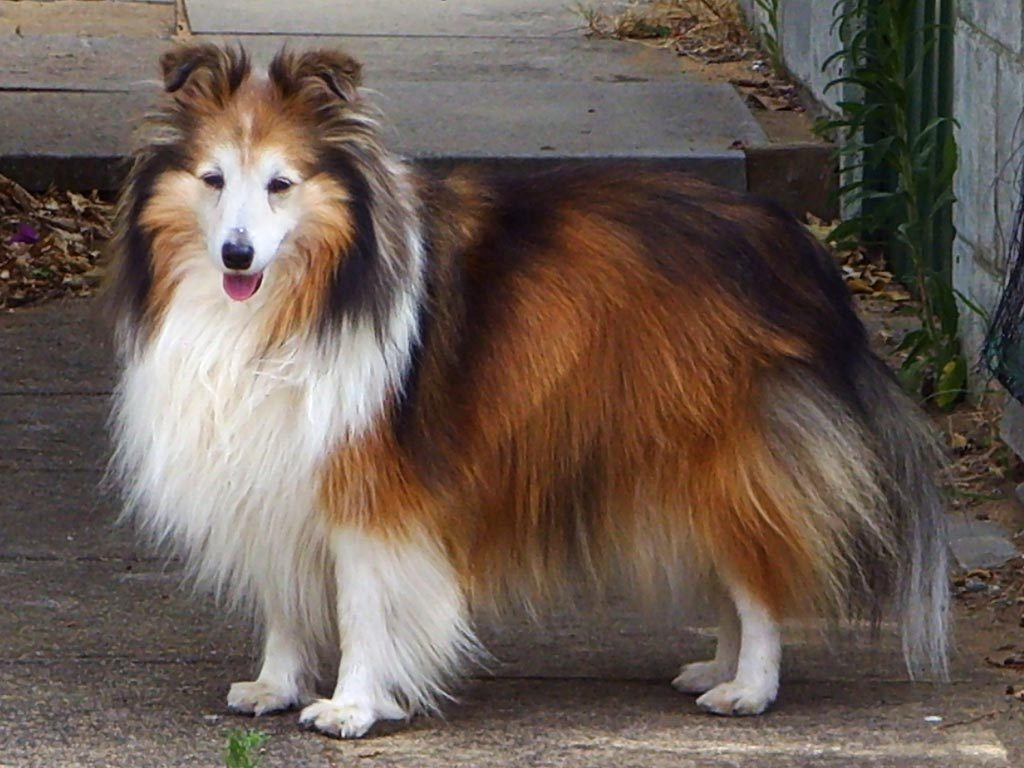

- Origin
- Scotland
- Type
- Herding
- Size
- Small
- Height
- 33–40 cm (13–16 in)
- Coat
- Long double coat, harsh and straight over a soft undercoat
- Colors
- Sable, tricolor, blue merle, black and white, or black and tan
- Life span
- 13–14 years
- Status
- Recognised by the FCI, AKC and The Kennel Club
The Shetland Sheepdog, or Sheltie, is a small herding dog from the Shetland Islands of Scotland. It is clever, vocal and willing to please, and although it can still herd, it is now mostly a working companion or family pet.
History
The Sheltie looks like a small Rough Collie, but it was not made simply by breeding Collies down in size, and its origins are obscure. The original sheepdog of Shetland was a spitz-type dog, probably much like today’s Icelandic Sheepdog. There is strong evidence that it was crossed with the Yakki, a dog that came ashore with whalers from Greenland. Collies from mainland Britain were also crossed in, Pomeranian ancestry is likely, and folk tales mention a King Charles Spaniel from a yacht. The early dogs were small and mixed, often only 20 to 30 cm (8 to 12 in) at the shoulder.
The first breed club asked for a dog like the Rough Collie in everything but size, no taller than 38 cm (15 in), and breeders added Collie blood to get it; such crosses went on until the 1940s. The Kennel Club at first refused to recognise the breed, then agreed in 1909 on condition that the name Shetland Collie, which Collie breeders objected to, was dropped. The old spitz-type sheepdog of Shetland is now extinct, replaced on the islands by the Border Collie.
Appearance
The ideal height at the withers is 37 cm (14.5 in) for males and 35.5 cm (14 in) for females, and a difference of more than 2.5 cm (1 in) either way is undesirable.
The head is a long, refined wedge tapering from ears to nose. The ears are small, set close together on top of the head, and carried half-erect with the tips forward when the dog is alert. The eyes are almond-shaped and dark brown, though merle dogs may have one or both eyes blue.
The outer coat is long, straight and harsh, over a soft, short undercoat. It forms a mane around the neck, while the face is smooth. Colors are sable, from pale gold to mahogany; tricolor; blue merle, a silvery blue marbled with black; black and white; and black and tan.
Temperament
Shelties are bright and biddable. In Stanley Coren’s 1995 study of trainability the breed ranked sixth of 138, typically learning a new command in fewer than five repetitions.
Care and health
Studies have put life expectancy at 13.4 years in the United Kingdom and 14.3 years in Japan. Hip dysplasia is uncommon.
The breed is predisposed to several skin conditions, including allergic skin disease, dermatomyositis, lupus, and an ulcerative skin disease shared with the Rough Collie. It has about four times the usual risk of transitional cell carcinoma, a bladder cancer, and a very strong predisposition to gall bladder mucocele. Collie eye anomaly and von Willebrand disease, an inherited bleeding disorder, both occur. Some Shelties carry the MDR1 gene mutation, which makes them sensitive to certain drugs, among them ivermectin and loperamide.
Facts on this page were checked against Wikipedia and may have changed since.