German Shepherd Dog

- Origin
- Germany
- Type
- Herding
- Size
- Large
- Height
- 55–65 cm (22–26 in)
- Weight
- 22–40 kg (49–88 lb)
- Coat
- Dense double coat, medium or long
- Colors
- Black and tan, black and red, sable or solid black
- Life span
- About 10 years
- Status
- Recognised by the FCI, AKC and The Kennel Club
The German Shepherd Dog, long known in Britain as the Alsatian, is a German working breed of medium to large size. Max von Stephanitz developed it from 1899 out of Germany’s traditional herding dogs. It was bred to herd sheep, but has since taken on many other jobs, including police work, search and rescue, assistance for disabled people and military service. It is also one of the most registered companion breeds in the world.
History
In the 1890s German shepherds bred their own dogs locally, and the results varied a great deal from one district to the next. The Phylax Society, formed in 1891 to standardise the native breeds, broke up after three years over whether dogs should be bred for work alone or for looks as well.
Von Stephanitz, a former cavalry captain who had belonged to the society, held firmly to work. At a dog show in 1899 he saw a dog called Hektor Linksrhein, bought him on the spot, renamed him Horand von Grafrath and founded the Verein für Deutsche Schäferhunde, the Society for German Shepherd Dogs. Horand was the first dog in its register. He and his descendants were closely inbred to fix the type, and every German Shepherd traces back to them. By 1923 the society claimed 50,000 members.
The breed spread abroad after the First World War, praised by returning soldiers and made popular by the film dogs Rin Tin Tin and Strongheart. Because the word “German” was thought a handicap, the Kennel Club in Britain renamed it the Alsatian Wolf Dog. “Wolf Dog” was soon dropped, but Alsatian remained the official name until 1977.
Appearance
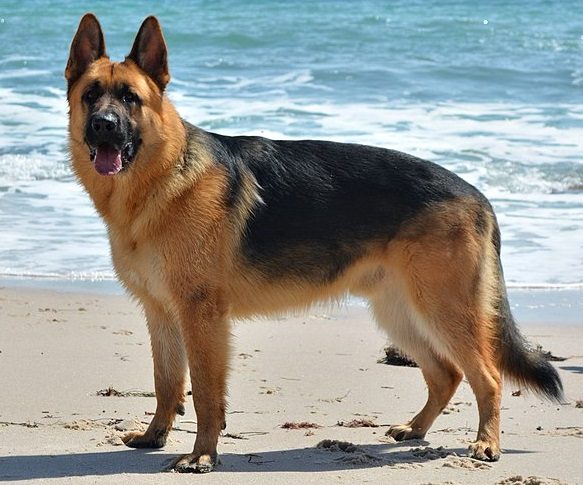
Males stand 60–65 cm (24–26 in) at the withers and females 55–60 cm (22–24 in). The German standard gives weights of 30–40 kg for males and 22–32 kg for females. The body is longer than it is tall. The forehead is domed, the muzzle long and square-cut with strong jaws and a black nose, and the eyes are brown. The large ears stand erect, and the bushy tail reaches the hock.
The double coat is close and dense with a thick undercoat, and comes in medium and long versions; the long coat is recessive and rarer. Most dogs are black and tan or black and red, with a black mask and a saddle or blanket of black. Sable and solid black are accepted by most standards. Blue and liver are serious faults, and white disqualifies a dog from the show ring.
Temperament
Breed standards describe a self-assured, curious dog. German Shepherds are highly intelligent, obedient, willing to learn and keen to have a job. They are protective of their owners and slow to make friends with strangers, and can become overprotective of family and territory if they are not properly socialised.
Care and health
Many of the breed’s common ailments go back to the early inbreeding. Hip and elbow dysplasia are frequent; the Orthopedic Foundation for Animals found hip dysplasia in 19.1% of German Shepherds. The breed is also among those more often affected by degenerative myelopathy, and is at risk of degenerative spinal stenosis, Von Willebrand disease, exocrine pancreatic insufficiency and hemangiosarcoma.
Lifespan is about 10 years overall. A 2024 British study found a mean of 11.3 years, a little below the average for purebred dogs.
Facts on this page were checked against Wikipedia and may have changed since.