East-European Shepherd

- Origin
- Soviet Union
- Type
- Herding
- Size
- Large
- Height
- 62–72 cm (24–28 in)
- Coat
- Dense, medium length, with a thick undercoat
- Colors
- Black and tan, sable or solid black
- Status
- Recognised by the Russian Kynological Federation and the Nordic Kennel Union
The East-European Shepherd, known in Russian as the Vostochno Evropeiskaya Ovcharka or VEO, is a Ukrainian and Russian shepherd dog. It was bred in the Soviet Union from the German Shepherd, with the aim of producing a larger dog that could better withstand the cold and serve in military and guard work.
History
In the 1920s a number of German Shepherds were imported from Germany into the Ukrainian SSR, and a breeding program was set up to adapt them to the harsher Soviet climate. After several decades of selection the dogs had become clearly different from the shepherd known in the West, and from 1950 the new type was called the Vostochno Evropeiskaya, or East European.
The breed was at first centered in Ukraine but soon spread across the Soviet Union. It suffered losses on the Eastern Front during the Second World War. When the war ended, large numbers of German Shepherds were brought in from Germany.
Soviet military and police forces relied on it heavily as a guard and sniffer dog. It was a favorite of the KGB, which kept only solid black dogs: if a single puppy of another color was born in a KGB litter, the whole litter was destroyed and the mating was not repeated.
A breed standard was approved in 1955 and again in 1964 by Soviet service-dog bodies. The East-European Shepherd is now among the most numerous breeds in Russia and several other former Soviet countries. Since January 1, 2017 it has been recognized by the Nordic Kennel Union, and so by the kennel clubs of Denmark, Finland, Iceland, Norway and Sweden.
Appearance
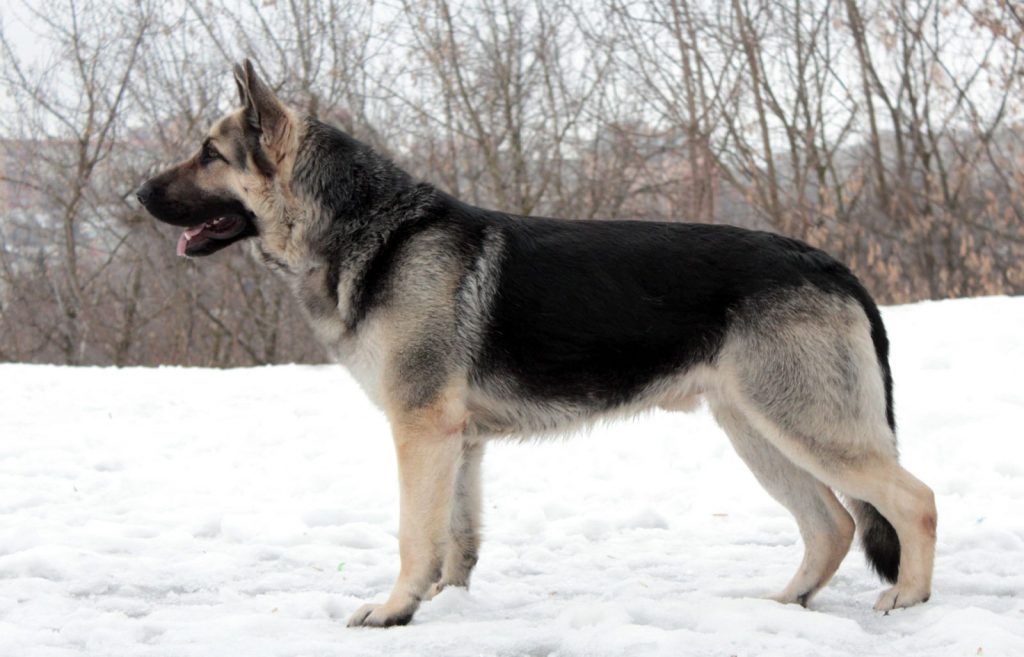
The East-European Shepherd is considerably larger than the German Shepherd, and males are clearly bigger than females. Males usually stand 67–72 cm (26–28 in) at the withers, with some reaching 74 cm (29 in). Females are usually 62–67 cm (24–26 in).
The coat is dense and of medium length, with a well-developed undercoat, and often has longer, softer hair on the ears, neck, legs and tail. It may be black and tan, sable or solid black. Brindle and white dogs are rare. The eyes can be brown, amber or blue, and some dogs have eyes of two different colors. The ears are long and upright. The paws are large with long toes, a little like snowshoes.
Temperament
The breed is regarded as particularly intelligent, courageous, determined and tough. Owners often compare its temperament to that of a Dobermann.
Facts on this page were checked against Wikipedia and may have changed since.