King Charles Spaniel

- Origin
- England
- Type
- Toy and companion
- Size
- Toy
- Height
- 23–28 cm (9–11 in)
- Weight
- 3.6–6.4 kg (8–14 lb)
- Coat
- Long
- Colors
- Black and tan, tricolor, red and white (Blenheim) or solid red (Ruby)
- Life span
- 10–12 years
- Status
- Recognised by The Kennel Club, the AKC (as the English Toy Spaniel) and the FCI
The King Charles Spaniel, known in the United States as the English Toy Spaniel, is a small dog of spaniel type. It took its present form in 1903, when The Kennel Club merged four toy spaniel breeds under one name: the King Charles, the Blenheim, the Ruby and the Prince Charles. Each supplied one of the four coat colors seen today. It should not be confused with the Cavalier King Charles Spaniel, a larger offshoot with a flat skull and a longer nose.
History
Toy spaniels are thought to have come from East Asia and were first seen in Europe in the 16th century, where they appear in paintings by Titian and Veronese. In England they were linked with royalty from the reign of Mary I. Charles II, who ruled from 1660 to 1685, was so fond of them that they now carry his name; Samuel Pepys complained of the king playing with his dog through a council meeting. There is no evidence that the modern breed descends from his own dogs.
When The Kennel Club tried to merge the four varieties as the Toy Spaniel in 1903, the breed club objected, and the matter was settled only when King Edward VII made known that he preferred the name King Charles Spaniel. The American Kennel Club merged them in 1904 as the English Toy Spaniel. Attempts in the 1920s to bring back the longer-faced dog of Charles II’s day produced the Cavalier, recognised in its own right in 1945.
The King Charles is now far rarer than the Cavalier. In 2010 The Kennel Club registered 199 puppies against 8,154 Cavaliers, and it has listed the breed as a Vulnerable Native Breed since 2003.
Appearance
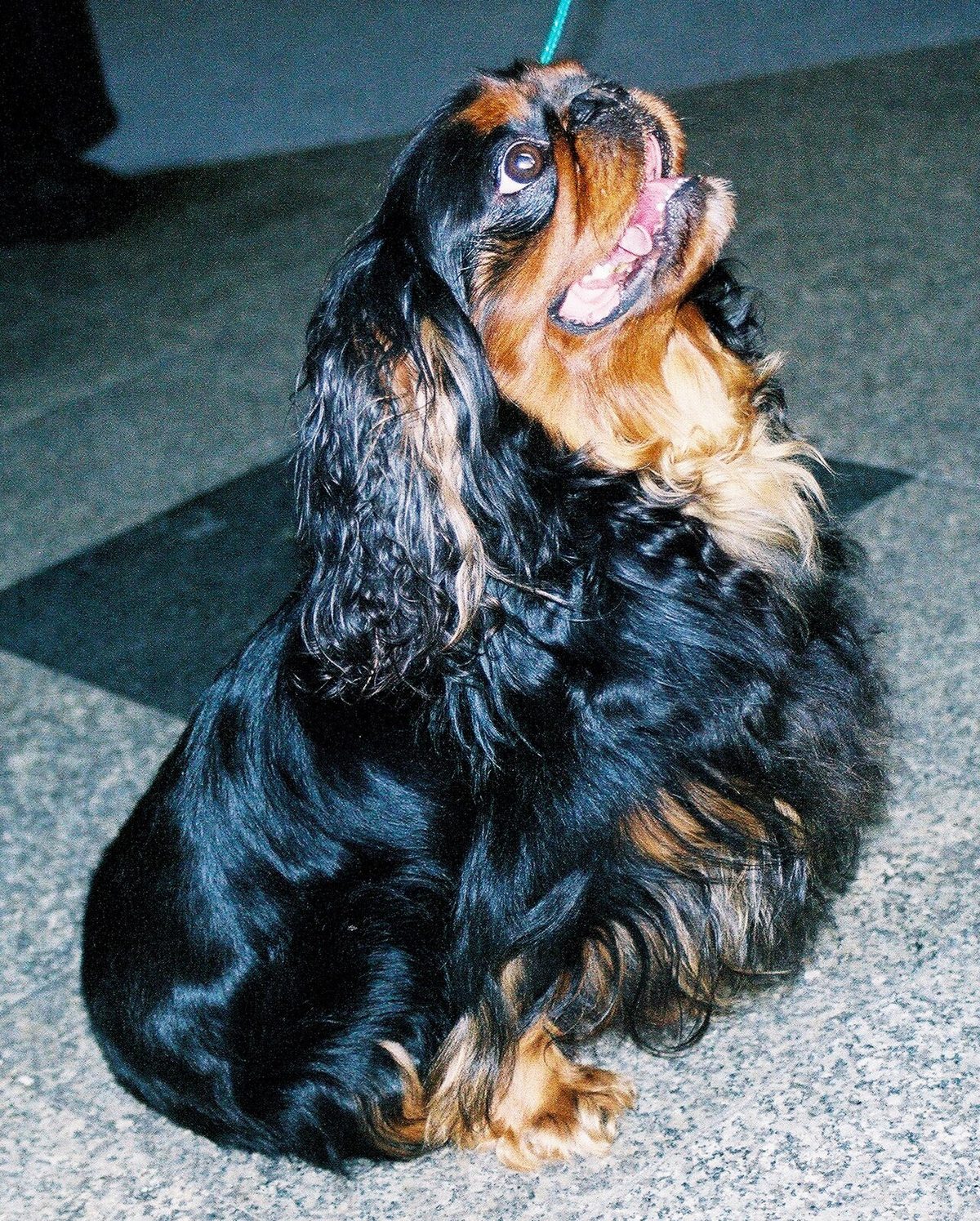
The King Charles has a small, compact body and stands 23 to 28 cm (9 to 11 in) at the withers, weighing 3.6 to 6.4 kg (8 to 14 lb). The head is high and domed, with large dark eyes, a short nose and a line of black skin around the mouth. The ears are long and hanging. The tail was traditionally docked, which is no longer legal in the United Kingdom.
The four color patterns keep the names of the old breeds. King Charles is black with mahogany-tan markings on the face, legs, chest and under the tail. Prince Charles is white with black patches and tan markings. Blenheim is white with red patches, ideally with a red spot in the center of the skull. Ruby is a solid rich red.
Temperament
This is a friendly, gentle lapdog, not a watchdog, though it may bark when a visitor arrives. It is not a high-energy breed, likes the company of its family and dislikes being left alone for long. It gets on with children but will not put up with rough handling. One of the quietest toy breeds, it suits apartment life. It usually tolerates other pets, though it keeps some hunting instinct.
Care and health
The average lifespan is 10 to 12 years. As a flat-faced breed the King Charles shares the eye and breathing problems common to such dogs, is sensitive to anesthesia and is prone to heat stroke. Eye conditions include cataracts, corneal dystrophy, distichia, entropion and keratitis. Heart problems include mitral valve disease and patent ductus arteriosus, both inherited. Slipping kneecaps, diabetes, cleft palate, umbilical hernia and a hanging tongue also occur.
Facts on this page were checked against Wikipedia and may have changed since.