Norfolk Terrier
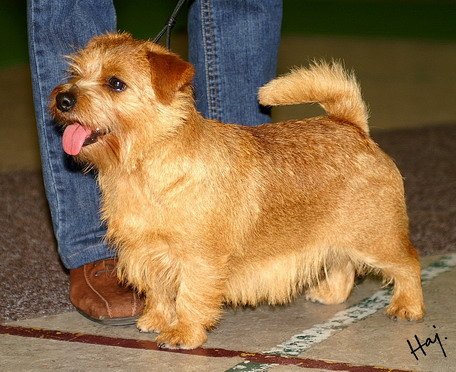

- Origin
- England
- Type
- Terrier
- Size
- Small
- Height
- 23–25 cm (9–10 in)
- Weight
- 5–5.4 kg (11–12 lb)
- Coat
- Hard, wiry and straight, with a soft undercoat
- Colors
- Red, wheaten, black and tan, or grizzle
- Life span
- About 13 years
- Status
- Recognised by The Kennel Club, AKC and UKC
The Norfolk Terrier is a small British terrier with folded, or drop, ears. Until 1964 it was a variety of the Norwich Terrier, which has pricked ears. Together the two are the smallest of the working terriers. Norfolks were bred as barn dogs to keep down vermin, and may also have been used now and then to bolt animals of their own size from a den.
History
In the 1880s British sportsmen developed a working terrier in East Anglia, in eastern England. The Norwich, and later the drop-eared dogs now called Norfolks, are believed to have come from crosses of local terrier-like dogs, small short-legged Irish terriers and the little red terriers used by the Romani ratters of Norfolk.
The dogs went by several names. They were Cantab Terriers when it became fashionable for Cambridge students to keep them in their rooms, and then Trumpington Terriers, after the street where a livery stable developed the breed further. Just before World War I an Irish horseman, Frank Jones, sold many of them to the United States, where they were called Jones Terriers. It was Jones who said the terriers came from Norwich.
The Kennel Club accepted the Norwich Terrier in 1932, and the American Kennel Club registered its first in 1936. In 1964 The Kennel Club made the drop-eared variety a breed of its own, the Norfolk Terrier. The American and Canadian kennel clubs recognized the split in 1979, as did the United Kennel Club.
Appearance
The Norfolk is active and compact, with good substance and bone for its size, and moves freely. The ideal height is 23–25 cm (9–10 in) at the withers and the weight about 5–5.4 kg (11–12 lb). It should be neither so heavy that it loses agility nor so fine that it looks like a toy dog. Compared with the Norwich it has a slightly longer back and covers more ground.
The coat is wiry and may be any shade of red, wheaten, black and tan, or grizzle.
Temperament
Norfolks are described as fearless, though they can have an independent streak. Along with Norwich and Border Terriers they have the softest temperaments in the terrier group. They were worked in packs and are expected to get on with other dogs, and they usually live well with other household pets if introduced as puppies.
They love people and children and thrive on human contact, so they should not be kept outdoors. They are not yappers, but they will bark when there is reason to. Outdoors they are natural hunters with a strong drive to chase small vermin. They are not great diggers, though a bored dog left alone too long may dig.
Care and health
The double coat has a harsh, wiry topcoat over a soft, warm undercoat. A good combing once a week removes dead hair and prevents matting. The coat is hand-stripped at least twice a year, in spring and fall. Clipping spoils its color and texture. Norfolks shed very little.
Health problems seen in the breed include mitral valve disease, luxating patellas and incorrect bites. Shallow hip sockets are common, and many lines have hip dysplasia. Litters are small to medium. A 2024 UK study found a life expectancy of 13.5 years.
Facts on this page were checked against Wikipedia and may have changed since.