Norwich Terrier
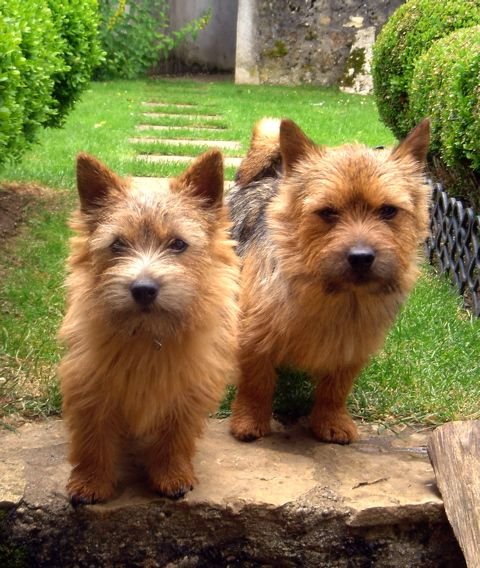

- Origin
- England
- Type
- Terrier
- Size
- Small
- Height
- 24–25.5 cm (9.5–10 in)
- Weight
- 5–5.5 kg (11–12 lb)
- Coat
- Hard, wiry double coat
- Colors
- Red, wheaten, black and tan, or grizzle
- Life span
- About 14 years
- Status
- Recognised by the FCI, AKC and The Kennel Club
The Norwich Terrier is one of the smallest working terriers, bred in the east of England to hunt rats and other small rodents. It has pricked ears; its drop-eared counterpart is the Norfolk Terrier. The breed is relatively rare.
History
Two extinct local terriers are usually named as its ancestors. In the 1880s Charles Lawrence, a dog dealer well known to Cambridge undergraduates, bred Irish Terriers, Yorkshire Terriers and red East Anglian terriers into a ratter that also made a good student companion. These were called Cantab terriers. After graduating in 1889, E. Jodrell Hopkins opened a livery stable on Trumpington Street and bred a Cantab terrier to a brindle Scottish Terrier bitch. His dogs became known as Trumpington terriers. One of them, a rough-coated red dog named Rags, went to the master of the Norwich staghounds and sired many red puppies.
Frank Jones, an Irishman who worked with the Norwich staghounds, later took terriers sired by Rags to Market Harborough as ratters and named them after the city he had left. He liked upright ears and solid red or black and tan coats with no white. His dogs reached the United States in the early 20th century, where they were called Jones Terriers.
Thirteen owners formed the first breed club in 1932. Members argued over ear carriage and color, and when the first standard appeared in 1935 it allowed both drop ears and black and tan. For more than thirty years Marion Sheila Scott Macfie campaigned to have the drop-eared dogs treated as a breed of their own.
In 2018 the Kennel Club listed the Norwich among its most vulnerable breeds, with fewer than 300 births a year.
Appearance
The Norwich weighs about 5.4 kg and ideally stands no more than 25 cm at the withers. The skull is broad and slightly rounded with a clear stop, the eyes are small and oval, and the pointed ears stand erect and well apart, though a relaxed dog may lay them back. The back is short and the legs are short. The tail, when undocked, is of moderate length, thick at the base and tapering.
The double coat comes in all shades of red, wheaten, black and tan, and grizzle.
Temperament
True to its terrier background, the Norwich may bark and dig. Early, consistent training helps keep these habits in check.
Care and health
A UK study found a life expectancy of 14 years. A large US study ranked the Norwich second among breeds for portosystemic shunt, which affected 7.41 percent of dogs, and North American hospital records showed a higher rate of cataracts than in mixed-breed dogs.
Some Norwich Terriers have an upper airway syndrome involving abnormalities of the larynx, and a 2019 study linked breathing problems in the breed to a variant of the ADAMTS3 gene. Whelping is often difficult: surveys report caesarean rates from about 37 percent to more than half of bitches, and a high proportion of stillborn puppies.
Facts on this page were checked against Wikipedia and may have changed since.