Old English Bulldog
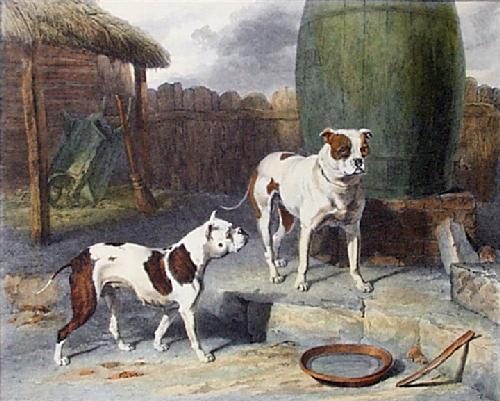

- Origin
- England
- Type
- Mastiff
- Size
- Medium
- Height
- About 38 cm (15 in)
- Weight
- About 20 kg (45 lb)
- Status
- Extinct
The Old English Bulldog was an English breed, now extinct, that was developed for the blood sport of bull-baiting. It should not be confused with the modern English Bulldog or with the Olde English Bulldogge, a modern re-creation.
History
Bull-baiting gave rise to a specialised dog. In London the main venues for the sport were the Westminster Pit, the Beargarden and Old Conduit Fields.
Historians are fairly confident that the breed came from ancient war dogs such as the old Mastiff or the extinct Alaunt, though others consider its origin unclear. Old prints show a small mastiff with a comparatively long head. The true Mastiff proved too slow for bull-baiting, and in time the word mastiff was dropped from the name of these smaller dogs.
The Cruelty to Animals Act of 1835 brought a decline in bull-baiting and dog fighting in England, and with it a loss of interest in keeping the breed going. Three dogs of the Duke of Hamilton’s strain, Wasp, Child and Billy, were painted together and are counted among its last known members.
Dog fighting carried on illegally for many years. Breeders found that crossing the bulldog with the Old English Terrier gave a quicker, more agile fighting dog. This bull and terrier was a forerunner of the Staffordshire Bull Terrier, the Bull Terrier and the American Pit Bull Terrier, and its rise hastened the bulldog’s extinction.
Appearance
The Old English Bulldog was compact, broad and muscular. The best-known image of the breed is the 1817 painting Crib and Rosa, widely reproduced through John Scott’s engraving. Rosa was held up as the ideal in form and size, though she was thought to lack wrinkle on the head and neck and bone in the legs. A standard of 1865, the Philo-kuon, gave an average height of about 38 cm and a weight of about 20 kg.
A description quoted by William Hamilton Maxwell pictures a dog low in stature and deep in the chest, with heavily muscled shoulders and thighs. The head was broad and the nose short. The lower jaw jutted beyond the upper so that the teeth always showed, and the eyes were prominent and set wide apart.
Temperament
Writers of the time stressed the bulldog’s courage and ferocity. It was said to attack any animal whatever its size and to hold on with stubborn tenacity. When set on a bull it went for the front, usually gripping the lip, tongue or eye; a dog that seized any other part was thought to show impure blood. Puppies were said to face a bull at six months, though dogs were rarely entered in a ring before fifteen to eighteen months. The same account calls the dog perfectly placid in appearance when at rest and scarcely capable of training.
Speed and agility were defining traits of the old breed. The modern English Bulldog, a stocky, short-legged companion dog with a marked underbite, has neither and was never used for baiting or fighting.
Facts on this page were checked against Wikipedia and may have changed since.