Bichon Frisé

- Origin
- France
- Type
- Toy and companion
- Size
- Small
- Height
- 23–30 cm (9–12 in)
- Weight
- About 5 kg (11 lb)
- Coat
- Loosely curled in corkscrews, with a thick soft undercoat
- Colors
- White
- Life span
- About 12.5 years
- Status
- Recognised by the FCI
The Bichon Frisé is a small Franco-Belgian toy dog of the bichon type, kept as a companion. Its French name, Bichon à Poil Frisé, means curly-haired small dog; bichon comes from a Middle French word for a small dog.
History
Dogs of this kind found early favor in Spain, and it is generally believed that Spanish seamen took them to Tenerife in the Canary Islands. From the 13th century they were associated with European nobility and appeared at the royal courts of Spain, Italy and France. Italian sailors are credited with bringing the dogs back to continental Europe in the 14th century after coming across them on their voyages.
The Société Centrale Canine of France recognized the breed in 1933, and the Fédération Cynologique Internationale gave it full acceptance in October 1959. Some dogs reached the United States in 1955 and the United Kingdom in 1973.
Appearance
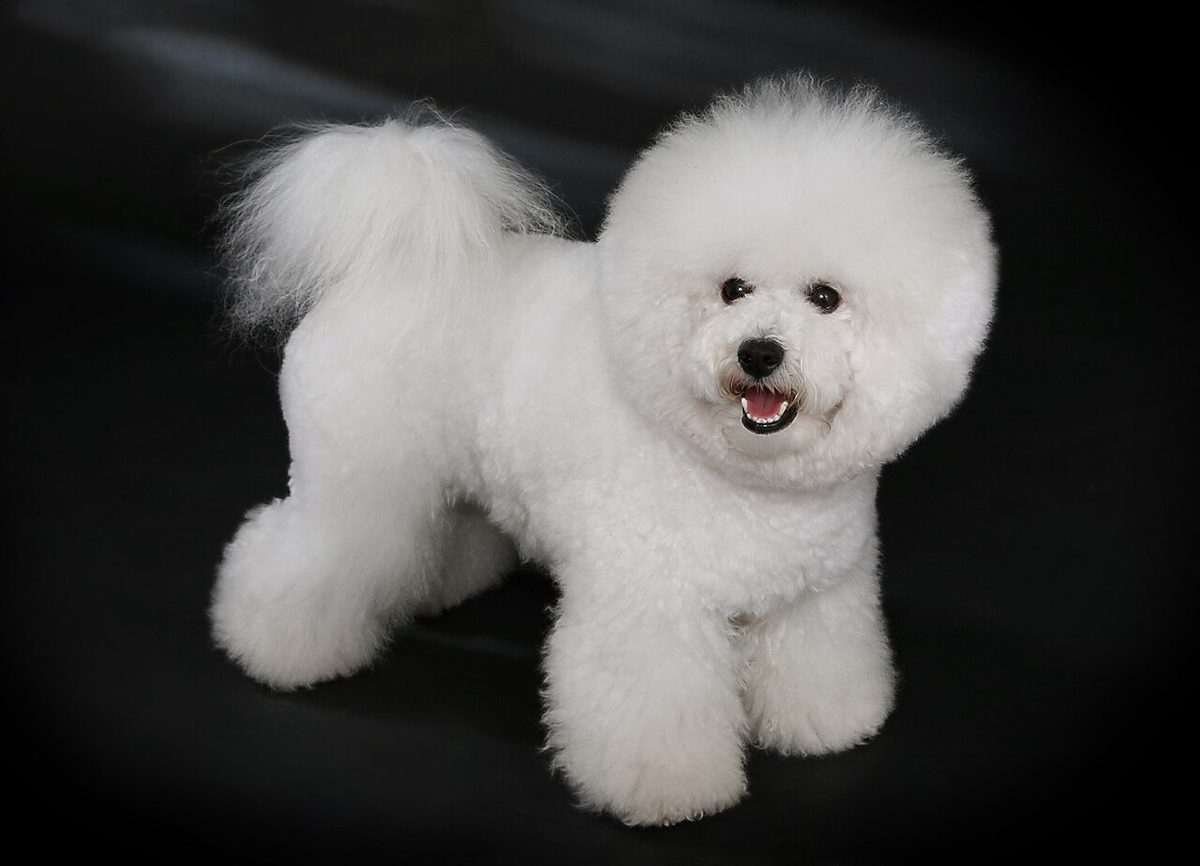
The Bichon Frisé stands 23 to 30 cm at the withers and weighs around 5 kg, with weight varying in proportion to height. The skull is fairly flat, though the coat can make it look rounded. The muzzle tapers only slightly and makes up two-fifths of the length of the head. The nose is black and the eyes are dark and round.
The coat curls loosely in spirals or corkscrews over a thick, soft undercoat. On the head it is usually trimmed into a ball shape. The color is always pure white. Dogs under a year old may carry a slight beige tinge, covering no more than a tenth of the body.
Care and health
A 2024 study in the United Kingdom put the breed’s life expectancy at 12.5 years, close to the 12.7-year average for purebred dogs. An American study found the Bichon Frisé predisposed to immune-mediated hemolytic anemia: the breed made up 9 percent of cases but only 2 percent of the comparison group. A British study found it more than nine times as likely as other dogs to develop gall bladder disease other than gall bladder mucocele.
Facts on this page were checked against Wikipedia and may have changed since.