Chesapeake Bay Retriever
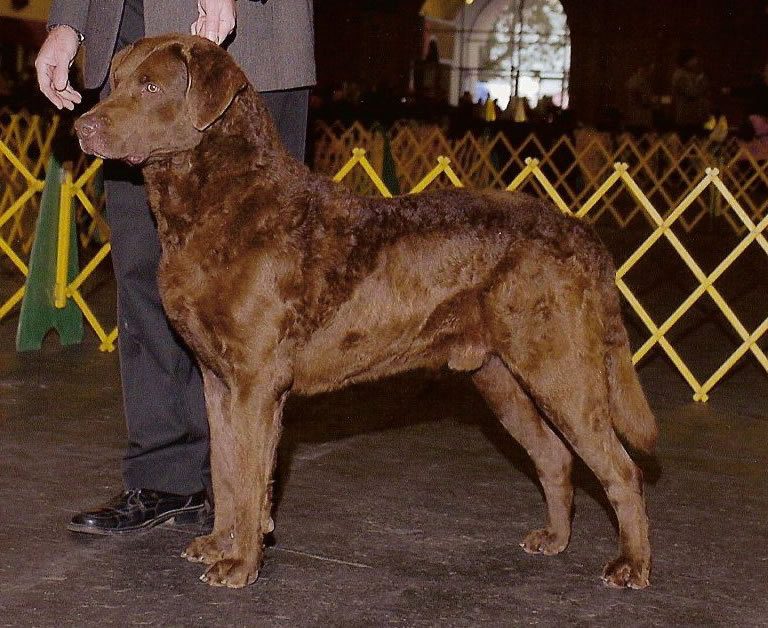

- Origin
- United States
- Type
- Gundog
- Size
- Large
- Height
- 56–66 cm (22–26 in)
- Weight
- 30–45 kg (66–100 lb)
- Coat
- Short, thick, oily double coat with a wave
- Colors
- Brown, sedge or deadgrass
- Life span
- About 9–11 years
- Status
- Recognised by the FCI, AKC and The Kennel Club
The Chesapeake Bay Retriever is a large gundog developed around Chesapeake Bay in the United States during the 19th century. Local market hunters used it to retrieve waterfowl, pull fishing nets and rescue fishermen. Today it is mainly a family pet and hunting companion. It looks something like a Labrador Retriever, but with a wavy coat.
History
The breed traces back to two pups saved from a sinking English brig off Maryland in 1807. The male, Sailor, was a dingy red and the female, Canton, was black. They were described as Newfoundland dogs, though they were more accurately St. John’s water dogs. Both became famous as water dogs for duck shooting.
The two lived in different parts of the bay and there is no record of a litter between them. Each was bred with local dogs, chosen for ability more than for breed.
In 1877 dogs from both shores of the bay were recognized as one of three types of Chesapeake Bay Ducking Dog. The American Kennel Club recognized a single type, the Chesapeake Bay Retriever, in 1918, and the standard has changed little since.
Appearance
Males stand 61 to 66 cm (24 to 26 in) and weigh 34 to 45 kg (75 to 100 lb). Females stand 56 to 64 cm (22 to 25 in) and weigh 30 to 40 kg (66 to 88 lb). The eyes are very clear, and yellowish or amber. The hindquarters are strong and stand as high as the shoulders or a little higher, the toes are webbed, and the chest is deep and powerful enough to break ice.
The coat counts for more than any other point in the standard. It is a thick double coat: a harsh outer layer over a woolly undercoat, with enough oil to shed water and keep the dog dry and warm. The hair is very short and straight on the face and legs, and waves, but never curls, over the shoulders, neck, back and loins.
There are three basic colors: brown, from light to deep dark; sedge, from reddish yellow to chestnut; and deadgrass, from faded tan to dull straw. The color is meant to match the dog’s working surroundings, and none is preferred over another. A small white spot is allowed on the breast, belly, toes or back of the feet. Black is not allowed.
Temperament
The Chesapeake has a bright, happy nature, with quiet good sense and an affectionate, protective side. Some are assertive, willful and reserved with strangers, while others are easygoing and outgoing. With proper socialization they can be excellent family dogs.
The breed is intelligent and learns fast. Some trainers now recommend consistent daily obedience work with play before and after.
Care and health
The coat needs little care: brushing once a week with a short-toothed brush and a bath every three to four months with a mild shampoo. More than that can strip the oil and spoil the texture.
Hereditary conditions in the breed include exercise-induced collapse, hip dysplasia, progressive retinal atrophy, type 3 von Willebrand disease, cataract, regional alopecia and degenerative myelopathy. A Kennel Club survey in Britain found a median lifespan of 10.75 years, and a US breed club survey an average of 9.4 years.
Facts on this page were checked against Wikipedia and may have changed since.