Clumber Spaniel

- Origin
- England
- Type
- Gundog
- Size
- Medium
- Height
- 43–51 cm (17–20 in)
- Weight
- 25–39 kg (55–85 lb)
- Coat
- Dense, straight and flat, with feathering
- Colors
- Mostly white with lemon or orange markings
- Life span
- About 12 years
- Status
- Recognised by the AKC and The Kennel Club (Vulnerable Native Breed)
The Clumber Spaniel is the largest of the spaniels, a long, low, heavy-boned gundog developed in England and named after Clumber Park in Nottinghamshire. It specializes in hunting through heavy cover and has been used on pheasant and partridge, working alone or in small packs.
History
Little is certain about the breed before the middle of the 19th century. One theory places its origin in France: at the time of the French Revolution the Duc de Noailles is said to have sent his kennel of spaniels to the Duke of Newcastle at Clumber Park, the dogs being a blend of the now extinct Alpine Spaniel with Basset Hounds and the Pyrenean Mountain Dog. A second theory holds that the Clumber descends from the old type of Blenheim Spaniel.
What is certain is that the breed took its name from Clumber Park and that the Duke’s gamekeeper, William Mansell, is credited with developing and improving it. Prince Albert kept Clumbers, and his son, King Edward VII, bred them at Sandringham. For a long time breeding was largely confined to the nobility. The breed was shown in England from 1859.
Breeding stopped entirely during World War I and numbers fell to a record low. In 1925 King George V rebuilt a line in the Royal Kennel for work at Sandringham.
Clumbers reached North America in 1844, when a British officer, Lieutenant Venables, brought them to Halifax, Nova Scotia. In 1884 the Clumber became one of the first ten breeds recognized by the American Kennel Club. In Britain The Kennel Club lists it as a Vulnerable Native Breed, meaning fewer than 300 new registrations a year.
Appearance
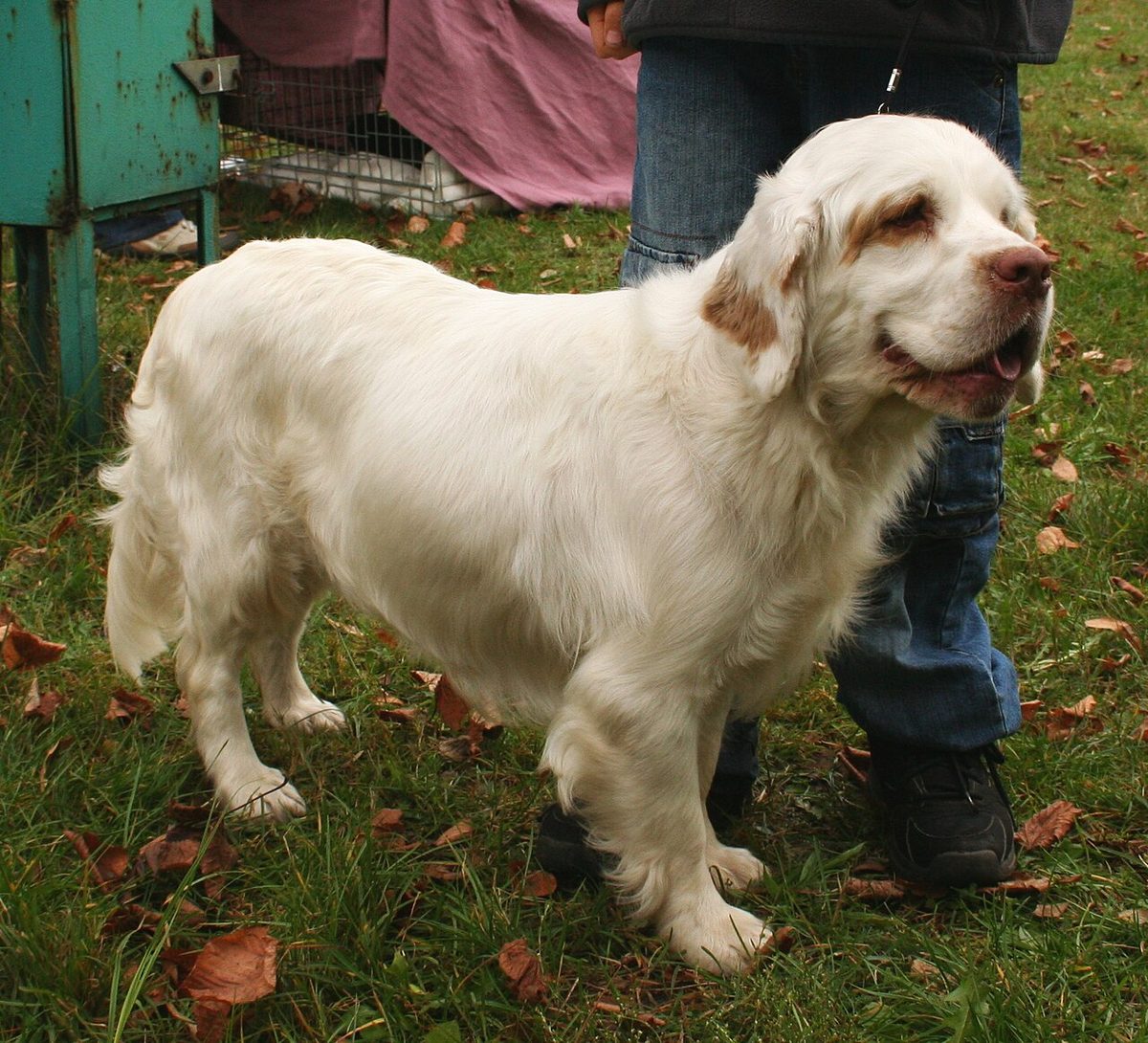
The Clumber stands only 43–51 cm (17–20 in) tall but weighs 25–39 kg (55–85 lb). It has a massive head with a mournful expression, a square nose and muzzle, and large ears shaped like vine leaves.
The coat is dense, weather-resistant, straight and flat, with feathering around the ears, belly and legs. It is mostly white, with lemon, brown or orange markings around the eyes and at the base of the tail.
Temperament
Clumbers are gentle, loyal and affectionate, though dignified and aloof with strangers and reserved with other dogs until they get to know them. They seem happiest wherever their owner is, do not bark much, and are companions more than watchdogs.
In the field the Clumber is slower than other spaniels but works quietly, with a fine nose and good stamina. The breed likes to carry something in its mouth most of the time, which can cause trouble if objects are swallowed.
Care and health
Clumbers shed moderately and need frequent brushing. Their droopy flews make them drool.
Being large-boned and fast-growing, young dogs can go temporarily lame between six and twelve months, which passes once the bones have finished growing. Impacted anal sacs and sensitivity to heat are also common. The most serious conditions in the breed are entropion and ectropion of the eyelids, spinal disc herniation and hip dysplasia; an Orthopedic Foundation for Animals survey found 45.7% of the Clumbers tested were affected by hip dysplasia. Clumbers often have trouble conceiving and giving birth.
A 2024 UK study put the breed’s life expectancy at 12.3 years.
Facts on this page were checked against Wikipedia and may have changed since.