German Shorthaired Pointer

- Origin
- Germany
- Type
- Gundog
- Size
- Medium
- Height
- 58–66 cm (23–26 in)
- Coat
- Dense, short and rough
- Colors
- Brown or black, solid, white with colored head and patches, or roan
- Life span
- About 13 years
- Status
- Recognised by the FCI and AKC
The German Shorthaired Pointer, or Deutsch Kurzhaar, is a German pointing dog of the continental Braque type. It took shape in the 19th century as an all-purpose gun dog, able to hunt and retrieve on land and in water. It is also kept as a companion.
History
The pointing dogs of Europe all descend from the Old Spanish Pointer, now extinct, which spread through France and the Low Countries to the princely houses of the German-speaking lands. There the dogs were first used for catching birds with nets or falcons, and later by hunters with guns. Bird dogs also came from England, and in the 19th century large numbers of dogs of the Burgos Pointing Dog type were brought to Germany. Early in that century the mixed dogs that resulted had no particular name. They were simply called bird dogs or hunting dogs.
At a dog show in Frankfurt am Main in 1878 it was agreed to set standards for German breeds, and the standard for the Deutsch Kurzhaar was introduced at Hannover in 1879. The first stud book came out in 1897.
The American Kennel Club recognized the breed in 1930, and the Fédération Cynologique Internationale gave it full acceptance in 1954. In 2013 it ranked twenty-second among the most registered breeds in the world. A dog of the breed was best in show at the Westminster Kennel Club Dog Show in 2016.
Appearance
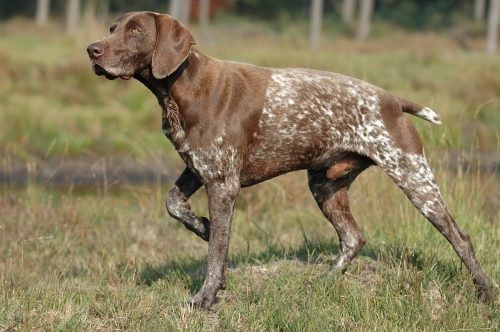
Males stand about 62 to 66 cm (24 to 26 in) at the withers, and females 3 or 4 cm less. The coat is dense, short and rough to the touch. It is brown or black, in one of three patterns: solid, with or without small white flecks on the chest and legs; white with a colored head and colored flecks or patches on the body; or roan, dark or light.
The head is of moderate size with a convex profile. The muzzle is long, broad and strong, suited to carrying game. The eyes are brown, and the rounded ears are set high and hang close to the head. Where it is allowed, the tail of a working dog may be docked to about half its length. It is carried roughly level when the dog moves.
Temperament
The breed was made to be versatile. It works in all weather, on any ground and in any cover. It finds and points game, furred or feathered, retrieves gently from land and water, follows a blood trail to wounded game and defends against poachers and predators. Registration depends on passing a working trial.
Beyond hunting and field trials, the dogs do well in agility, dock diving and obedience, and police forces use them for detection work.
Care and health
This is a tough, healthy dog. A British study in 2024 found a median lifespan of 13.4 years, a little above the 12.5 years for dogs in general.
The breed has some inherited tendency to neurological conditions, among them GM2 gangliosidosis, hemivertebrae and sensory neuropathy. Other disorders linked with it include cataract, cranial cruciate ligament rupture, progressive retinal atrophy, hereditary lupoid dermatosis, nasal carcinoma and von Willebrand’s disease.
Facts on this page were checked against Wikipedia and may have changed since.