Great Dane

- Origin
- Germany
- Type
- Mastiff
- Size
- Giant
- Height
- 72–90 cm (28–35 in)
- Weight
- From 45 kg (100 lb) for females and 54 kg (120 lb) for males
- Coat
- Short
- Colors
- Fawn, brindle, black, harlequin, mantle, blue and merle
- Life span
- About 10 years
- Status
- Recognised by the FCI, AKC and The Kennel Club
The Great Dane is a giant German breed that combines the build of a mastiff with the legs of a sighthound. It descends from medieval hunting dogs used on bear, boar and deer, and from the guard dogs of the German nobility. With the Irish Wolfhound, it is among the tallest dogs in the world. Despite the name, it has no known connection to Denmark.
History
In the 16th century, nobles across Europe imported strong, long-legged dogs of mastiff and sighthound type from England and Ireland. In Germany these were called Englische Dogge, simply “English dog”. From the early 17th century the German courts bred them independently.
At the hunt they were catch dogs. Sent in after the other hounds, they seized the boar, bear or deer and held it until the huntsman could kill it. The favorites slept in their lords’ bedchambers, wore ornate collars and guarded the sleeping princes against assassins; these were the Kammerhunde, or chamber dogs. When firearms changed hunting, the dogs lost their work, grew rare and survived as a luxury.
In 1878 a committee in Berlin renamed the Englische Dogge the Deutsche Dogge, or German mastiff, laying the foundation for the modern breed. English speakers of the 19th century called it the German Boarhound. As tensions rose between Germany and its neighbors, the English-speaking world adopted “Great Dane”, a translation of the French name Grand Danois. In Germany it is still the Deutsche Dogge. In the late 19th century the dogs were also nicknamed Reichshunde, “Empire dogs”, because Otto von Bismarck kept them.
Appearance
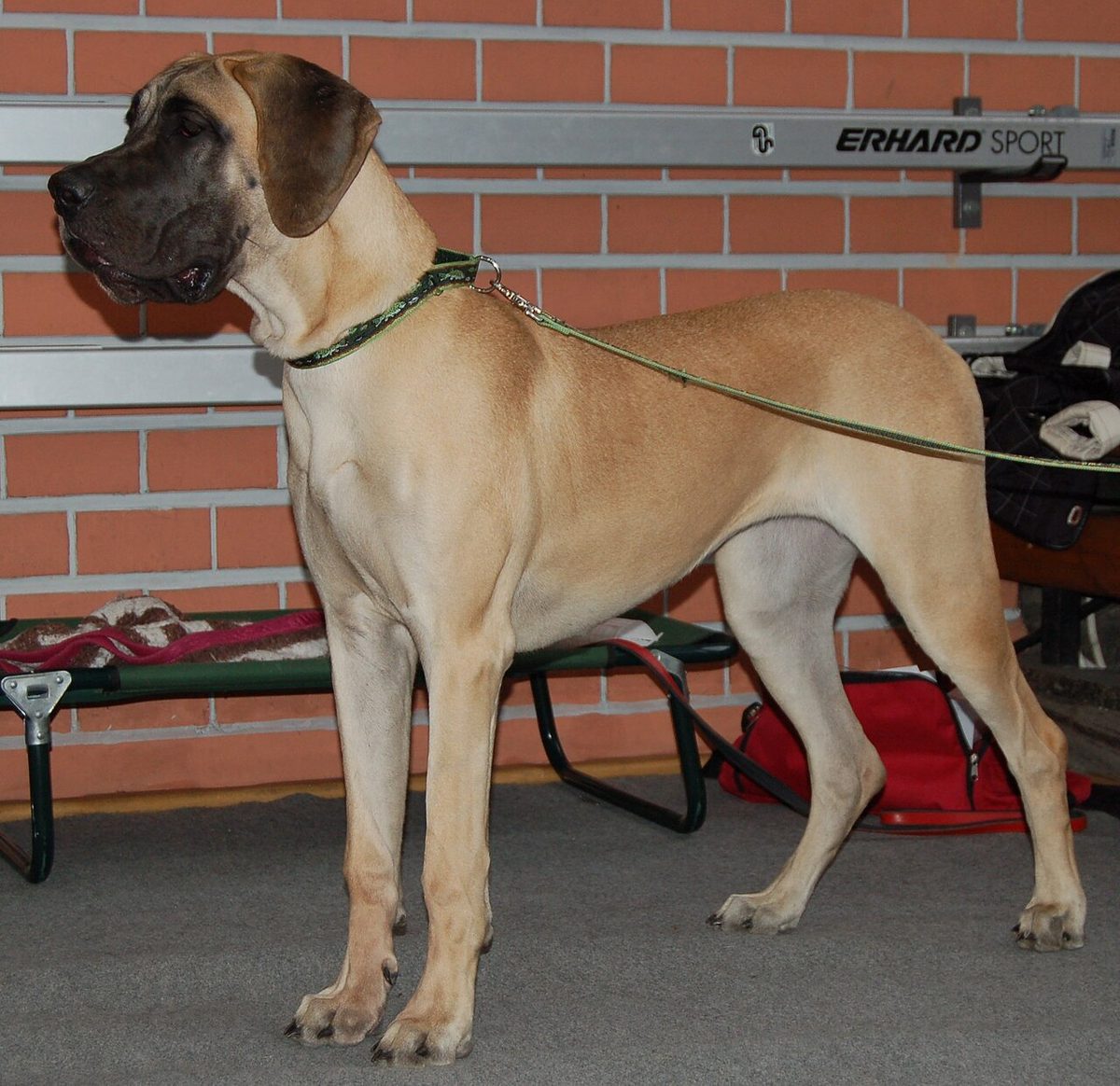
Often called the “Apollo of dogs”, the Great Dane joins great size with elegance. The body is powerful, smoothly muscled and square in proportion, and so well balanced that the dog should never look clumsy. Under the FCI standard males stand 80 to 90 cm (31 to 35 in) and females 72 to 84 cm (28 to 33 in). The UK and New Zealand kennel clubs set minimum adult weights of 54 kg (120 lb) for males and 45 kg (100 lb) for females. The tallest dog on record was a black Great Dane named Zeus, who measured 111.8 cm (44 in) at the shoulder.
The ears are naturally triangular and hang down. They were once cropped to protect them during boar hunts. Cropping is still common in the United States for the sake of tradition and looks, but is banned or restricted in a number of European countries, including Germany, Denmark, the United Kingdom and Ireland.
The coat is short. Show colors are fawn (yellow-gold with a black mask), brindle (fawn with black stripes), glossy black, harlequin (white with torn black patches), mantle (black with a white muzzle, collar, chest, legs and tail tip) and steel blue. Since 2012 the FCI has also tolerated gray merle, and the American Kennel Club recognises merle.
Temperament
Great Danes are generally not unduly aggressive toward people or other animals.
Care and health
Like most giant dogs, Great Danes have a fairly slow metabolism and eat less for their weight than small breeds do.
Bloat, or gastric dilatation-volvulus, is the greatest killer of the breed. One model put a Great Dane’s lifetime risk at about 37% and found that a preventive gastropexy could greatly reduce deaths. A study of large and giant dogs linked about half of the cases in giant breeds to feeding from a raised bowl.
Dilated cardiomyopathy and a number of congenital heart diseases are also common, which, with the short lifespan, has given the Great Dane the nickname “the heartbreak breed”. A 2024 study in the United Kingdom found an average life expectancy of 10.6 years, against 12.7 for purebred dogs in general, and a Swedish study of insurance records found that 83% of Great Danes had died by the age of 10.
Harlequin dogs carry the merle gene. A puppy that inherits two copies has too much white and may be deaf or blind.
Facts on this page were checked against Wikipedia and may have changed since.