Dog breedsPinscher and schnauzer
Giant Schnauzer
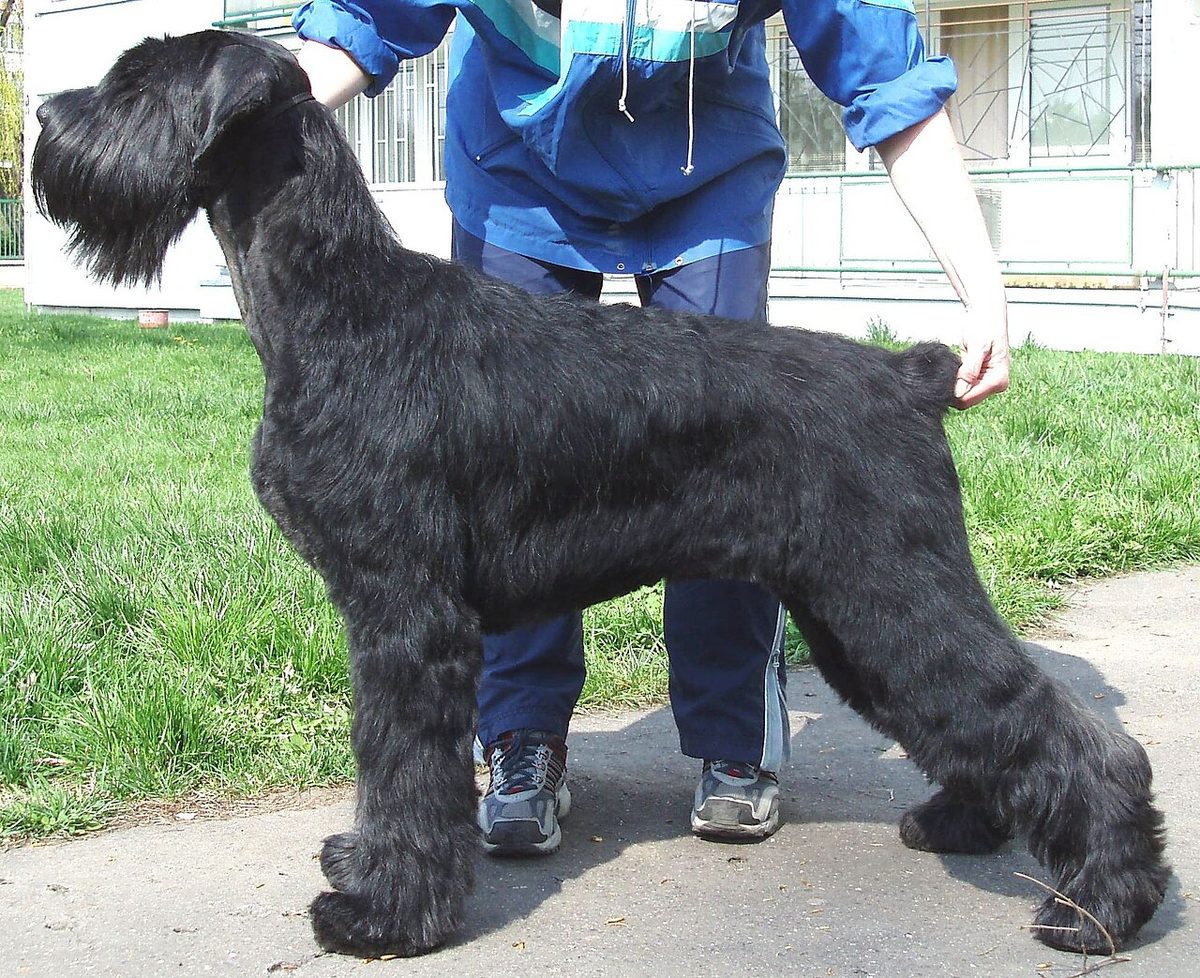

- Origin
- Germany
- Type
- Pinscher and schnauzer
- Size
- Large
- Height
- 60–70 cm (23.5–27.5 in)
- Weight
- 35–47 kg (77–104 lb)
- Coat
- Dense and wiry
- Colors
- Pure black, pepper and salt, or black and silver
- Life span
- About 12 years
- Status
- Recognised by the FCI and AKC
The Giant Schnauzer, in German the Riesenschnauzer, is the largest of the three Schnauzer breeds. It was bred in Bavaria as an all-purpose farm dog that drove livestock to market and guarded the farmer’s property. Later it moved into town to watch over breweries, butchers’ shops, stockyards and factories.
History
Schnauzers come from southern Germany and share their history with the German Pinscher. Rough-haired and smooth-haired dogs of this type were kept as carriage and stable dogs and were good ratters. Both came from the same line, and both coats could turn up in one litter. The first standard was drawn up in 1880, and a breed society for both types, the Pinscherklub, was founded in 1895. In 1917 the rough-haired dogs were officially renamed Schnauzer.
By about 1900 the Giant Schnauzer was a watchdog at factories, breweries, butcheries and stockyards across Bavaria. It was unknown elsewhere until it served as a military dog in the two World Wars. The first dogs reached America in the 1930s. They stayed rare until the 1960s.
Today the breed works as a police dog and in search and rescue, pulls carts, and competes in obedience, agility, herding, nosework and Schutzhund. In Europe it is seen more as a working dog than a show dog. In several countries, Germany among them, a dog must earn a Schutzhund title before it can become a show champion.
Appearance
The “giant” in the name is a comparison with the Standard and Miniature Schnauzers, not with other big breeds. Even so, this is a large, stocky dog. The American Kennel Club standard asks for males of 65 to 70 cm (25.5 to 27.5 in) and females of 60 to 65 cm (23.5 to 25.5 in). The body is square, like a bigger Standard Schnauzer, and the head is about half as long as the back.
The coat is dense, wiry and weather-resistant, and protects the dog from vermin as well. On the face it forms a distinct beard and eyebrows. There are three colors: pure black with a black undercoat, pepper and salt, and black and silver. The tail is long and the ears are small button ears carried high. Where the law allows, the ears may be cropped and the tail docked.
Temperament
The Giant Schnauzer is an alert dog, a quality that suits it to police work.
Care and health
A 2024 study in the United Kingdom found a life expectancy of 12.1 years, close to the average for purebred dogs.
Hip and elbow dysplasia are common. The breed is prone to eye problems, including glaucoma, cataracts, dry eye and progressive retinal atrophy, and to skin diseases such as seasonal flank alopecia, vitiligo and follicular cysts. Skin cancer is common in dark dogs, most often melanoma of the limbs and toes. Some dogs develop hypothyroidism, diabetes insipidus, narcolepsy or seizure disorders, and some are sensitive to sulfonamide drugs.
Facts on this page were checked against Wikipedia and may have changed since.