Flat-Coated Retriever

- Origin
- England
- Type
- Gundog
- Size
- Large
- Height
- 56–64 cm (22–25 in)
- Weight
- 25–36 kg (55–80 lb)
- Coat
- Glossy and smooth, with a feathered tail
- Colors
- Black or liver
- Life span
- About 12 years
- Status
- Recognised by the FCI, AKC and The Kennel Club
The Flat-Coated Retriever is an English gundog, developed to retrieve game both on land and from water. It is a cheerful, energetic dog that one writer on the breed called the “Peter Pan” of retrievers, because it never quite grows up.
History
The breed arose in England in the middle of the 19th century and became popular as a gamekeeper’s dog. Its ancestry is thought to include the now extinct St. John’s water dog, imported from North America, though this is unverified, and Newfoundlands brought to British ports by Canadian seafarers. Collie-type dogs may have been added for trainability and setters for scenting ability. The first examples were shown around 1860, and the type was settled about twenty years later.
In the United States the breed quickly became a popular gun dog, and the American Kennel Club recognised it in 1915. It was soon overtaken by the Golden Retriever, which was itself bred partly from the Flat-Coat. By the end of World War II so few remained that the breed’s survival was in doubt. Careful breeding from the 1960s rebuilt its numbers, and today it enjoys modest popularity as a show dog and companion, though it has not returned in large numbers to field competition. Flat-Coated Retrievers won Best in Show at Crufts in 1980, 2011 and 2022.
Appearance
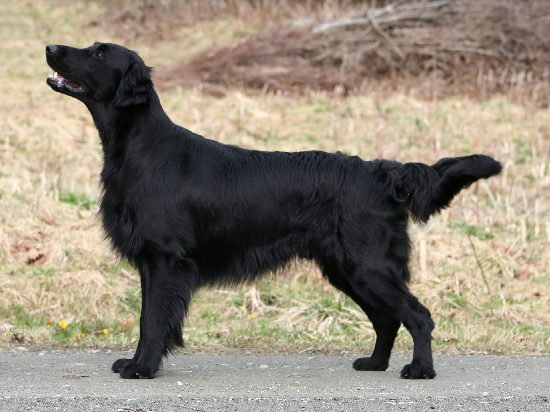
The standard calls for males of 58 to 64 cm (23 to 25 in) and 27 to 36 kg (60 to 80 lb), and females of 56 to 61 cm (22 to 24 in) and 25 to 34 kg (55 to 75 lb). The head is distinctive: long and molded “in one piece”, with very little stop and a muzzle about as long as the skull. The jaws are strong, the eyes dark brown and almond-shaped with a friendly, intelligent look, and the ears small, hanging close to the head. The head flows into a well-arched neck and a strong, level back. The tail is well feathered, of moderate length, and carried straight off the back.
Black is the most common color, followed by liver. Yellow dogs also occur; they cannot be shown in conformation but can compete in other events.
Temperament
Flat-Coats have boundless energy and are eager to please. They will announce a visitor with a confident bark but are unlikely to follow it with aggression. Their excellent noses have led to work as drug-detection dogs, and in the United Kingdom they are used in the breeding program of The Guide Dogs for the Blind Association, both purebred and crossed with Labradors.
Care and health
A 2024 UK study found a life expectancy of 11.7 years. Cancer is the breed’s main health concern: a 2004 UK survey found that about half of Flat-Coated Retriever deaths were due to some form of cancer. The most common tumors are cutaneous histiocytomas and soft-tissue sarcomas.
Facts on this page were checked against Wikipedia and may have changed since.