German Longhaired Pointer

- Origin
- Germany
- Type
- Gundog
- Size
- Large
- Height
- 58–70 cm (23–28 in)
- Weight
- About 30 kg (66 lb)
- Coat
- Medium-length, thick, straight or slightly wavy, with a dense undercoat
- Colors
- Solid brown, brown with white or speckling, brown roan, or white with brown spots
- Status
- Recognised by the FCI
The German Longhaired Pointer, or Deutsch Langhaar, is a German gundog of pointer type. It is closely related to the other German pointing breeds: the German Shorthaired Pointer, the German Wirehaired Pointer and the Large Münsterländer. It is a versatile hunting dog, bred to find game, point it and then retrieve it, both on land and from water.
History
The breed was developed in Germany as a pointer, and selective breeding began in 1879. A first set of standards, drawn up by a hunting dog society in Hannover, was not found satisfactory. In 1893 Friedrich von Schorlemer-Alst founded a breed association, the Club Langhaar, and in 1897 he wrote the standard on which the modern dog is based.
The FCI gave the breed definitive acceptance in 1954.
It remains a fairly uncommon dog at home. Between 2010 and 2024 Germany recorded about 509 new registrations a year on average, with a low of 352 and a high of 587. The total for those fifteen years was 7,632, about 0.68% of all dogs registered in the country.
Appearance
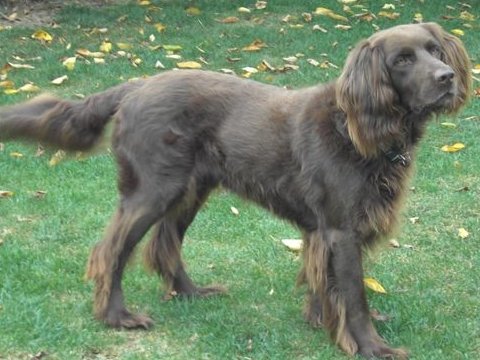
The German Longhaired Pointer is a medium to large dog. Males stand 60 to 70 cm (24 to 28 in) at the withers, with 63 to 66 cm as the ideal; females stand 58 to 66 cm (23 to 26 in), ideally 60 to 63 cm. Both sexes weigh about 30 kg (66 lb) on average.
The coat is of medium length, about 3.5 cm (1.4 in) on the body, shorter on the head and somewhat longer under the neck and body. It is thick, straight or slightly wavy, lies close and has a dense undercoat.
The color is always some arrangement of brown and white: solid brown; brown with speckling or white markings; dark roan with dark brown patches; pale roan with pale brown patches; white mottled with small brown spots; or brown and white, with or without spotting.
Facts on this page were checked against Wikipedia and may have changed since.