Jagdterrier
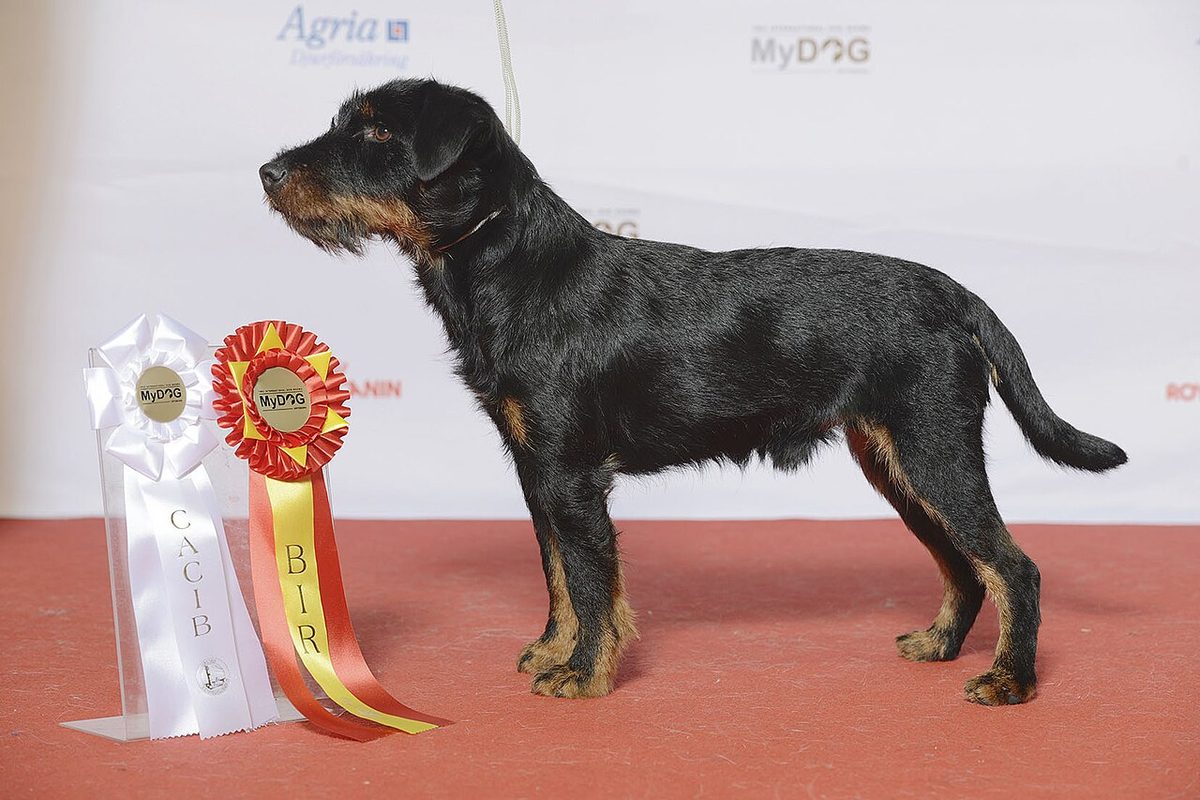

- Origin
- Germany
- Type
- Terrier
- Size
- Small
- Height
- 33–40 cm (13–16 in)
- Weight
- 7.5–10 kg (17–22 lb)
- Coat
- Thick and abundant; smooth, rough or broken
- Colors
- Black, dark brown or grayish-black with clearly defined tan markings
- Life span
- 12–14 years
- Status
- Recognised by the FCI and UKC
The Jagdterrier, whose name means “hunting terrier”, is a working terrier from Germany. It was bred as an all-round hunting dog for quarry both above and below ground: it goes into dens after badger, fox and raccoon, drives wild boar and rabbits out of thickets, and follows the blood trail of wounded game such as deer.
History
The breed was created in Germany between the two World Wars, at a time when terriers were at the height of fashion and German hunting circles were caught up in nationalism and a fascination with selective breeding. Lutz Heck, curator of the Berlin Zoo, gave four black-and-tan Fell terriers, much like today’s Patterdale Terrier, to Carl Eric Gruenewald and Walter Zangenbert. They were joined by Chief Forester R. Fiess and Dr. Herbert Lackner, who had the land and the money to run a kennel through a ten-year project.
The four founding dogs had the wanted color but were not outstanding hunters, and breeding brother to sister gave poor results. Matters improved when they were crossed with proven old hunting fox terriers. The dark color still came through, and dogs with much white or with spots were removed from breeding. The program was very large, with as many as 700 dogs in the kennels at one time, and its selection was strict. Smooth coats were bred away from in favor of a short, hard, wiry coat that sheds water and dirt. After about ten years the dogs were breeding more or less true. The German Hunting Terrier Club was founded in 1926.
Max Thiel Sr. brought the breed to the United States in 1951, and Armin Schwarz Sr. imported a champion sire in 1954. Nine owners formed the Jagdterrier Club of America in St. Louis in March 1956, hoping for American Kennel Club recognition, but the club faded away. The breed was slow to catch on, partly because few Americans hunt fox to ground. Newer imports are now used across the country for work above and below ground and for flushing and retrieving on land and in water.
Appearance
The typical Jagdterrier is black and tan, the tan closer to rust on the muzzle and underside. Chocolate and liver brown are also accepted. The standard asks for a dog 33 to 40 cm (13 to 16 in) at the shoulder, with females weighing 7.5 to 8.5 kg (17 to 19 lb) and males 9 to 10 kg (20 to 22 lb). The coat may be smooth, rough or broken, and all types shed. The tail is usually, though not always, docked to two-thirds of its natural length.
Temperament
Jagdterriers are intense, energetic working dogs with a strong prey drive. They are intelligent and adaptable and bond closely with their owners, so they can make good pets, but they are hunting dogs first and need structured training.
Care and health
The Jagdterrier is generally considered robust and long-lived, with a typical lifespan of about 12 to 14 years. No major breed-specific problems are widely reported. Primary lens luxation, an inherited eye condition, is one to watch for.
Facts on this page were checked against Wikipedia and may have changed since.