Dog breedsPinscher and schnauzer
Schnauzer

- Origin
- Germany
- Type
- Pinscher and schnauzer
- Height
- 30–61 cm (12–24 in)
- Weight
- 6.4–36 kg (14–80 lb)
- Coat
- Wiry, water-resistant outer coat over a soft undercoat
- Colors
- Salt and pepper, black, white or black and silver
- Status
- Recognised by the FCI as three breeds
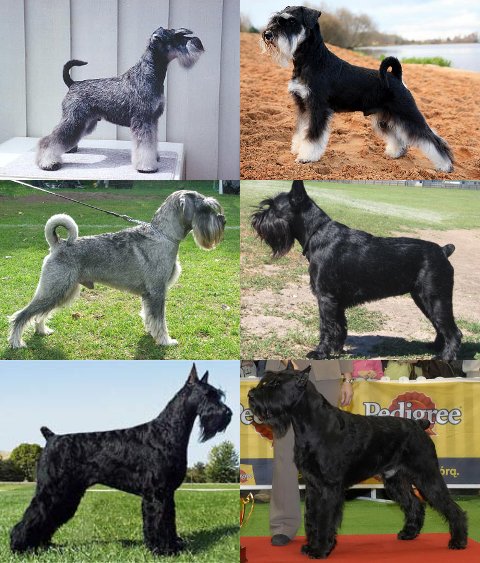
The Schnauzer is a type of dog from Germany that goes back to the 14th to 16th centuries. It is not a single breed but a family of three: the Standard, the Giant and the Miniature. The name comes from the German word for snout and refers to the dog’s whiskered muzzle. The dogs were first called Wire-Haired Pinschers; the name Schnauzer was adopted in 1879.
History
The original Schnauzer was the size of today’s Standard and was bred to catch rats and to guard. It is thought to share its ancestry with the German Pinscher, as a wire-coated variety of the same dog, and may have been crossed with black German Poodles and gray Wolfspitz.
The Giant Schnauzer was developed in Swabia in the 17th century and was once called the Munich Schnauzer. It drove livestock to market and guarded farms, and later became a police and military dog.
The Miniature Schnauzer dates from the late 19th century and is thought to be the Standard crossed with smaller dogs such as the Affenpinscher and Miniature Poodle. Some kennel clubs group it with the terriers, but it is not related to them. “Toy” and “teacup” Schnauzers are not breeds; the terms are used to sell undersized Miniatures.
Appearance
Standard Schnauzers stand about 46 cm (1.5 ft) at the shoulder and weigh 14 to 20 kg (30 to 45 lb). Giants stand about 61 cm (2 ft) and weigh 25 to 36 kg (55 to 80 lb). Miniatures stand about 30 cm (1 ft) and weigh 6.4 to 9.1 kg (14 to 20 lb).
All have the beard and long, feathery eyebrows that give the type its look. The double coat has a wiry, water-resistant top coat and a soft undercoat. Most Schnauzers are salt and pepper, black or white; the AKC accepts salt and pepper, black, and black and silver in the Miniature. Tails were traditionally docked and ears cropped, which gave rats less to grab; both are now illegal in the European Union, Australia and New Zealand.
Temperament
Schnauzers are of above-average intelligence and can be independent-minded, so early training and varied daily exercise are recommended. They are protective, energetic and watchful, and will warn the household of anything unusual, which can turn into persistent barking unless it is curbed by training.
Care and health
Schnauzers shed less than most dogs. Show dogs have the coat stripped by hand, which removes dead hair and keeps the top coat hard and wiry; a clipped pet loses the wiry coat and shows only the soft undercoat. The undercoat may be stripped at least twice a year, and the beard and leg hair need frequent brushing to prevent mats.
Schnauzers are prone to liver and gall bladder disease. One study found them much more likely than other dogs to develop gall bladder mucocele, impaired blood flow to the liver, and liver damage secondary to hormonal disorders such as Cushing’s syndrome and hypothyroidism.
Facts on this page were checked against Wikipedia and may have changed since.