Small Münsterländer
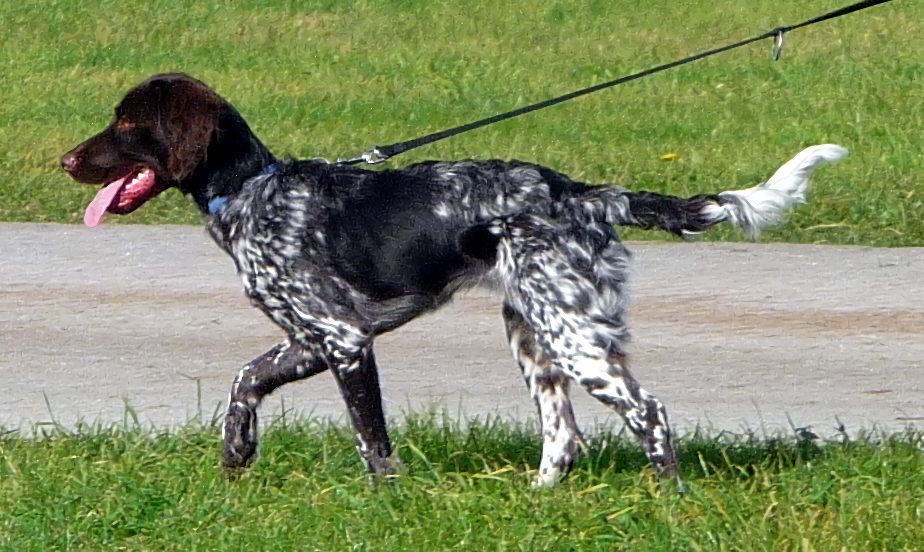

- Origin
- Germany
- Type
- Gundog
- Size
- Medium
- Height
- 50–56 cm (19.75–22 in)
- Weight
- 17–26 kg (38–58 lb)
- Coat
- Medium length, glossy and dense, straight or slightly wavy, with feathering
- Colors
- Large brown patches on a white or ticked background
- Status
- Recognised by the FCI, The Kennel Club and UKC; in the AKC Foundation Stock Service
The Small Münsterländer is a versatile hunting dog that points and retrieves, and it took its present form in the country around Münster in Germany. Despite the name, it is not related to the Large Münsterländer, which comes from the same area but from different stock. It is related to the Epagneul Français and the Drentsche Patrijshond.
History
The breed’s ancestors worked for noble families and their falconers before guns were used on birds and small game. The dog flushed prey for the falcon, then pointed at the catch until the falconer came to collect it. The breed is thought to be well over 500 years old.
By the 1800s it had fallen into obscurity, kept by a few farming families around Münster. For about half a century the dogs were mainly companions that also helped put food on the table, and this period is credited with giving the breed its good manners in the home. At the end of the 19th century an effort was made to re-establish it from the remaining lines. As firearms and land became open to ordinary people, the breed was developed further as a retriever for field and water.
The Small Münsterländer is more numerous in Germany, Belgium, the Netherlands, Denmark and the Czech Republic. It is rare in the United States, with around 2,000 dogs, where breeders usually give preference to hunters. The Kennel Club in Britain recognised it as an imported breed in 2006.
Appearance
This is a strong, well-balanced dog of medium size with an elegant outline. Males stand 52–56 cm at the withers and females about 50–54 cm, and the weight runs from 17 to 26 kg, with males the heavier. The coat is of medium length, glossy and dense, straight or slightly wavy. The front legs are well feathered, the hind legs carry breeches and the tail, held level, is well flagged. The color is large patches of brown on a white or ticked background.
Temperament
Small Münsterländers are very intelligent, attentive and trainable, but they need gentle, patient handling, and a dog may test an owner who is inconsistent. In the field they work close to the hunter. They have a strong prey drive and are strong swimmers.
At home the breed is a happy, affectionate family dog. It usually bonds most closely with one person, typically the one who hunts with it, while enjoying the rest of the family. It is sociable and needs to live in the house, not in a kennel. It can live happily with cats and other pets it was raised with, but will not treat strange small animals outdoors the same way.
Care and health
The breed needs hunting or equally demanding exercise for an hour or more every day. Without enough exercise and mental work, unwanted behavior is likely. Breeding programs are selective about hips, eyes and temperament, and inherited disease is very uncommon. The few problems mentioned are dry skin in cold climates and water in the ears after swimming.
Facts on this page were checked against Wikipedia and may have changed since.