Rottweiler
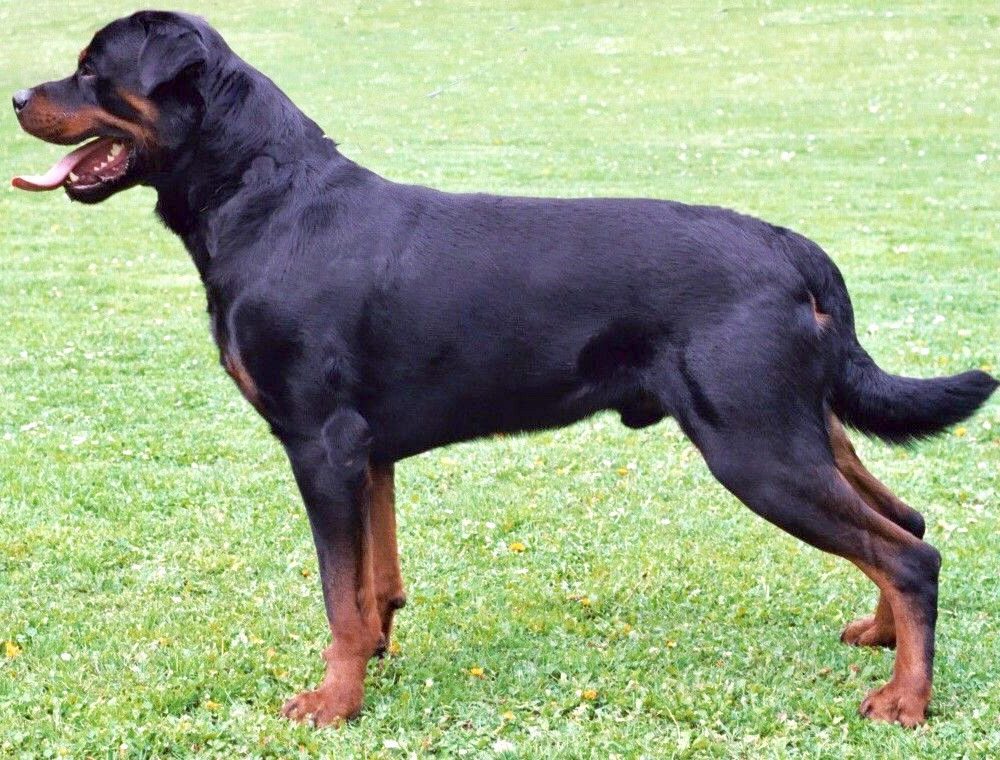

- Origin
- Germany
- Type
- Mastiff
- Size
- Large
- Height
- 56–69 cm (22–27 in)
- Weight
- 35–60 kg (77–132 lb)
- Coat
- Double coat; medium-length, coarse, dense and flat
- Colors
- Black with rich tan, rust or mahogany markings
- Life span
- 8–10 years
- Status
- Recognised by the FCI and AKC
The Rottweiler is a strong, mastiff-type dog from Germany, medium-large to large in size. In German it was the Rottweiler Metzgerhund, the butchers’ dog of Rottweil, because its main jobs were herding livestock and pulling carts of meat to market. That work ended in the mid-19th century when railways replaced droving. Rottweilers still herd stock in many parts of the world and also serve as guard, police and search and rescue dogs.
History
The FCI standard counts the Rottweiler among the oldest surviving breeds and traces it to Roman times, when herding and driving dogs crossed the Alps with the legions, guarding the people and moving their cattle. Around Rottweil these dogs mixed with local ones. The butchers of the old free city bred the result purely for usefulness, producing a watch and driving dog that could also pull loads.
The demand for police dogs before World War I revived interest in the breed, and Rottweilers served in both world wars as messenger, ambulance, draft and guard dogs. The first German club was founded in 1914, and the German clubs merged in 1921 as the Allgemeiner Deutscher Rottweiler Klub (ADRK), regarded worldwide as the breed’s home club.
The American Kennel Club recognized the Rottweiler in 1931, and the breed was shown at Crufts in Britain in 1936. In the mid-1990s it was the AKC’s most registered breed.
Appearance
By the FCI standard males stand 61–69 cm (24–27 in) at the withers and weigh 50–60 kg (110–130 lb); females stand 56–63 cm (22–25 in) and weigh 35–48 kg (77–106 lb).
The skull is fairly broad between the ears, with a strong stop, a broad black nose and strong jaws with a scissor bite. The eyes are almond-shaped and dark brown. The ears are medium-sized, triangular and pendant, set high and wide apart. The back is straight and firm and the chest broad and deep. The Rottweiler is a trotting dog with a steady, energetic stride.
The outer coat is medium-length, coarse, dense and flat, over an undercoat on the neck and thighs. The color is always black with clearly defined tan markings on the cheeks, muzzle, throat, chest and legs, over each eye and under the tail.
Tails were traditionally docked. Docking is now banned in most countries, and the FCI standard describes a natural tail.
Temperament
A 2008 survey of breed club members found the breed average in aggression toward owners and other dogs but above average toward strangers, which seems tied to its watchdog and territorial instincts. The Rottweiler is very territorial, and owners need to work with the dog regularly to keep this in check.
With livestock, the AKC describes a natural gathering style and a strong wish to control. Working cattle, a Rottweiler seeks out the dominant animal and challenges it, and may use its body and shoulders to move stubborn stock.
Care and health
The coat needs little care, though it sheds heavily at certain times of year.
Studies of life expectancy give figures between 8 and 10.6 years, lower than the average for dogs. A breed club survey attributed more than 45% of deaths to cancer. Large American studies found the Rottweiler predisposed to hip dysplasia, elbow dysplasia and cranial cruciate ligament deficiency. It is also prone to several skin conditions, among them acral lick dermatitis and vitiligo.
Facts on this page were checked against Wikipedia and may have changed since.