Irish Setter

- Origin
- Ireland
- Type
- Gundog
- Size
- Large
- Height
- 55–71 cm (21.5–28 in)
- Weight
- 25–34 kg (55–75 lb)
- Coat
- Moderately long and silky, with feathering
- Colors
- Red or chestnut
- Life span
- 11–13 years
- Status
- Recognised by the FCI and AKC
The Irish Setter is a gundog and family dog from Ireland. Its Irish name, sotar rua, means “red setter”. It was bred to find upland gamebirds by scent and then hold a point to show where the bird is hiding, in fields and on wet or dry moorland. The name covers both the show-bred dog recognised by the American Kennel Club and the field-bred Red Setter of the Field Dog Stud Book.
History
Setting dogs are described in English books from 1570, though those early dogs were setting spaniels, mostly white with red spots, and did not look like today’s setters. By the early 18th century the setter was an established type and the Irish were breeding their own. The de Freyne family of French Park kept detailed stud records from 1793.
In 1845 setters in Ireland were noted to be mainly red, red and white, lemon, or white patched with deep chestnut. The taste for solid red won out through selective breeding. The Irish Red Setter Club in Dublin drew up the breed standard, approved on 29 March 1886, and it has changed little since.
The breed reached the United States in the early 19th century. The all-red dog became a favorite in the show ring, and between 1874 and 1948 the breed produced 760 show champions but only five field champions. In the 1940s Ned LaGrande of Pennsylvania gathered the last working Irish Setters in America, imported others, and with the approval of the Field Dog Stud Book crossed them with red and white field champion English Setters. The result was the modern Red Setter.
Appearance
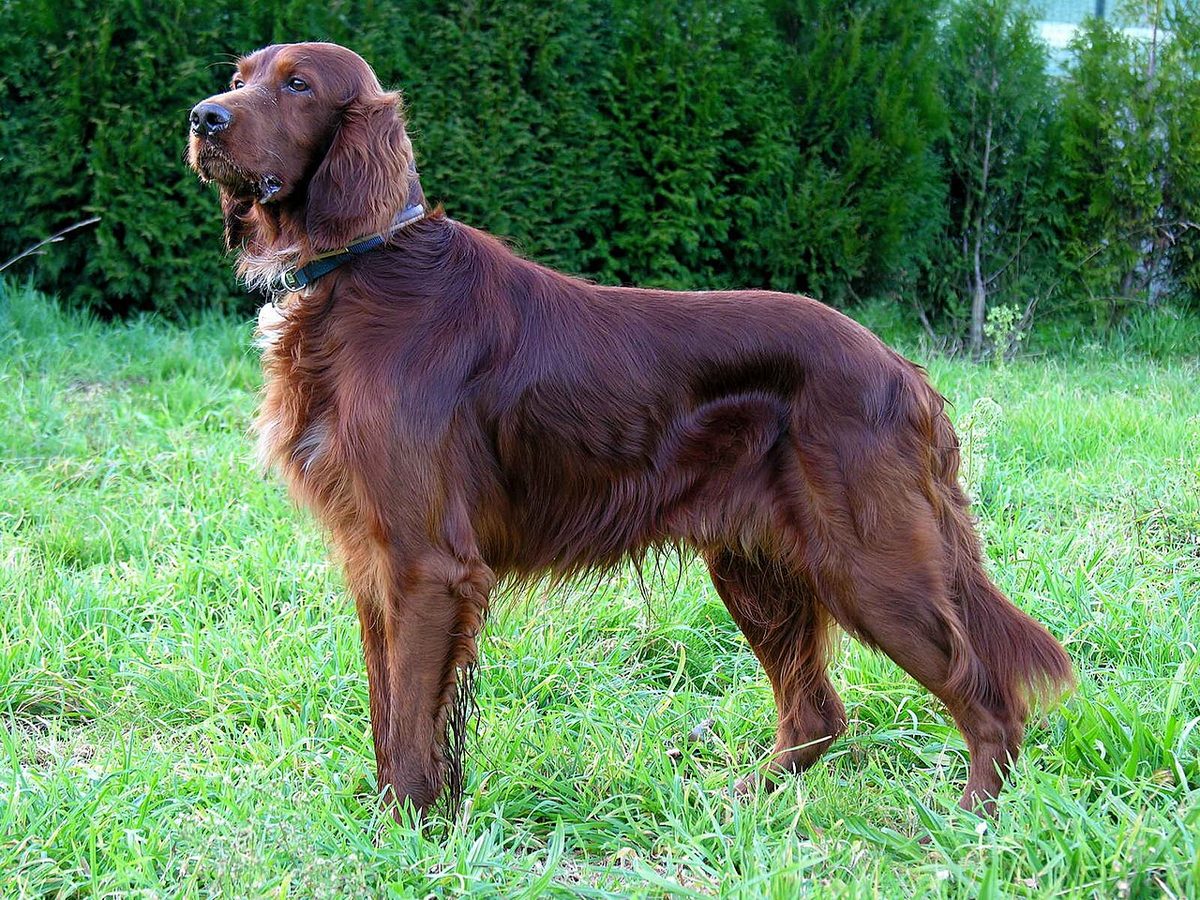
The coat is moderately long and silky, red or chestnut in color, with a fine top coat and an undercoat that thickens in winter. It feathers on the tail, ears, chest, legs and body. The dog is deep-chested with a small waist.
Irish Setters stand 61 to 71 cm (24 to 28 in). Males weigh 29 to 34 kg (65 to 75 lb) and females 25 to 29 kg (55 to 65 lb). The FCI standard asks for 58 to 67 cm in males and 55 to 62 cm in females.
The working Red Setter is smaller, generally about 20 kg (45 lb), with a less silky coat, shorter feathering and a lighter russet or fawn color, often with white patches on the face and chest.
Temperament
The breed is known for a friendly, gentle nature. The UK standard asks for a dog that is “demonstrably affectionate”, and the American Kennel Club standard speaks of a “rollicking personality”. Shyness is not part of its character.
Care and health
The coat needs frequent brushing to stay in condition and free of mats.
Life expectancy is around 11 to 12 years; a 2024 UK study put it at 12.9 years. The breed can inherit gluten intolerance, which appears at about six months and damages the small intestine; affected dogs fed a gluten-free diet show no effects. Irish Setters are also predisposed to atopic dermatitis and, as deep-chested dogs, to gastric dilatation volvulus, or bloat.
Facts on this page were checked against Wikipedia and may have changed since.