Irish Red and White Setter

- Origin
- Ireland
- Type
- Gundog
- Size
- Large
- Height
- 57–66 cm (22.5–26 in)
- Weight
- 23–32 kg (50–70 lb)
- Coat
- Short and flat on the body, with long silky feathering
- Colors
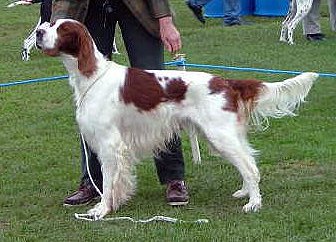
- Pearly white with solid patches of deep red
- Life span
- 10–12 years
- Status
- Recognised by the FCI, AKC and The Kennel Club; a Vulnerable Native Breed in the UK
The Irish Red and White Setter is a gundog from Ireland, bred to find gamebirds such as grouse, partridge, pheasant, snipe and woodcock. In use and temperament it is almost the same as the solid red Irish Setter, but it is more often seen working in the field.
History
In Ireland, setters were originally mostly red, red and white, or nearly all white, and all were bred together as Irish Setters. At a Dublin show in 1875, 23 of the 66 Irish Setters entered were red and white. Then solid red became the fashion and fetched high prices, and the red and white dogs declined almost to extinction. A handful of breeders in remote parts of Ireland kept them going. Among the best-known strains was that of the Rossmore family of County Monaghan, kept since the mid 18th century, and the dogs were sometimes called Rossmore Setters.
After the First World War a clergyman, Noble Huston, worked to revive the breed, but numbers stayed small. Maureen Cuddy’s careful records persuaded the Irish Kennel Club in 1974 that the pedigrees of the few remaining dogs were accurate, and a planned revival began in the 1970s. A breed society formed in 1981. Interest in Britain grew after a dog named Harlequin of Knockalla was shown at Crufts in 1980.
The Canadian Kennel Club recognised the breed in May 1999 and the American Kennel Club on 1 January 2009. In the United Kingdom it is listed as a Vulnerable Native Breed, with fewer than 300 registrations a year.
Appearance
This setter is strong and athletic without being coarse. It is heavier in the body than the red Irish Setter, with a broader head. The FCI asks for 62–66 cm (24.5–26 in) in males and 57–61 cm (22.5–24 in) in females. The American standard gives a weight of about 23–32 kg (50–70 lb).
The coat is short and flat on the head and body, with long silky feathering on the ears, chest, legs, belly and tail. It should be straight, never curly. The base color is pearly white with solid patches of deep red, like a freshly opened chestnut. Some flecking is allowed on the face, feet and lower legs only.
Temperament
The breed is affectionate, gentle and good-natured, and gets on well with children and other dogs. It is intelligent and responds to firm but not harsh training, though it can take longer to train than other gundogs. It has a lot of energy and does best with an active family and room to run hard.
Care and health
The coat needs combing and brushing each week, with some trimming of the hair on the feet and behind the ears.
The breed is generally healthy. Breed clubs monitor three conditions: canine leucocyte adhesion deficiency, an immune system failure; von Willebrand disease, a blood clotting disorder; and posterior polar cataract. Thanks to DNA testing, the first two are now almost unheard of in British dogs. In 2011 the Irish Kennel Club began a monitored program of outcrossing to Irish Setters to widen the gene pool.
Facts on this page were checked against Wikipedia and may have changed since.