Bullmastiff
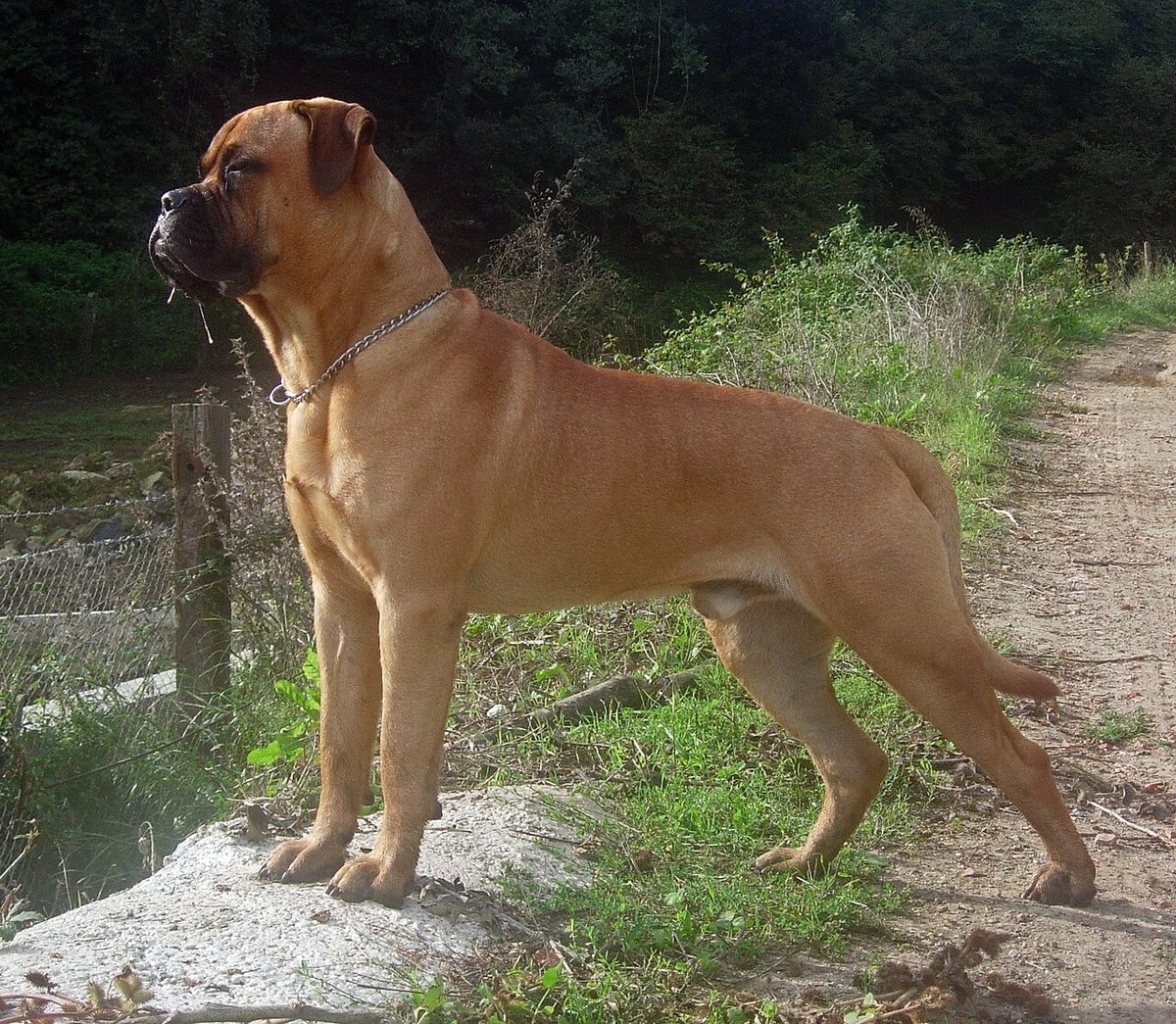

- Origin
- England
- Type
- Mastiff
- Size
- Large
- Height
- 61–69 cm (24–27 in)
- Weight
- 41–59 kg (90–130 lb)
- Coat
- Short and weather-resistant
- Colors
- Fawn, red or brindle in any shade, with a black muzzle
- Life span
- About 10 years
- Status
- Recognised by the FCI, AKC and The Kennel Club
The Bullmastiff is a large English dog of mastiff type, solidly built and short in the muzzle. It was developed as a guard dog by crossing the English Mastiff with the Old English Bulldog, a breed that no longer exists.
History
The beginnings of the Bullmastiff are not clear. In the 18th century, in parts of England, Mastiffs and Bulldogs were often bred together to produce dogs for guarding people and property. By the start of the 20th century the cross was widely used by gamekeepers against poachers. The aim was strength, size and speed: the tough, heavy, aggressive bulldog of the 19th century was combined with the larger, strong and less aggressive mastiff. This work gave the dog its other name, the Gamekeeper’s Night Dog.
The Kennel Club recognized the Bullmastiff as a breed in 1924. To be registered, a dog needed at least four generations of Bullmastiff ancestors with no Bulldog or Mastiff added, and crossbred dogs were not accepted. The American Kennel Club followed in 1934, and the Fédération Cynologique Internationale gave full acceptance in 1955.
In 1928 the De Beers diamond company brought Bullmastiffs to South Africa to guard its mines.
Appearance
Females stand about 61 to 66 cm (24 to 26 in) at the withers and usually weigh 41 to 50 kg (90 to 110 lb). Males are on average about 3 cm taller and 9 kg heavier.
The short coat may be fawn, red or brindle, in any shade. A little white on the chest is allowed. The muzzle is black, growing paler toward the eyes. The face is flat and the muzzle short, but this does not affect the dog’s breathing.
Care and health
A British study in 2024 found a life expectancy of 10.2 years for the breed, against an average of 12.7 years for purebred dogs.
Health concerns in the breed include hip dysplasia and elbow dysplasia, found in 24.5 and 13.8 percent of dogs, as well as bloat, entropion, hypothyroidism and cancer, with a fairly high rate of lymphoma and mast cell tumors. A dominant inherited form of progressive retinal atrophy, caused by a mutation in the RHO gene, is common. Bullmastiffs are also prone to ear infections.
Facts on this page were checked against Wikipedia and may have changed since.