Shar Pei

- Origin
- China
- Type
- Mastiff
- Size
- Medium
- Height
- 44–51 cm (17–20 in)
- Weight
- 16–29 kg (35–64 lb)
- Coat
- Short, harsh and bristly
- Colors
- Any solid color except white
- Life span
- About 10–11 years
- Status
- Recognised by the FCI, AKC and China Kennel Union
The Shar Pei is a dog from southern China, where it was traditionally kept to guard property. Its name means “sand skin”. In the West it is known for its deep wrinkles; a less wrinkled traditional form survives in Hong Kong. The breed came close to extinction in the 20th century.
History
No records show where the Shar Pei came from. It closely resembles figures of an unwrinkled guard dog kept in southern China under the Han dynasty, and some believe that it and the Chow Chow descend from those dogs. Genetic work places it among the basal breeds, older than the modern breeds of the 19th century.
Once very popular, the Shar Pei suffered badly from the wars and political upheaval of 20th-century China. In 1973 a Hong Kong businessman, Matgo Law, appealed for help abroad, particularly to the American Kennel Club. By 1978 the Guinness Book of Records named it the rarest breed in the world, with only 60 dogs left.
The publicity created a strong demand in the United States. Some breeders in Hong Kong, Macau and Taiwan answered it by crossing their remaining dogs with Bull Terriers, pugs and bulldogs and selling the puppies to American buyers. These crosses produced a dog with a much fleshier muzzle, the “meat-mouth” type, as against the original “bone-mouth”. American breeders built the breed up from the dogs that reached them in the 1970s, and the American Kennel Club recognised it in 1992 with a standard describing the meat-mouth type. A few Hong Kong breeders keep the bone-mouth type, of which only an estimated 50 to 100 remain.
Some American breeders have also bred a smaller, more wrinkled “miniature Shar Pei” of up to 40 cm (16 in), against the wishes of many breeders of the standard size.
Appearance
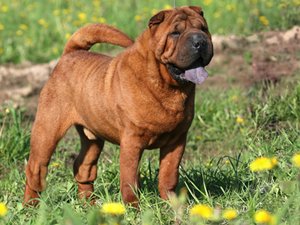
The Shar Pei is a medium-sized dog with a short, very harsh coat. Adults usually stand 44 to 51 cm (17 to 20 in) tall and weigh 16 to 20 kg (35 to 44 lb), though some are heavier. Any solid color but white is allowed; black, red, fawn and cream are the most common.
The head is large for the body, with a broad, well-padded muzzle that is usually darker than the coat, small triangular ears set wide apart, and eyes sunk deep in folds of skin. The legs are straight and muscular, and the broad tail curls over the back.
It looks like a member of the mastiff family, but its nearest relatives are spitz breeds, the Chow Chow closest of all. Both have a blue-black tongue.
Care and health
A 2024 British study found a life expectancy of 10.6 years, below the average for purebred dogs.
Shar Pei fever is a condition of the breed, thought to be inherited, that brings recurring fever and swollen hocks. It can lead to a build-up of amyloid in the kidneys and liver and to failure of those organs. It is associated with the Western type, and an estimated 23% of dogs in the United States are affected.
The breed is predisposed to several skin problems, including atopic dermatitis, demodicosis, cutaneous mucinosis, skin fold inflammation and ear infections. Entropion, in which the eyelids roll inward and the lashes rub the eye, is common and painful and can cause blindness if left untreated. Other conditions linked with the breed are primary open angle glaucoma, hypothyroidism, vitamin B12 deficiency, elbow dysplasia and hiatal hernia.
Facts on this page were checked against Wikipedia and may have changed since.