St. Bernard

- Origin
- Switzerland
- Type
- Mastiff
- Size
- Giant
- Height
- 65–90 cm (26–35 in)
- Weight
- 54–82 kg (120–180 lb)
- Coat
- Smooth, close and flat, or longhaired
- Colors
- White with red patches or a red mantle; brindle red and brownish-yellow also allowed
- Life span
- About 9 years
- Status
- Recognised by the FCI, AKC, UKC and The Kennel Club
The St. Bernard is a very large working dog from the Western Alps. It was bred for rescue work by the hospice on the Great St Bernard Pass, on the border between Italy and Switzerland, and the FCI treats Switzerland as its country of origin. It is known for its size, its gentle nature and the stories of its Alpine rescues.
History
The hospice, founded by the monk Bernard of Menthon, acquired its first dogs between 1660 and 1670. The monks’ earliest written records of them date from 1707. The dogs were never specially trained; young ones learned search and rescue from older ones. The most famous, Barry, is said to have saved between 40 and 100 lives, and his body is preserved in the Natural History Museum in Bern.
The hospice dogs were smaller than the modern breed, about the size of a German Shepherd Dog. Severe winters from 1816 to 1818 brought many avalanches, which killed a large share of the breeding dogs. To save the breed, the survivors were crossed in the 1850s with Newfoundlands and other breeds. This changed their looks, and the long coat they gained froze in the snow and weighed them down. Later breeding for the show ring made the dogs larger still.
The name St. Bernard came into wide use only in the mid-19th century. The Swiss St. Bernard Club was founded in Basel in 1884, the breed was the first entered in the Swiss Stud Book that year, and the standard was approved in 1888. The last recorded Alpine rescue by a St. Bernard was in 1955.
The familiar picture of a dog with a brandy barrel at its neck is traced to an 1820 painting by Edwin Landseer. The monks say their dogs never carried casks.
Appearance
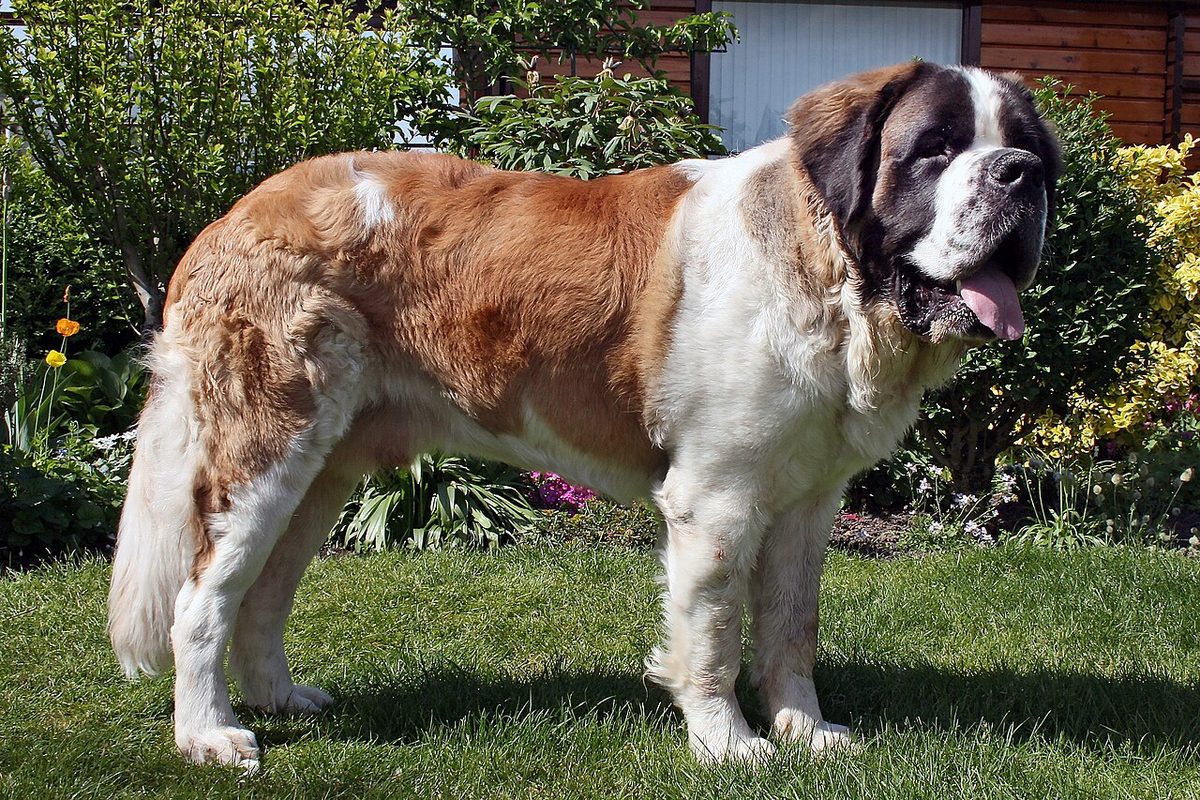
The St. Bernard is a giant molosser-type dog. Under the FCI standard, males stand 70–90 cm and females 65–80 cm; the AKC gives weights of 140–180 lb (64–82 kg) for males and 120–140 lb (54–64 kg) for females. The smooth coat is close and flat, and there are longhaired dogs as well. The color is white with red patches of varying size or a red mantle.
Temperament
The St. Bernard is often called a gentle giant. It is calm, patient and sweet with adults and especially with children, and loyal and affectionate. A well-socialized dog should be very friendly. The breed is not strongly protective by instinct, but it may bark at strangers, and its size alone puts off intruders. It keeps its talent for scent work and can take part in tracking or search and rescue.
Care and health
A 2024 UK study found a life expectancy of 9.3 years, well below the average for purebred dogs. Studies have found the breed predisposed to hip dysplasia, cruciate ligament problems, dilated cardiomyopathy and gastric dilatation volvulus (bloat). Bone cancer (osteosarcoma) has been shown to be hereditary in the breed. Several skin conditions are also recorded.
Facts on this page were checked against Wikipedia and may have changed since.