Bull Terrier

- Origin
- England
- Type
- Terrier
- Coat
- Short and dense
- Colors
- White, brindle, fawn, red, black or tricolor
- Life span
- 10–12 years
- Status
- Recognised by the FCI, AKC and The Kennel Club
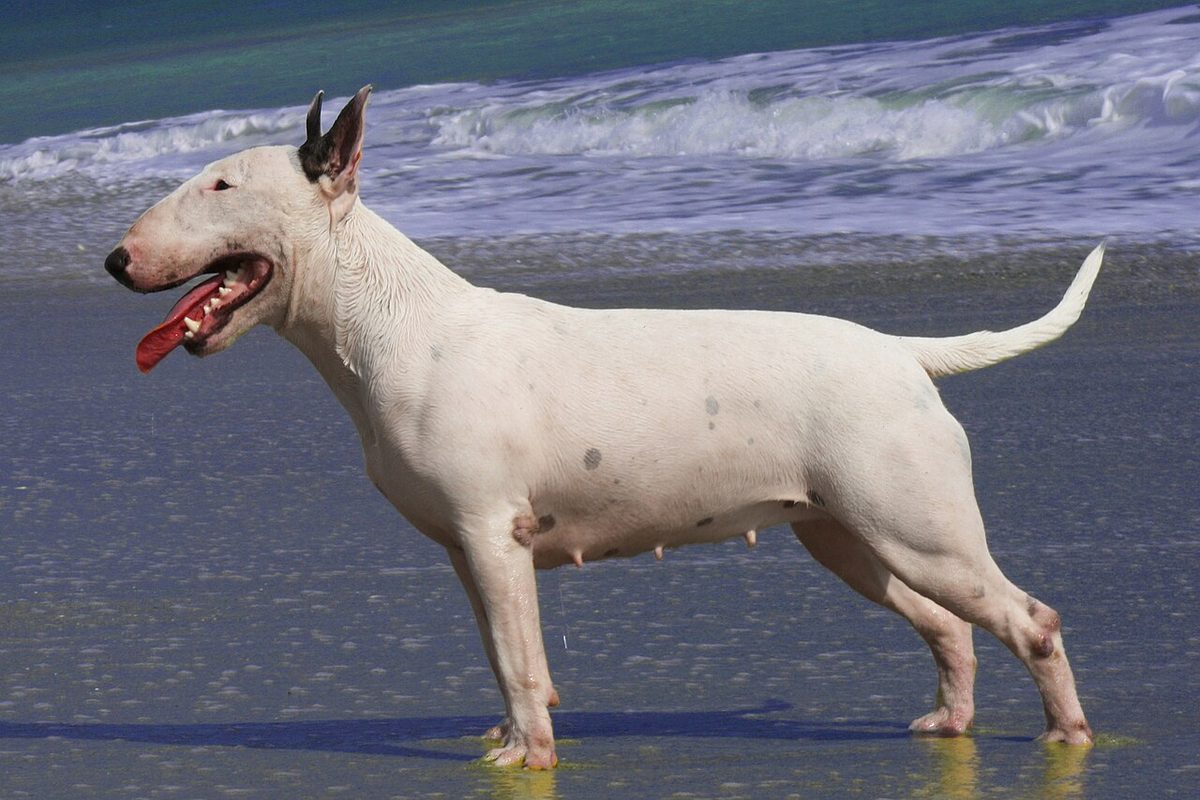
The Bull Terrier is an English terrier with a head like no other dog’s: egg-shaped from the front, with small triangular eyes. It grew out of the bull and terrier dogs once bred for vermin control and blood sports. A smaller version, the Miniature Bull Terrier, also exists.
History
At the start of the 19th century, breeders crossed the Old English Bulldog with old English terriers to get a dog with the terrier’s speed and the bulldog’s tenacity. These bull and terriers were bred for performance, with no standard, and in time split into the ancestors of the Bull Terrier and the Staffordshire Bull Terrier.
In the middle of the century James Hinks began crossing bull and terriers with the English White Terrier, now extinct, looking for a cleaner outline, better legs and a nicer head. He showed a bitch named Puss in the Bull Terrier class at a London show in 1862. The dogs caught on at once. Dalmatian, Spanish Pointer and Whippet were added for elegance and agility, and Borzoi and Rough Collie to flatten the profile. Hinks wanted his dogs white. The early ones still had a stop in the skull; Lord Gladiator, in 1917, was the first with none at all and is seen as the first modern Bull Terrier.
Because all-white breeding brought medical problems, Ted Lyon and others introduced color in the early 20th century using Staffordshire Bull Terriers. The AKC recognized colored Bull Terriers as a separate variety in 1936.
Appearance
Seen from the front the head is egg-shaped, with the top of the skull almost flat. In profile it curves gently down from the skull to the tip of the black nose. The lower jaw is deep and strong, and the eyes are small, dark, deep-set and triangular. The body is full and round with muscular shoulders, and the tail is carried horizontally. The short, dense coat is white, red, fawn, black, brindle or a mix of these. The FCI standard sets no limits on height or weight.
Temperament
Bull Terriers are described as even-tempered, open to discipline and good at socializing. The breed is sometimes covered by breed-specific laws and cannot be imported into Germany, although a 2008 German study found no significant difference in temperament between Bull Terriers and Golden Retrievers.
Care and health
A 2024 UK study found a life expectancy of 12 years; an earlier breed survey gave a median of 10.
Deafness affects 20.4 percent of pure white Bull Terriers and 1.3 percent of colored ones. Many develop skin allergies, and insect bites can set off hives, rash and itching. Lethal acrodermatitis, a rare inherited disease found only in white Bull Terriers, causes poor growth, skin lesions and a weak immune system, and most affected puppies die before the age of two. The breed is also predisposed to neutrophilic cholangitis and to patellar luxation.
Facts on this page were checked against Wikipedia and may have changed since.