Rüppell's Fox
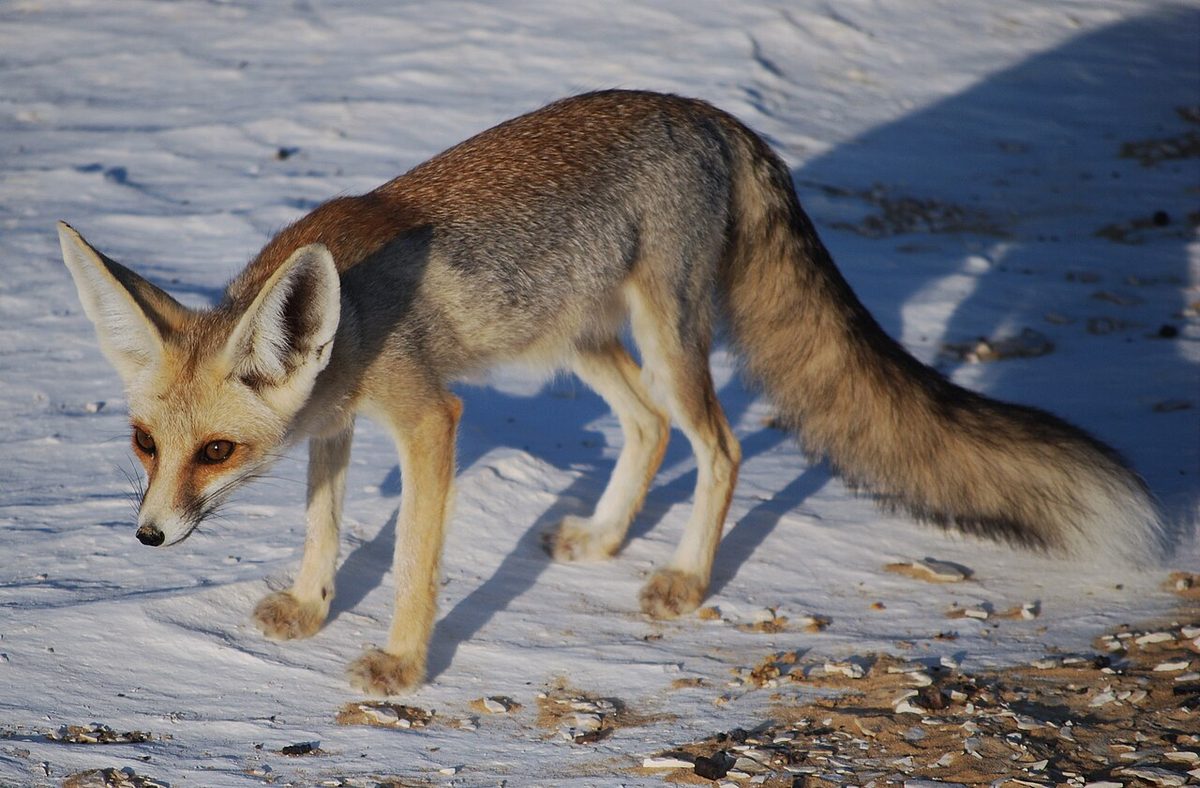

- Origin
- North Africa
- Type
- Wild canid
- Size
- Small
- Weight
- About 1.7 kg (3.7 lb)
- Coat
- Very soft and fluffy; thicker in winter
- Colors
- Sandy with a reddish back, white underparts and a white tail tip
- Life span
- About 7 years in the wild; up to 12 in captivity
- Status
- Least Concern (IUCN)
Rüppell’s fox (Vulpes rueppellii), also called Rüppell’s sand fox, is a wild fox of deserts and semi-deserts in North Africa, the Middle East and southwestern Asia. It is named after the German naturalist Eduard Rüppell. Its closest relative is the red fox. The IUCN has listed it as Least Concern since 2008.
Range and habitat
In Africa the species lives in the deserts south of the Atlas Mountains, from Mauritania and Morocco in the west to Egypt and Djibouti in the east, including parts of Algeria, Niger, Libya, Chad, Sudan, Ethiopia and Somalia. It is common in Arabia and ranges on through Syria, Jordan and Iraq to Iran, Afghanistan and Pakistan.
It prefers sandy or rocky desert but also lives in semiarid steppe and sparse scrub. It seems to avoid the driest heart of the Sahara and is more abundant around the fringes, in mountain massifs and near oases. Its range is thought to be limited mainly by competition with the red fox and by human settlement.
Appearance
This is a small fox, 66–74 cm (26–29 in) long including a tail of 27–30 cm (11–12 in). Both sexes average about 1.7 kg (3.7 lb), with males slightly larger.
The coat is sandy, ticked with white hairs, reddish along the middle of the back and fading to pure white on the underparts. The muzzle and forehead are a rustier shade, with dark brown patches on the sides of the muzzle reaching toward the eyes. The bushy tail has a black patch at its base and a white tip. The fur is very soft, with a heavy winter coat and a thinner summer coat.
Like other desert foxes it has large ears that help it lose heat. The soles of its feet are thickly furred, covering the pads. This protects them from extreme temperatures and probably helps the fox move on sand.
Behavior
Rüppell’s foxes are monogamous and active at dusk or at night. They usually rest by day in underground dens. Outside the breeding season each fox uses small resting dens that hold one adult, moving to a new one about every five days. Breeding dens are larger and house a pair and their kits.
A pair holds a territory year round and marks it with urine. In Oman, territories of around 70 square km (27 sq mi) have been reported. The foxes can cover more than 9 km (5.6 miles) in a night of foraging. They are omnivores, and the diet depends on what is available: insects such as beetles in some regions, small mammals, lizards and birds in others, along with grasses, desert succulents, dates and human garbage.
Mating takes place in November. After a gestation of about 52–53 days the female bears up to six blind kits, more often two or three. The young become independent at about four months and may travel up to 48 km (30 miles) to find a territory. The only natural predators are the steppe eagle and the eagle-owl.
Facts on this page were checked against Wikipedia and may have changed since.