Portuguese Water Dog
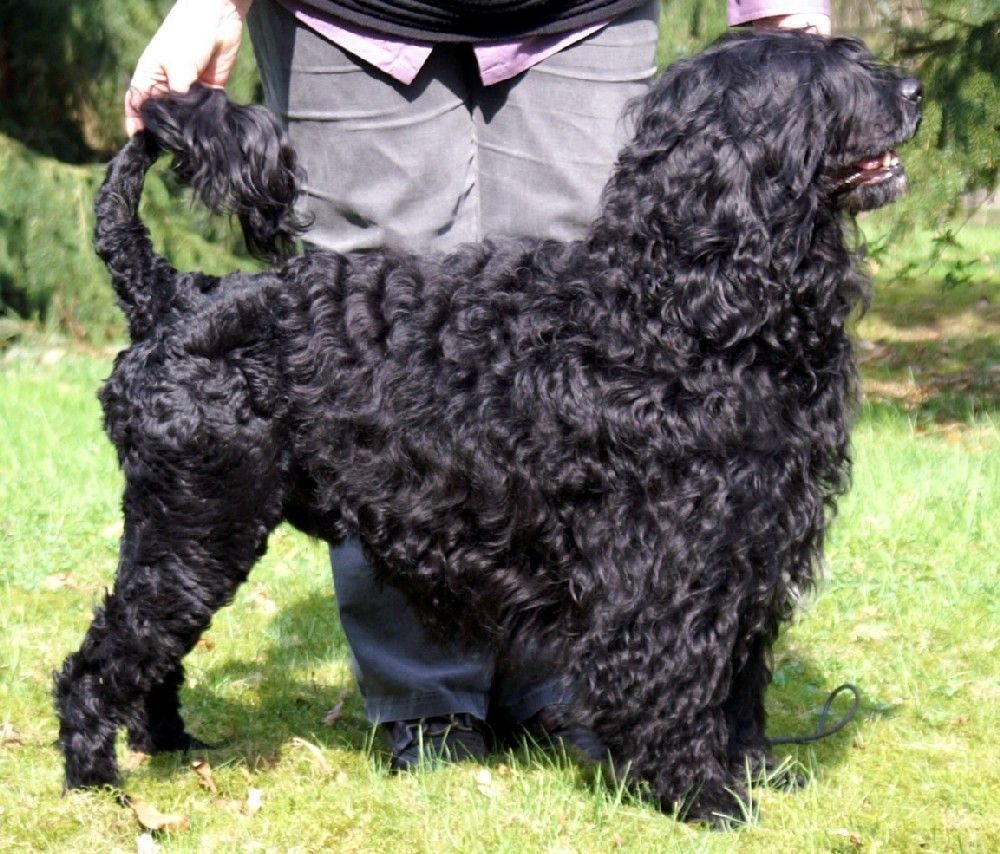

- Origin
- Portugal
- Type
- Gundog
- Size
- Medium
- Height
- 43–57 cm (17–22 in)
- Weight
- 16–25 kg (35–55 lb)
- Coat
- Curly or wavy, single-layered and non-shedding
- Colors
- Black, brown, black and white or brown and white
- Status
- Recognised by the FCI
The Portuguese Water Dog comes from the Algarve region of Portugal and spread from there along the whole Portuguese coast. It was a fisherman’s dog, taught to herd fish into nets, fetch lost tackle and broken nets, and carry messages from boat to boat or boat to shore. The dogs sailed on trawlers as far as the cod grounds off Iceland.
History
The Portuguese Water Dog is related to the Spanish Water Dog, and both are widely thought to be close to the Standard Poodle, with which they seem to share an ancient gene pool.
By the 1930s the breed was close to extinction. Vasco Bensaude, a wealthy shipping magnate, sought out fishermen’s dogs to rebuild it. His stud dog Leão, born in 1931, sired so many litters that about half of all pedigreed Portuguese Water Dogs trace back to him. Conchita Cintron de Castelo Branco carried on the work, and António Cabral founded the Alvalade kennels, registering his first dog in 1954.
In the United States, Deyanne Miller did most to establish the breed. She and others formed the Portuguese Water Dog Club of America in 1972. The breed remains fairly rare. Barack Obama’s family kept two, Bo and Sunny, while he was president.
Appearance
This is a solidly built, muscular dog with strong bone, slightly longer than tall, and sturdier than a Poodle. The toes are webbed for swimming. Males usually stand 51–58 cm (20–23 in) and weigh 18–27 kg (40–60 lb); females stand 43–53 cm (17–21 in) and weigh 16–23 kg (35–50 lb).
The single-layered coat is either curly, in compact cylindrical curls, or wavy with a slight sheen. Dogs are black, brown, black and white or brown and white; black with white on the chin and chest is most common. The eyes are black or brown.
Temperament
Portuguese Water Dogs are affectionate, independent and intelligent. They take readily to training, remember the names of objects, and are used as hearing, mobility, seizure-response and therapy dogs. They are generally friendly to strangers but tend to bond with one member of the family and like to stay close to their people; they do not do well left alone for long. They are usually quiet, with a loud, distinctive bark when someone approaches the home. Many jump up in greeting or stand at kitchen counters in search of food. They need vigorous exercise and mental challenges, and can become destructive when bored.
Care and health
The coat does not shed and keeps growing, so it needs brushing every other day and trimming about every two months. The two usual styles are the lion cut, with hindquarters and muzzle shaved, which began with the fishing dogs, and the retriever cut, about 2.5 cm (1 in) long all over.
The gene pool is small. Inherited conditions in the breed include hip dysplasia, cataracts, progressive retinal atrophy, GM1 storage disease, which testing has almost eliminated, and juvenile dilated cardiomyopathy, a fatal heart condition of puppies. DNA tests exist for the last three.
Facts on this page were checked against Wikipedia and may have changed since.