Kooikerhondje
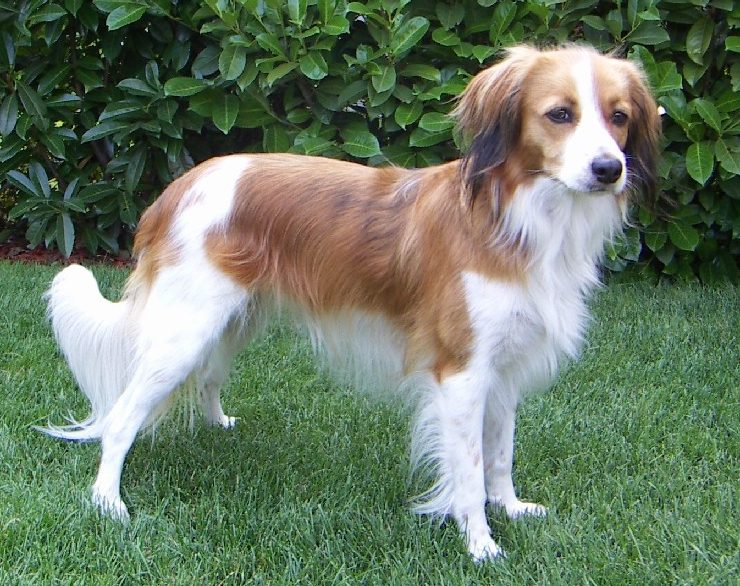

- Origin
- Netherlands
- Type
- Gundog
- Size
- Small
- Height
- 36–41 cm (14–16 in)
- Coat
- Wavy, medium-length double coat
- Colors
- White and orange-red
- Status
- Recognised by the FCI, AKC and The Kennel Club
The Kooikerhondje is a small spaniel-type dog from the Netherlands. It was bred as a working dog for the duck decoy, where its job was to lure ducks along the water so that hunters could catch them.
History
The breed was developed in the Netherlands around the 16th century. Dutch hunters had noticed that ducks are drawn toward a fox playing near the water, as long as it does not look straight at them, and the Kooikerhondje’s way of working copies that behavior. Its white plumed tail is there to catch the ducks’ attention.
The dog appears often in paintings of the Dutch Golden Age, including works by Jan Steen, Rembrandt and Johannes Vermeer. It is believed to be an ancestor of the Nova Scotia Duck Tolling Retriever.
The Kooikerhondje almost died out during World War II and was rescued by Baroness van Hardenbroek van Ammerstol. The Dutch Kennel Club did not officially recognize it until 1971. Since then it has been exported and recognized in other countries. In the United Kingdom, The Kennel Club moved it from the gun dog group to the utility group from January 2014, with the agreement of the British breed clubs. The American Kennel Club recognized it in 2018. In the 2020s it became better known in the United States, partly through Decoy, the Kooikerhondje owned by baseball player Shohei Ohtani.
Appearance
The Kooikerhondje is a small, spaniel-like sporting dog. The preferred height at the withers is 40 cm (16 in) for males and 38 cm (15 in) for females; the FCI standard allows 38 to 41 cm for males and 36 to 39 cm for females.
The coat is double, wavy and of medium length, colored white and orange-red. The tail is white and well plumed. Some dogs have black tips to the ears, known as “earrings”.
Care and health
Several inherited diseases have been identified in the breed: inflammatory myopathy, type III von Willebrand’s disease, necrotizing myelopathy, renal dysplasia, patellar luxation and ataxia.
A Dutch study of 842 Kooikerhondjes found patellar luxation in 24% of the dogs examined. Over the course of the study, from 1994 to 2011, the rate fell from 28% to 19%, though it remained higher than in other spaniels.
Facts on this page were checked against Wikipedia and may have changed since.