Pekingese

- Origin
- China
- Type
- Toy and companion
- Size
- Toy
- Height
- 15–23 cm (6–9 in)
- Weight
- 3.2–6.4 kg (7–14 lb)
- Coat
- Long double coat
- Colors
- Most often gold, red or sable; many others allowed
- Life span
- About 13 years
- Status
- Recognised by the FCI, AKC and The Kennel Club
The Pekingese is a toy dog from China, named for Beijing, formerly written Peking, the city of the Forbidden City. It was the companion of the Chinese Imperial court. Its unusual looks bring with them a number of health problems.
History
The breed emerged from several kinds of small dog kept by aristocratic Chinese families. Unlike the others, it could be owned only by members of the Imperial Palace.
It reached the West after 1860, when British and French troops sacked the Old Summer Palace in Beijing during the Second Opium War. Captain John Hart Dunne found a lone Pekingese there and took her to England, the first to survive the voyage. He gave her to Queen Victoria, who named her Looty. A popular story tells of five dogs found beside the body of the emperor’s aunt and shared among British officers, but no document of the time supports it.
The Empress Dowager Cixi later gave Pekingese to several Americans, among them John Pierpont Morgan and Alice Roosevelt Longworth. Around the turn of the century the breed became fashionable in Western countries. It has lost ground in recent years, partly to the Shih Tzu and partly because of the work its coat demands, though it has won Best in Show at Westminster five times.
A very small form, the sleeve Pekingese, weighs 2.7 to 3.6 kg (6 to 8 lb) and is named for the custom of carrying such dogs in the wide sleeves of court robes.
Legend gives the breed two origins: a lion that fell in love with a marmoset, or a lioness that loved a butterfly, their sizes brought together by the gods or the Buddha.
Appearance
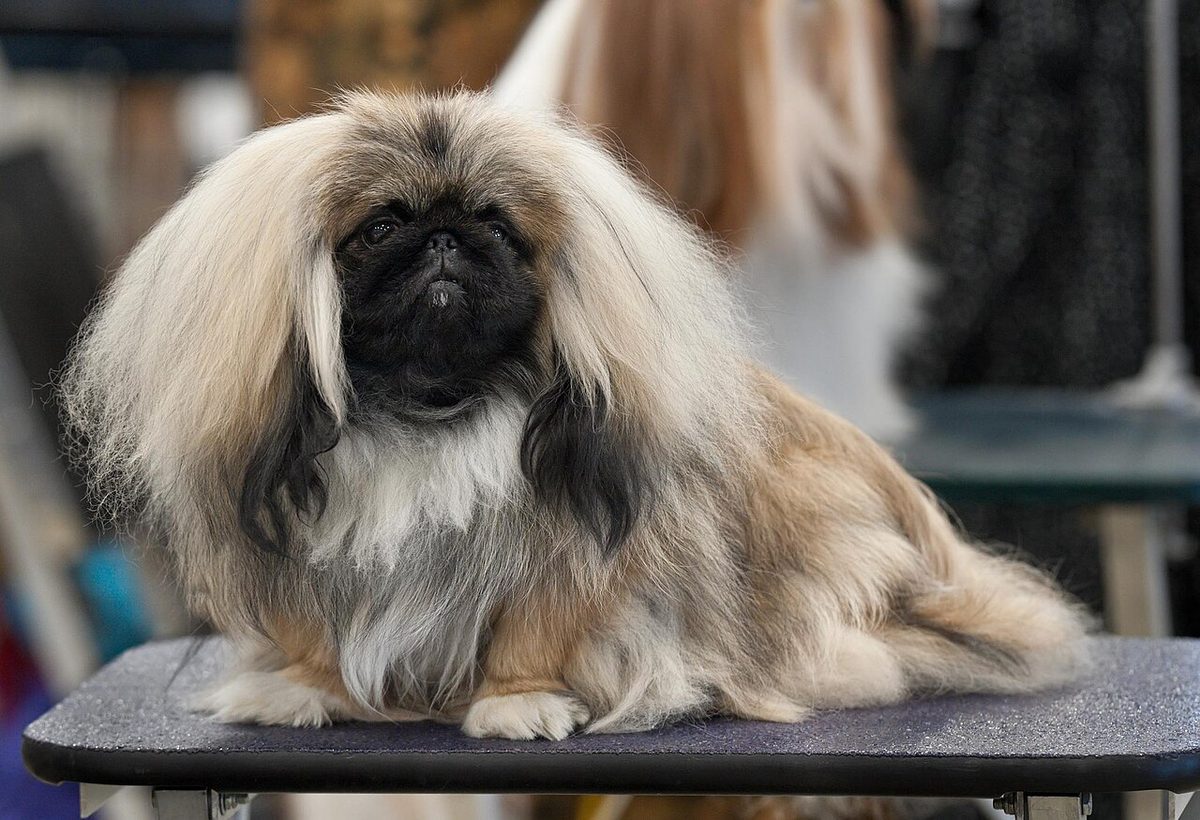
The flat face and large eyes are the first things one notices. The body is compact, muscular and low to the ground, a little longer than tall. Bowed front legs and a pear-shaped body give the dog a rolling gait.
Pekingese usually weigh 3.2 to 6.4 kg (7 to 14 lb) and stand about 15 to 23 cm (6 to 9 in) at the withers. The American standard disqualifies any dog over 14 lb.
Most are gold, red or sable. Cream, black, white, tan, black and tan and occasionally slate gray also occur, with or without a black mask. Whatever the coat, the skin of the muzzle, nose, lips and eye rims is black.
Care and health
The double coat sheds heavily and needs frequent, thorough brushing through both layers. It should never be shaved, since that can lead to sunburn. The eyes and the creases of the face need cleaning every day, and the long hair at the rear must be kept clean.
Exercise needs are small. Because of the very short muzzle, most Pekingese manage no more than about 20 minutes at a time, and they overheat easily; the breed is prone to heatstroke and to brachycephalic airway problems.
The large eyes are easily injured and infected. Hair on the nose folds can rub the eye, and the breed is prone to ulcers, keratitis, dry eye, lens luxation, progressive retinal atrophy and other eye diseases. Neurological and heart defects are the main health concerns, and trauma is the leading cause of death, as in many toy breeds.
In October 2008 The Kennel Club rewrote its standard to require that the muzzle be evident, in answer to concern about breathing difficulties. A 2024 British study found a life expectancy of 13.3 years.
Facts on this page were checked against Wikipedia and may have changed since.