Pug
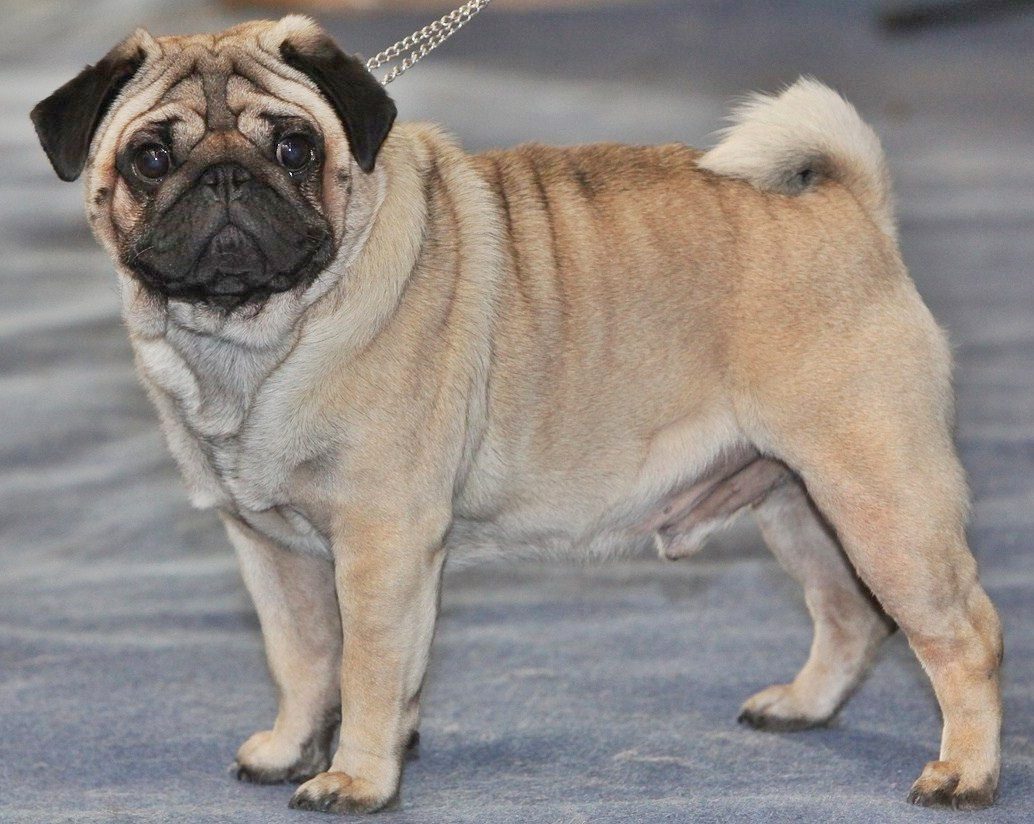

- Origin
- China
- Type
- Toy and companion
- Size
- Small
- Weight
- 6.3–8.2 kg (14–18 lb)
- Coat
- Short, fine, smooth and glossy
- Colors
- Fawn, apricot, silver or black
- Life span
- About 12 years; studies vary
- Status
- Recognised by the FCI and AKC
The Pug is a small companion dog from China, known by its wrinkled, short-muzzled face and curled tail. Unlike most breeds it was never meant to hunt, herd or guard. It was bred to keep people company and has done so for centuries.
History
The Pug’s ancestor was a short-legged, short-faced, short-coated Chinese dog called the Lo-sze, which was popular at the imperial court during the Song dynasty. Emperors prized these dogs, kept them in luxury and had them guarded by soldiers.
The Dutch East India Company brought the dogs to Europe in the sixteenth century. The Pug is said to have become the official dog of the House of Orange in 1572, after one named Pompey warned the Prince of Orange of approaching assassins. A Pug came to England with William III and Mary II in 1688, and the breed spread through the courts of Europe.
In nineteenth-century England, Queen Victoria bred Pugs herself and passed her liking for them to later members of the royal family. The breed’s look probably changed after 1860, when soldiers brought back short-legged, flat-nosed dogs from the Old Summer Palace in Beijing. Lady Brassey is credited with making black Pugs fashionable after bringing some from China in 1886. The American Kennel Club recognised the breed in 1885.
Appearance
Pugs in eighteenth-century prints are long and lean. Today’s preference is for a square, compact body with a deep chest and well-developed muscle. The weight is 14 to 18 pounds (6.3 to 8.2 kg).
The muzzle is blunt and very short, which makes the head look square, and the lower teeth usually sit in front of the upper ones. The legs are straight and strong and the feet small. The tail curls tightly over the hip. The coat is fine, smooth, short and glossy, in fawn, apricot, silver or black, with a trace of a dark line along the back.
Temperament
Pugs are sociable, gentle and playful. The American Kennel Club describes them as even-tempered and charming. They are sensitive to their owners’ moods, eager to please and happiest with people. They are sometimes called shadows for the way they follow their owners around.
Care and health
Many of the Pug’s health problems come from its shape. The short muzzle narrows the upper airway and can obstruct breathing, makes anesthesia riskier and leaves the dog poor at cooling itself by panting. The prominent eyes are easily injured and prone to dryness and corneal disease.
British research found Pugs three times as likely as other dogs to become obese. Hip dysplasia affected nearly 64 percent of Pugs in a 2010 survey. Other conditions include demodicosis, hemivertebrae of the spine and a brain inflammation known as Pug Dog Encephalitis, which affects 1 to 2 percent of the breed. Pugs very often need a cesarean to give birth.
Studies of lifespan disagree. One British study of veterinary records found 7.65 years, another found 11.6 years, and a Japanese study found 12.8 years.
Facts on this page were checked against Wikipedia and may have changed since.