Indian Spitz

- Origin
- India
- Type
- Spitz
- Size
- Small
- Height
- 22–45 cm (9–18 in)
- Weight
- 5–20 kg (11–44 lb)
- Coat
- Fluffy double coat
- Colors
- Usually milky white; also brown, or black and white
The Indian Spitz is a small spitz dog from India, thought to descend from the German Spitz. It was one of the most popular dogs in the country in the 1980s and 1990s.
History
The British brought spitz dogs to India during the 19th century. Over years of breeding they produced a dog that could cope with the heat of the Indian summer while keeping the intelligence and adaptability of the German breed.
The Indian Spitz owes much of its popularity to the import rules of the 1980s and 1990s, which made foreign breeds hard to obtain and turned Indian buyers toward local dogs. Redo, an Indian Spitz, played Tuffy in the 1994 film Hum Aapke Hain Koun.
Appearance
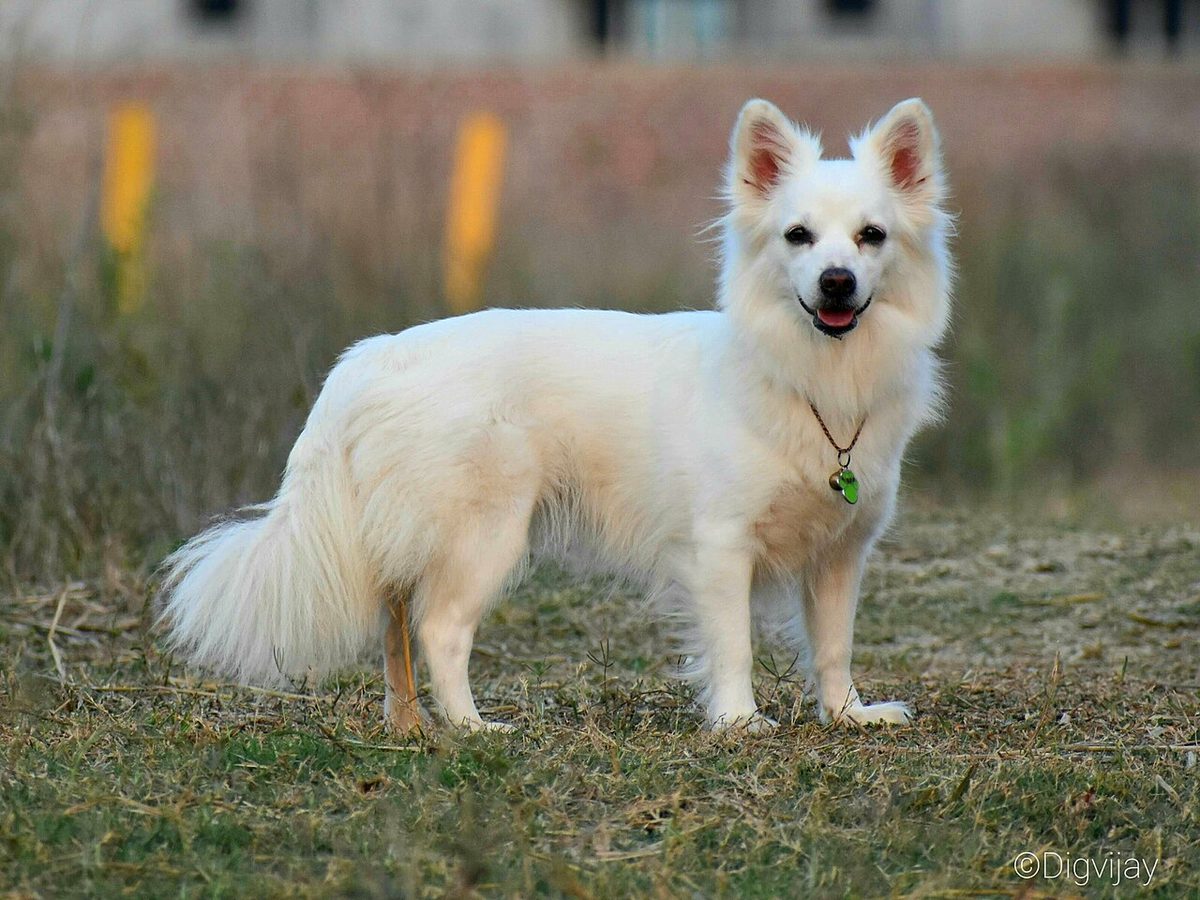
The Indian Spitz resembles both the Samoyed and the Pomeranian. It has a double coat, pointed, fox-like ears covered in thick fur, and a fluffy tail that curls over the back. Most are milky white. Solid brown also occurs, and very rarely a mix of black and white.
The dogs are generally divided into two sizes. The Smaller or Lesser Indian Spitz weighs roughly 5 to 7 kg (11 to 15 lb) and stands 22 to 25 cm (9 to 10 in) at the withers. The Bigger or Greater Indian Spitz weighs roughly 12 to 20 kg (26 to 44 lb) and stands 35 to 45 cm (14 to 18 in).
In India the breed is commonly called a Pomeranian, but the two are distinct. The Pomeranian is a toy dog, lighter and shorter than even the Lesser Indian Spitz, with a flatter face, less pointed ears and a denser, thicker coat. The Indian Spitz has a more conical muzzle and a shorter, less dense coat.
Temperament
The Indian Spitz is an easy dog to live with and a popular family pet. It is easily housebroken and trained, and it adapts as readily to a small apartment as to a large house. It needs a moderate amount of exercise.
Care and health
The long coat needs regular brushing, with a double-row brush that reaches the undercoat. A bath once or twice a month is enough, since the coat dries out if washed too often. Like other spitz breeds, the Indian Spitz sheds its thick winter coat in the warmer months. A matted dog should not be shaved, because the double coat may grow back in patches. The thick fur in and around the ears needs extra attention.
The breed has a high risk of corneal ulceration.
Facts on this page were checked against Wikipedia and may have changed since.