Karelian Bear Dog

- Origin
- Finland
- Type
- Spitz
- Size
- Medium
- Height
- 49–60 cm (19–24 in)
- Weight
- 17–28 kg (37–62 lb)
- Coat
- Straight, stiff outer coat over a fine, soft, thick undercoat
- Colors
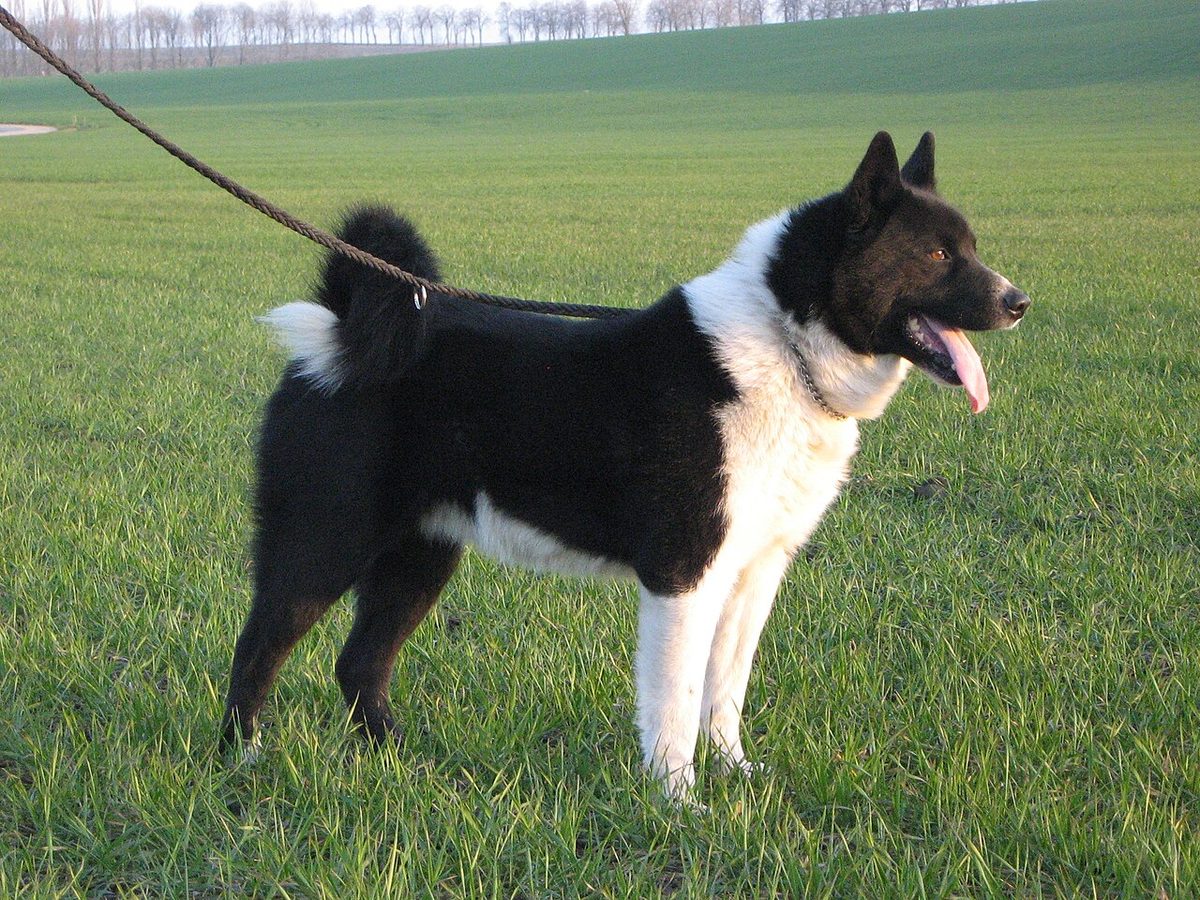
- Black with white markings
- Status
- Recognised by the FCI
The Karelian Bear Dog is a Finnish hunting dog, regarded by many in its home country as a national treasure. Quick reflexes and a fearless nature have made it a favorite for hunting large game such as brown bear, moose and wild boar, and its skill with bears gave it its name. It is among the ten most common breeds in Finland.
History
The breed descends from the Komi dog. Its foundation stock came from Ladoga Karelia, Olonets Karelia and East Karelia, where such dogs were used for hunting. Breeding began in 1936 with the aim of a sturdy dog that would bark at big game. The first standard was set in 1945, and the first dogs were registered in 1946.
In everyday use these dogs mostly hunted small fur-bearing animals such as squirrel and marten. They were also taken after moose, lynx, wolf and the Eurasian brown bear. For bear, at least two dogs worked together, harrying and barking to hold the animal’s attention while the hunter closed in.
More recently Karelian Bear Dogs have been used to reduce conflict between people and bears in the United States, Canada and Japan, through programs developed by the Wind River Bear Institute and its founder, Carrie L. Hunt. They have worked in Yosemite and Glacier national parks, in Alberta, Montana and Washington State. In Karuizawa, a Japanese resort town where the dogs were introduced in 2004, black bear incidents fell from 255 in 2006 to four in 2017.
Appearance
Males stand 54 to 60 cm (21 to 24 in) at the withers and weigh 25 to 28 kg (55 to 62 lb). Females are smaller, at 49 to 55 cm (19 to 22 in) and 17 to 20 kg (37 to 44 lb).
The coat has straight, stiff guard hairs over a fine, soft, thick undercoat. Today’s standard calls for a black dog with white markings. In the breed’s early days there were also wolf-gray dogs of various shades, red dogs like the typical spitz, and black-and-tan ones.
Temperament
The Karelian Bear Dog hunts silently and with great persistence. It gives voice only once it has its quarry at bay, then holds it with a fast, high-pitched bark while circling or running back and forth until the hunter arrives. It can keep an animal cornered for a very long time, and will nip at the hindquarters of a bear that tries to leave.
These dogs are usually aggressive toward other animals and can be territorial with other male dogs. They are not aggressive toward people, though a poorly socialized dog may be a little reserved, and biting a person is very rare. With their owners they are very affectionate. They are watchful and will signal anything unfamiliar that moves nearby.
They are very social and prone to separation anxiety. They prefer life outdoors, need room to run and want plenty of mental and physical work. For those reasons the breed has not become a common companion dog.
Care and health
An inherited form of chondrodysplasia, first described in the Norwegian Elkhound, occurs in the breed. Signs include curved forelimbs, delayed bone formation and shortened vertebrae. Finnish researchers traced it to a recessive mutation in the ITGA10 gene, and its presence is thought to go back to a popular sire that was part Norwegian Elkhound.
A mutation in the LHX3 gene, which causes pituitary dwarfism in the German Shepherd Dog, is also found in the Karelian Bear Dog through German Shepherd ancestry. Affected dogs grow poorly, keep their puppy coat and later lose hair.
Facts on this page were checked against Wikipedia and may have changed since.