Japanese Spitz
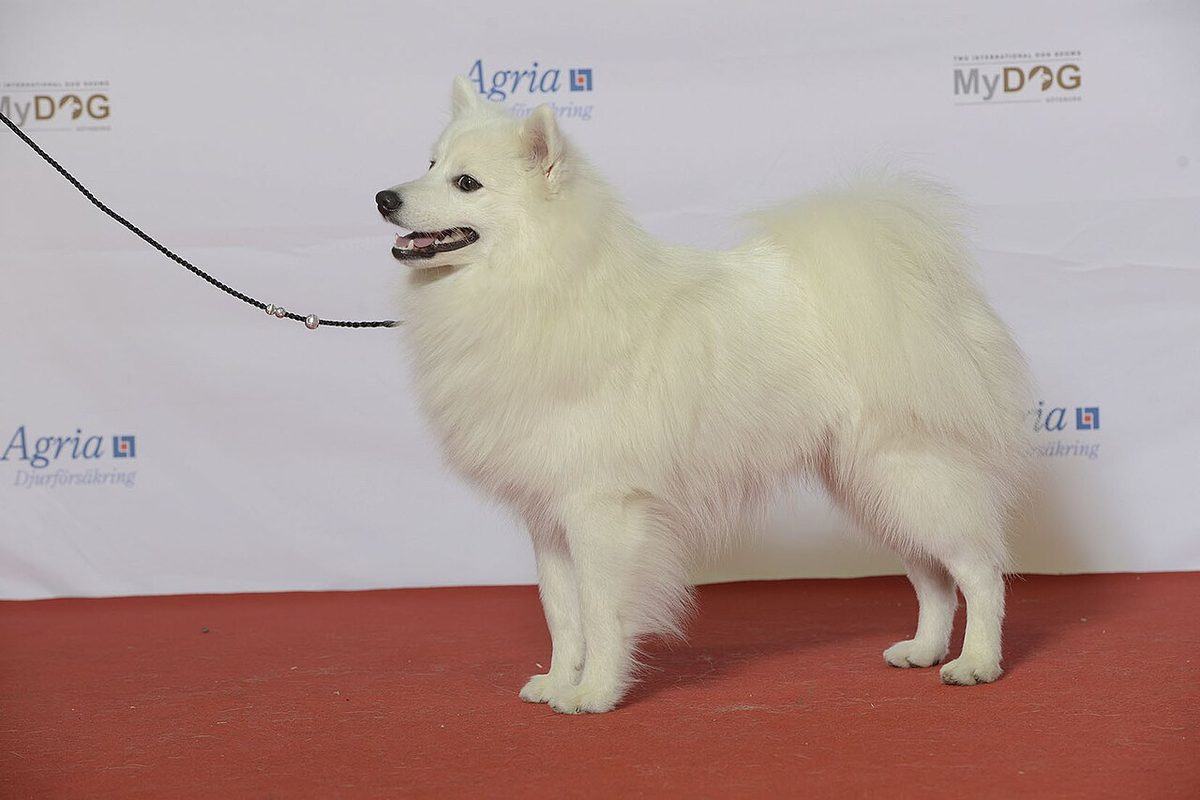

- Origin
- Japan
- Type
- Spitz
- Size
- Small
- Height
- 30–38 cm (12–15 in)
- Coat
- Thick double coat that stands off from the body
- Colors
- Pure white
- Life span
- About 13 years
- Status
- Recognised by the FCI, The Kennel Club and UKC; in the AKC Foundation Stock Service
The Japanese Spitz is a small to medium-sized white companion dog of the spitz type, developed in Japan in the 1920s and 1930s. It is larger than the Pomeranian and resembles the Samoyed and the American Eskimo Dog.
History
Japanese breeders created the breed by crossing several other spitz breeds. They started with white German Spitz dogs that had come to Japan from northeastern China, which were first exhibited at a Tokyo dog show in 1921. Between 1925 and 1936 small white spitz dogs were imported from around the world and bred into the developing line.
The final standard was written after World War II and accepted by the Japan Kennel Club. The breed became popular in Japan in the 1950s and was exported to Sweden early in that decade. From Sweden it reached England, where The Kennel Club recognized it in 1977 in the Utility Group. It is also recognized by the Canadian, New Zealand and Australian kennel clubs and by the United Kennel Club. The American Kennel Club added it to its Foundation Stock Service in April 2019 and has not yet fully recognized it.
Appearance
The Japanese Spitz has a somewhat square body, a deep chest and a very thick, pure white double coat. The outer coat stands away from the soft undercoat and forms a ruff around the neck; the fur is shorter on the muzzle, ears and fronts of the legs. The face is wedge-shaped with a pointed muzzle and small, triangular pricked ears. The long, heavily plumed tail curls over the back.
Ideal size varies from one standard to another. The Japanese standard, used by the FCI, asks for males of 30–38 cm with females a little smaller. The Kennel Club gives 34–37 cm (13–15 in) for males and 30–34 cm (12–13 in) for females.
Temperament
This is first of all a companion dog. It thrives on human contact and wants to be part of the family. It is active, bright, playful, loyal and affectionate, and it is good with children and older people. Despite its size it makes a reliable watchdog and tends to bark when strangers arrive.
Care and health
The Japanese Spitz copes with cold weather but prefers to live indoors with its family. It can live in an apartment as long as it gets time to run off the leash somewhere safe.
The coat is easier to keep than it looks. It is dry in texture, and mud and dirt fall off or brush out easily. It still needs regular brushing, about twice a week, with a pin brush that reaches the undercoat, to stop knots forming.
The breed is healthy, with few genetic problems. The main concern is patellar luxation, in which the kneecap slips out of place. Some dogs have runny eyes, usually because of small tear ducts, allergy or stress. A late-onset inherited eye disease, progressive retinal atrophy of the rcd4 type, has also been identified. A 2024 UK study found a life expectancy of 13 years.
Facts on this page were checked against Wikipedia and may have changed since.