Norwegian Lundehund

- Origin
- Norway
- Type
- Spitz
- Size
- Small
- Height
- 30–40 cm (12–16 in)
- Weight
- 5–8 kg (11–18 lb)
- Coat
- Dense, rough outer coat with a soft undercoat
- Colors
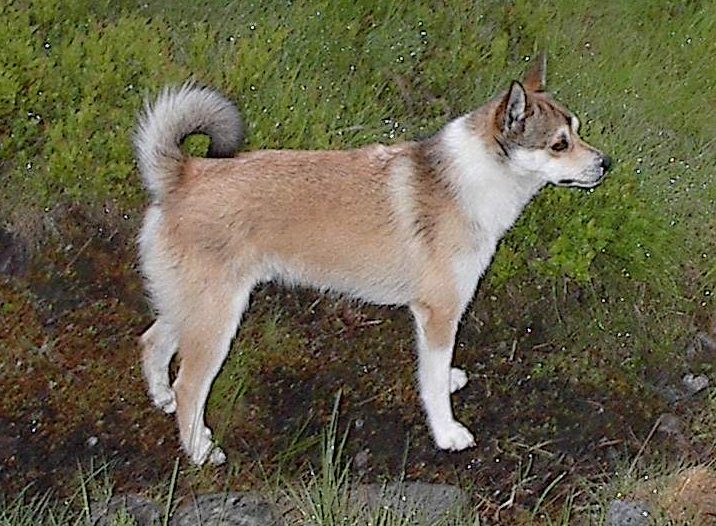
- Red-brown to yellow-brown with white areas
- Status
- Recognised by the FCI
The Norwegian Lundehund is a small spitz from Norway. Its name joins lunde, meaning puffin, and hund, meaning dog. It was developed to hunt puffins and collect their eggs from nesting places in caves and on cliffs that people could not reach.
History
For more than 400 years the Lundehund was a valued working dog along the Norwegian coast, where puffins were caught for food. The first known written record dates to 1591, when a bailiff visiting the island of Værøy noted that the birds could not easily be taken from their holes without a small dog trained to crawl in and pull them out.
Interest in the breed fell away when hunters began netting puffins and a dog tax was introduced. By about 1900 the dogs were found only in the isolated village of Mostad in Lofoten.
Around World War II, canine distemper struck Værøy and the nearby islands and left just two dogs. A second outbreak in 1963 left six, five of them from the same mother. Careful breeding under strict guidelines has since raised the number to an estimated 1,500 dogs worldwide in 2022, about 900 of them in Norway.
Appearance
The Lundehund is a small, rectangular spitz with several features found in few other dogs. It normally has six toes on each foot instead of four, all fully formed, jointed and muscled. Its joints are extremely flexible. It can bend its head backward along its own spine and turn its forelegs out to the side at a right angle to the body, much like human arms. The pricked ears can fold shut, forward or backward, to keep out dirt and parasites. All of this helped it climb narrow cliff paths and squeeze in and out of tight tunnels.
The outer coat is dense and rough over a soft undercoat. The color is red-brown to yellow-brown with white areas.
Temperament
The Lundehund is an active dog that needs a fair amount of exercise. It makes a good family dog and tolerates children well if properly socialised. The breed has also been tried at Tromsø airport, where the dogs search for birds’ eggs so they can be removed, to cut the risk of bird strikes.
Care and health
The breed’s tiny founding population shows in its health. There are signs of inbreeding depression, including small litters and low sperm quality.
Lundehunds are prone to intestinal lymphangiectasia, often called Lundehund Syndrome. This protein-losing gut disease causes bouts of diarrhea, vomiting, weight loss and fluid in the abdomen, and affected dogs can lose the ability to absorb nutrients from food. There is no cure, though the disease can be managed. One study found that Lundehund Syndrome accounted for 30% of deaths before the age of 11.
To widen the gene pool, the Norwegian Lundehund club is running a crossbreeding program with selected dogs of other Nordic breeds, including the Norwegian Buhund, Icelandic Sheepdog and Norrbottenspets.
Facts on this page were checked against Wikipedia and may have changed since.