Newfoundland

- Origin
- Canada
- Type
- Working
- Size
- Giant
- Height
- 56–76 cm (22–30 in)
- Weight
- 55–80 kg (121–176 lb)
- Coat
- Thick double coat with a coarse, water-resistant outer layer
- Colors
- Black, brown, gray, or white and black
- Life span
- About 11 years
- Status
- Recognised by the FCI, AKC, The Kennel Club and the Canadian Kennel Club
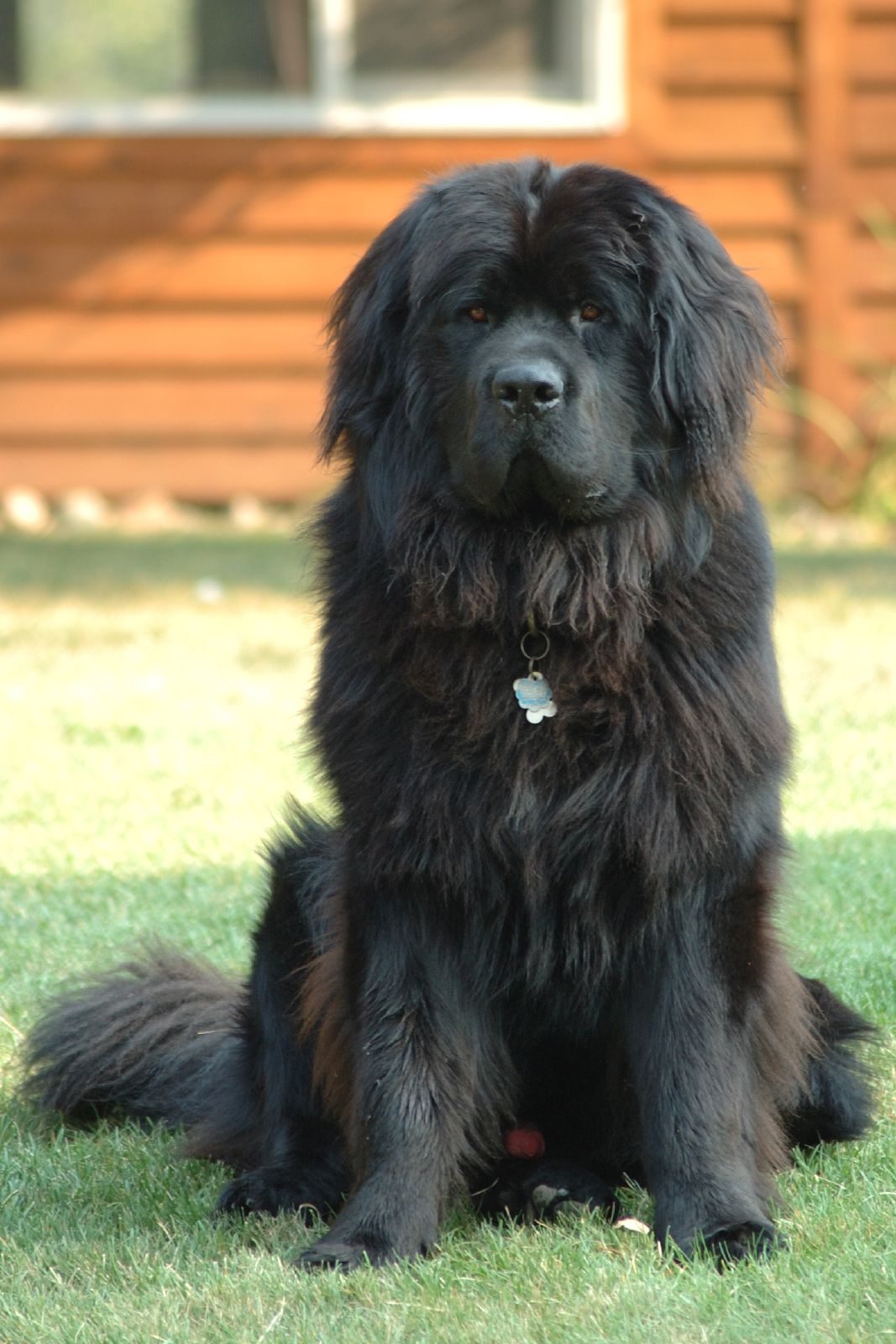
The Newfoundland is a giant working dog from the island of Newfoundland, now part of Canada, where it was bred to work for fishermen. Its muscular build, thick double coat, webbed paws and strong swimming make it very good at water rescue and lifesaving.
History
The term “Newfoundland dog” is recorded as early as 1766, in the journal of Joseph Banks. Fishermen and explorers from Ireland and England who visited the Grand Banks described two kinds of working dog. One was large and heavy with a longish coat, the greater Newfoundland. The other was a medium-sized, smooth-coated water dog, the lesser Newfoundland or St. John’s water dog, which went on to found the modern retrievers. Both pulled fishing nets, and the larger also hauled carts. One theory holds that the island’s original dog was smaller and was crossed with mastiffs after being sold to the English, giving the modern breed. Genomic analysis links the Newfoundland to the Irish Water Spaniel, Labrador Retriever and Curly-Coated Retriever.
Newfoundlands were bred into the St. Bernard in the 18th century, when distemper threatened that breed, and were part of the foundation of the Leonberger.
There are many accounts of rescues. In 1828 Ann Harvey of Isle aux Morts, her father, her brother and a Newfoundland called Hairyman saved more than 160 Irish immigrants from the wreck of the brig Despatch. A Newfoundland named Seaman traveled with Lewis and Clark to the Pacific and back. The breed still trains for rescue work, for example at the Italian School of Water Rescue Dogs.
In the United Kingdom the breed did well until wartime restrictions in 1914 and again in 1939 nearly wiped it out. Numbers have risen steadily since the 1950s.
Appearance
Males normally weigh 65 to 80 kg (143 to 176 lb) and females 55 to 65 kg (121 to 143 lb), and some dogs exceed 90 kg (200 lb). Height at the shoulder is 56 to 76 cm (22 to 30 in). The frame is heavy-boned, with stout legs, a massive head, a broad muzzle and a thick neck.
The double coat has a dense, soft underlayer for warmth and a coarse, moderately long, oily outer layer that sheds water. The American Kennel Club accepts black, brown, gray and white-and-black. The Kennel Club and the FCI allow black, brown and white-and-black, and the Canadian Kennel Club only black and white-and-black. The white-and-black pattern is called Landseer, after the painter Sir Edwin Landseer, who often portrayed such dogs.
Care and health
The Newfoundland’s size and its fondness for mud and water make it a poor fit for many households.
A 2024 UK study found a life expectancy of 11 years. The breed is predisposed to hip dysplasia, with the highest rate in two large American studies, and to elbow dysplasia, cranial cruciate ligament deficiency, dilated cardiomyopathy and gastric dilatation volvulus. Skin and related conditions it is prone to include acral lick dermatitis, allergic skin disease, ichthyosis, primary seborrhea and hypothyroidism.
Facts on this page were checked against Wikipedia and may have changed since.