Danish/Swedish Farm Dog
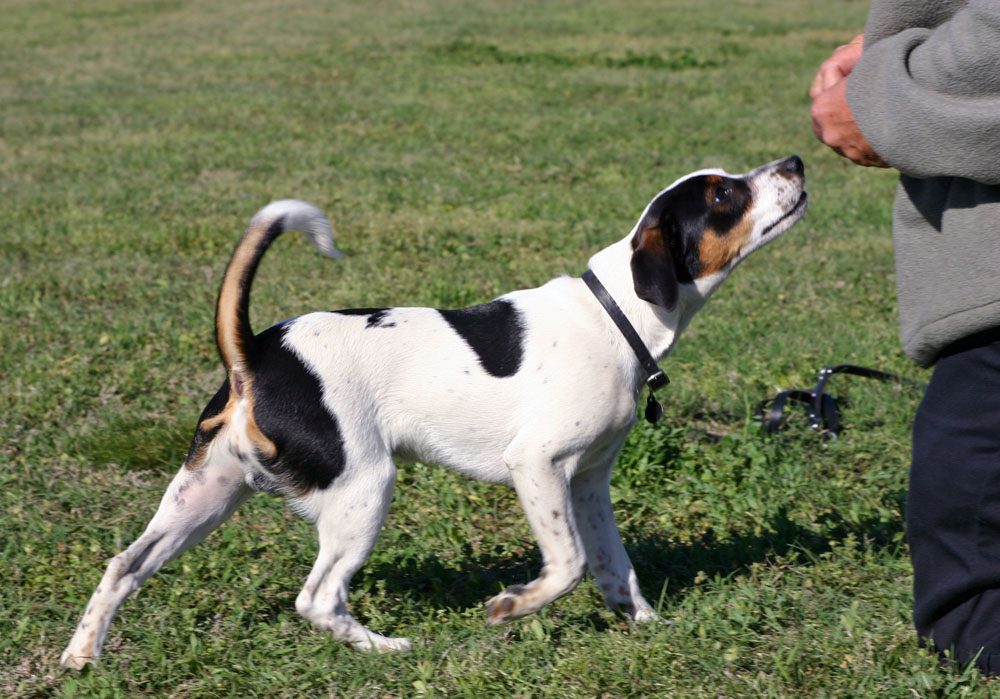

- Origin
- Denmark
- Type
- Working
- Size
- Small
- Height
- 30–39 cm (12–15 in)
- Coat
- Short, hard and smooth
- Colors
- Mostly white with one or more colored patches
- Status
- Recognised by the FCI and AKC
The Danish/Swedish Farm Dog is a small all-purpose farm dog from Denmark and southern Sweden, now popular across Scandinavia. It was formerly known as the Danish Pinscher.
History
The breed may have begun in Scania, in the far south of what is now Sweden. For centuries it was the everyday dog of Scandinavian farms, where it kept watch, caught rats, helped with hunting and herded stock.
Its numbers began to fall in the 1870s, when industrialization in Denmark left it with less and less work to do, and by the 1980s it was close to extinction. The Danish and Swedish kennel clubs then worked together to save it, and it became a recognized breed in both countries in 1987. It was shown at the World Dog Show for the first time in 1989.
In the United States the breed club, Danish–Swedish Farmdogs USA, applied in 2010 for a place in the American Kennel Club’s Foundation Stock Service, which the breed was given in January 2011. The AKC recognized it fully in 2025.
Appearance
The FCI standard describes a compact dog 30–39 cm tall, with height at the withers and body length in a ratio of 9 to 10. Males stand 32–39 cm (13–15 in) and females 30–37 cm (12–15 in). The head is rather small and triangular, with a clearly marked stop.
The coat is short, hard and smooth. White is the main color, broken by one or more patches in various color combinations. The tail may be long, a half bobtail or a bobtail.
Facts on this page were checked against Wikipedia and may have changed since.