Nova Scotia Duck-Tolling Retriever
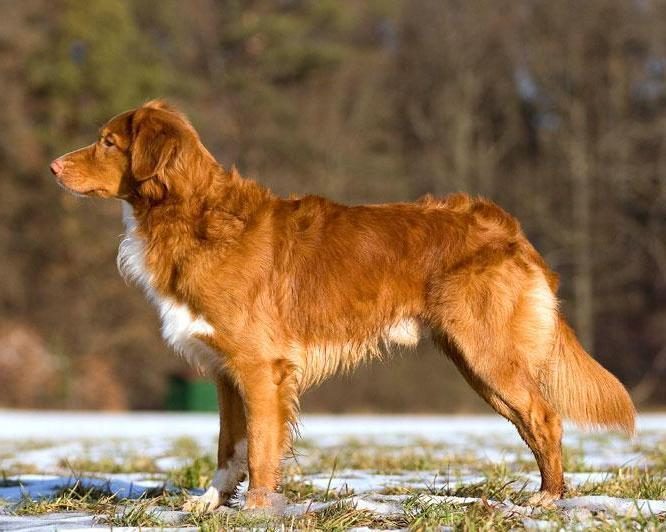

- Origin
- Canada
- Type
- Gundog
- Size
- Medium
- Height
- 43–53 cm (17–21 in)
- Weight
- 14–23 kg (30–50 lb)
- Coat
- Medium-length, water-repellent double coat
- Colors
- Shades of red or orange, often with white on the chest, feet and tail tip
- Life span
- About 13 years
- Status
- Recognised by the FCI, AKC and Canadian Kennel Club
The Nova Scotia Duck-Tolling Retriever, or toller, is a medium-sized gundog from Yarmouth County in Nova Scotia, Canada. It is the smallest of the retrievers and is often taken for a small Golden Retriever. Its name comes from “tolling”, the trick of luring waterfowl within gunshot range.
History
The breed was developed around the start of the 19th century in the Acadian community of Little River Harbour and was first known as the Little River Duck Dog. It is a blend of retriever, spaniel and setter, possibly with some farm collie. It was refined in the second half of the 19th century, and the Canadian Kennel Club recognised it as a purebred in 1945. In 1995 it was declared the provincial dog of Nova Scotia.
To toll, the hunter hides in a blind and sends the dog to romp along the shore, usually after a thrown ball or stick. The dog looks rather like a fox, and its antics and white markings draw curious ducks and geese closer. The hunter then calls the dog in, stands to flush the birds and shoots, and the toller retrieves what falls.
Appearance
Tollers stand 43 to 53 cm (17 to 21 in) at the withers and weigh 14 to 23 kg (30 to 50 lb), with females a little smaller. They are compact, muscular and athletic, with a deep chest, sturdy legs and webbed feet. The head is clean-cut and slightly wedge-shaped, like a fox’s, with high-set triangular ears and almond-shaped eyes of amber to dark brown.
The coat is a water-repellent double coat of medium length, straight or slightly wavy on the back, over a soft, dense undercoat. It may be any shade of red from golden red to dark copper, with lighter feathering under the tail and on the hindquarters. Most tollers have white on the tail tip, feet or chest, but its absence is not a fault.
Temperament
Tollers are intelligent, curious, alert and full of energy. They are affectionate, eager to please, good with children, and happiest with a job to do. They do well in agility, dock diving and obedience and make good search and rescue dogs. Without daily exercise, or when left alone for long, they can become destructive.
They are outgoing with family but reserved with strangers, so early socialisation matters. They usually get along with other dogs, but their strong prey drive may send them after cats and other small animals. An excited toller may let out the “toller scream”, a high-pitched, howling bark sometimes called singing.
Care and health
The coat sheds seasonally. A 2024 UK study found a life expectancy of 13.2 years. Tollers are generally hardy, but the gene pool is fairly small and several inherited disorders occur, many of them related to the immune system. These include autoimmune thyroiditis, Addison’s disease, immune-mediated rheumatic disease and steroid-responsive meningitis–arthritis. Progressive retinal atrophy affects about 7 percent of tollers, and collie eye anomaly, hip dysplasia and epilepsy are also seen.
Facts on this page were checked against Wikipedia and may have changed since.