Greater Swiss Mountain Dog

- Origin
- Switzerland
- Type
- Working
- Size
- Giant
- Height
- 60–72 cm (23.5–28.5 in)
- Weight
- 36–64 kg (80–140 lb)
- Coat
- Short double coat
- Colors
- Tricolor: black, rust and white
- Life span
- 8–11 years
- Status
- Recognised by the FCI, AKC, UKC and The Kennel Club
The Greater Swiss Mountain Dog was developed in the Swiss Alps as a draft and droving dog. Its German name, Grosser Schweizer Sennenhund, refers to the Senn, the dairymen and herders of the Alps. It is the largest of the four Swiss mountain dogs and is considered the oldest.
History
The breed’s origin is not known for certain. It almost surely came from local dogs mating with big mastiff-type dogs brought into Switzerland by settlers. For about three centuries from 1515 the remote Swiss valleys were largely cut off, and distinct types of dog arose there through close breeding.
The dogs pulled carts and drove cattle in steep country, and were so widely used for hauling that they were nicknamed the poor man’s horse. By the late nineteenth century other breeds and machines had taken over this work, and the type was assumed to have almost died out.
In 1908 Franz Schertenlieb showed two dogs, entered as short-haired Bernese Mountain Dogs, to Albert Heim, a geology professor and an expert on the Swiss mountain dogs. Heim urged breeders to take them up, and the breed was re-established. The first breed club was formed in 1912.
The FCI first published the Swiss standard in 1939. By 1945 more than 100 puppies were registered in a year. The breed reached the United States in 1968. The United Kennel Club recognized it in 1992, the American Kennel Club in 1995 and the Canadian Kennel Club in 2006. The breed probably played a part in the development of the St. Bernard and the Rottweiler.
Appearance
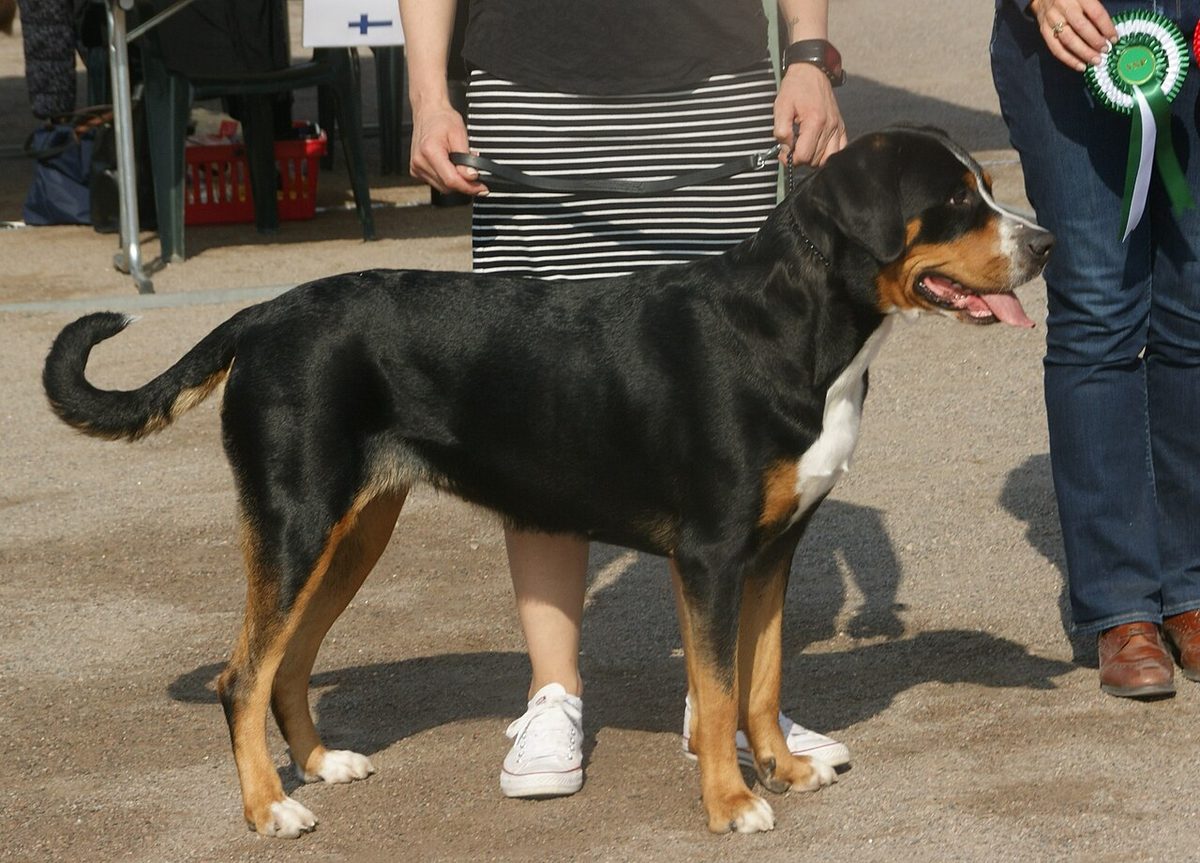
Males stand 65–72 cm (25.5–28.5 in) at the shoulder and females 60–69 cm (23.5–27 in). There is no weight standard; males tend to weigh 41–64 kg (90–140 lb) and females 36–50 kg (80–110 lb). The body is slightly longer than tall, and the chest is about half as deep as the dog is high. The hindquarters are broad and muscular, as a draft dog needs. The eyes are almond-shaped and hazel to chestnut, with dark brown preferred.
The coat is double. The dense outer coat is about 3 to 5 cm long and may be short, straight and fine or longer, wavier and coarser. The undercoat is thick. The dogs shed all year, with one or two heavy sheds.
The standard asks for black, white and rust. Black covers the back, ears, tail and most of the legs. Rust appears on the cheeks, as a spot over each eye, and on the legs between the black and the white. White marks the muzzle, a blaze between the eyes, the chest, the feet and the tail tip. Blue tricolor and rust-and-white dogs also occur. Working ability counts for more than perfect markings; as breeders put it, markings don’t pull the cart.
Temperament
Greater Swiss Mountain Dogs are generally enthusiastic and strongly attached to people, including children. They are often described as sociable, active, calm and dignified. They need exercise but not a great deal of space, and they tend to stay close to their owners.
Care and health
For its size the breed is fairly healthy. Diseases of the spleen, namely splenic torsion and splenic tumors, are noted in the breed. Signs of torsion include lethargy, a swollen abdomen and pale gums.
Like other heavy dogs, it tends to live a shorter life than smaller breeds. Published estimates run from 8–10 to 10–11 years, while a survey by the breed club in the United States found a median of 6.75 years.
Facts on this page were checked against Wikipedia and may have changed since.