Red Fox

- Origin
- Northern Hemisphere
- Type
- Wild canid
- Size
- Small
- Height
- 35–50 cm (14–20 in)
- Weight
- 2.2–14 kg (4.9–30.9 lb)
- Coat
- Dense, soft and silky in winter
- Colors
- Red, silver or black, and cross
- Status
- Least Concern (IUCN)
The red fox (Vulpes vulpes) is the largest of the true foxes and the most widely distributed member of the order Carnivora. It is a wild species that adapts quickly to new surroundings, and it has spread alongside people into farmland, suburbs and cities. The IUCN lists it as Least Concern.
Range and habitat
The red fox lives on every continent except South America and Antarctica, over a range of nearly 70 million square kilometers reaching north to the Arctic Circle. It is found throughout Europe, in Africa north of the Sahara, across Asia apart from the far southeast, and across North America apart from most of the southwestern United States and Mexico. It is absent from the Arctic islands, the far north of central Siberia and extreme deserts. The species arose in Eurasia about 400,000 years ago and reached North America more than 130,000 years ago.
Settlers brought foxes to Australia in the 1830s and 1840s for hunting. They now number in the millions across most of the mainland and prey on native rodents and marsupials, which has put the red fox on the list of the world’s 100 worst invasive species.
Foxes have also settled in towns, mostly in low-density residential suburbs. They colonized British cities from the 1930s, and the number of urban foxes in the UK was estimated at 150,000 in 2017.
Appearance
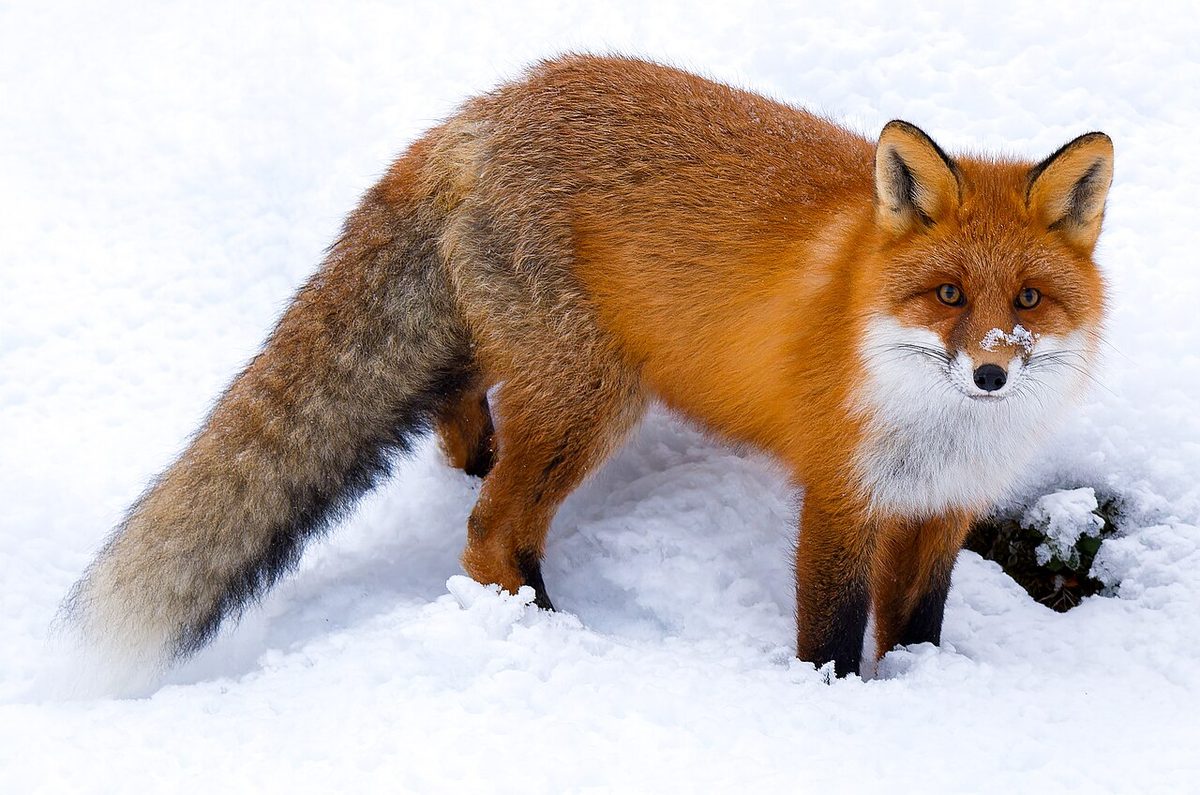
The red fox has a long body, fairly short legs and a fluffy tail more than half the length of the body, which touches the ground when the animal stands. The muzzle is narrow and the pupils are vertical ovals. Adults average 35–50 cm (14–20 in) at the shoulder and 45–90 cm (18–35 in) in body length, with a tail of 30–55.5 cm. Weight ranges from 2.2 to 14 kg (4.9–30.9 lb), and females are typically 15–20% lighter than males. For its size the red fox is much lighter than a domestic dog.
The winter fur is dense, soft and silky. Despite the name, not all red foxes are red: the three main color forms are red, silver or black, and cross. Forty-six subspecies are recognised, falling broadly into large northern foxes and small gray desert foxes of North Africa and Asia.
Behavior
Red foxes usually live in pairs or small family groups that share a territory, which they mark with urine. A group may be a mated pair and their young, or a male with several related females. Young from the previous year often stay on and help rear the next litter.
They breed once a year. After a pregnancy of 49–58 days the female gives birth to four to six kits on average, which are born blind, deaf and toothless.
The red fox is an omnivore with a very varied diet. It eats mainly small rodents, but also rabbits, birds, reptiles, insects and other invertebrates, and fruit, which in some areas makes up its whole diet in autumn. It needs about 500 g of food a day and prefers to hunt before sunrise and in the late evening. It can run at up to 50 km/h (31 mph), jump fences 2 m high and swim well.
People have long hunted the red fox as a pest and for its fur. In Russia, selective breeding has produced a domesticated silver fox.
Facts on this page were checked against Wikipedia and may have changed since.