Eurasier
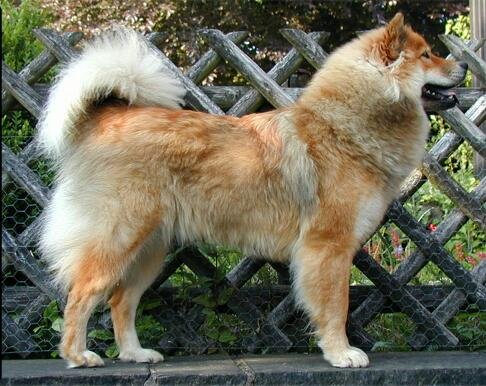

- Origin
- Germany
- Type
- Spitz
- Size
- Medium
- Height
- 48–60 cm (19–24 in)
- Weight
- 18–32 kg (40–71 lb)
- Coat
- Thick undercoat with medium-long guard hair
- Colors
- All colors except pure white, white patches and liver
- Status
- Recognised by the FCI, The Kennel Club and the Canadian Kennel Club
The Eurasier, or Eurasian, is a spitz-type dog created in Germany by crossing European and Asian spitz breeds. It was bred as a companion, and is known for bonding closely with its family while staying politely reserved with strangers.
History
The breed dates from 1960, when Julius Wipfel, Charlotte Baldamus and a small group of enthusiasts set out to combine the best qualities of the Chow Chow and the Wolfspitz. Their first dogs were called Wolf-Chows. Twelve years later a Samoyed cross was added and the breed was renamed the Eurasier. The FCI recognized it in 1973.
The Nobel laureate Konrad Lorenz had a Eurasier from Charlotte Baldamus, a dog he called Babett, and thought her character the best he had known in a dog.
The Canadian Kennel Club recognized the breed in 1995 in its Working Dogs group. In Britain, The Kennel Club moved it from the imported register to the breed register from April 1, 2013.
Keeshond and Chow Chow mixes are sometimes passed off as Eurasiers. They are genetically similar but are not the same breed.
Appearance
The Eurasier is a balanced, well-built, medium-sized spitz with prick ears. Males stand 52–60 cm (20–24 in) at the withers and weigh 23–32 kg (51–71 lb). Females stand 48–56 cm (19–22 in) and weigh 18–26 kg (40–57 lb).
The FCI standard asks for a thick undercoat under medium-long, loosely lying guard hair. The hair is short on the muzzle, face, ears and front of the legs, and long on the tail and the backs of the legs. It is a little longer on the neck but should not form a mane.
Colors include fawn, red, wolf-gray, solid black and black and tan. Any combination is allowed except pure white, white patches and liver. The tongue may be pink, blue-black or spotted.
Temperament
Eurasiers are calm and even-tempered. They are watchful and alert, and reserved with strangers without being timid or aggressive. Indoors they are quiet; outdoors they are lively and enjoy activity, especially anything that involves their family.
They need constant, close contact with their people and do badly when kept in a kennel, a yard or a crate, or on a chain, where they pine and become depressed. For the same reason they are not suited to institutional service-dog training or to sled or guard work, though they can make very good therapy dogs. They are very sensitive to harsh words and discipline, and respond best to consistent training with positive reinforcement.
Care and health
Eurasiers are generally healthy, but the small gene pool of the breed’s early years means some hereditary conditions are seen now and then. These include hip dysplasia, luxating patella and hypothyroidism, and eyelid and lash disorders such as distichiae, entropion and ectropion. Health tests listed for breeding dogs cover hips, elbows, patellas, eyes, teeth, Dandy-Walker-like malformation and autoimmune thyroid disease.
Facts on this page were checked against Wikipedia and may have changed since.