Boxer
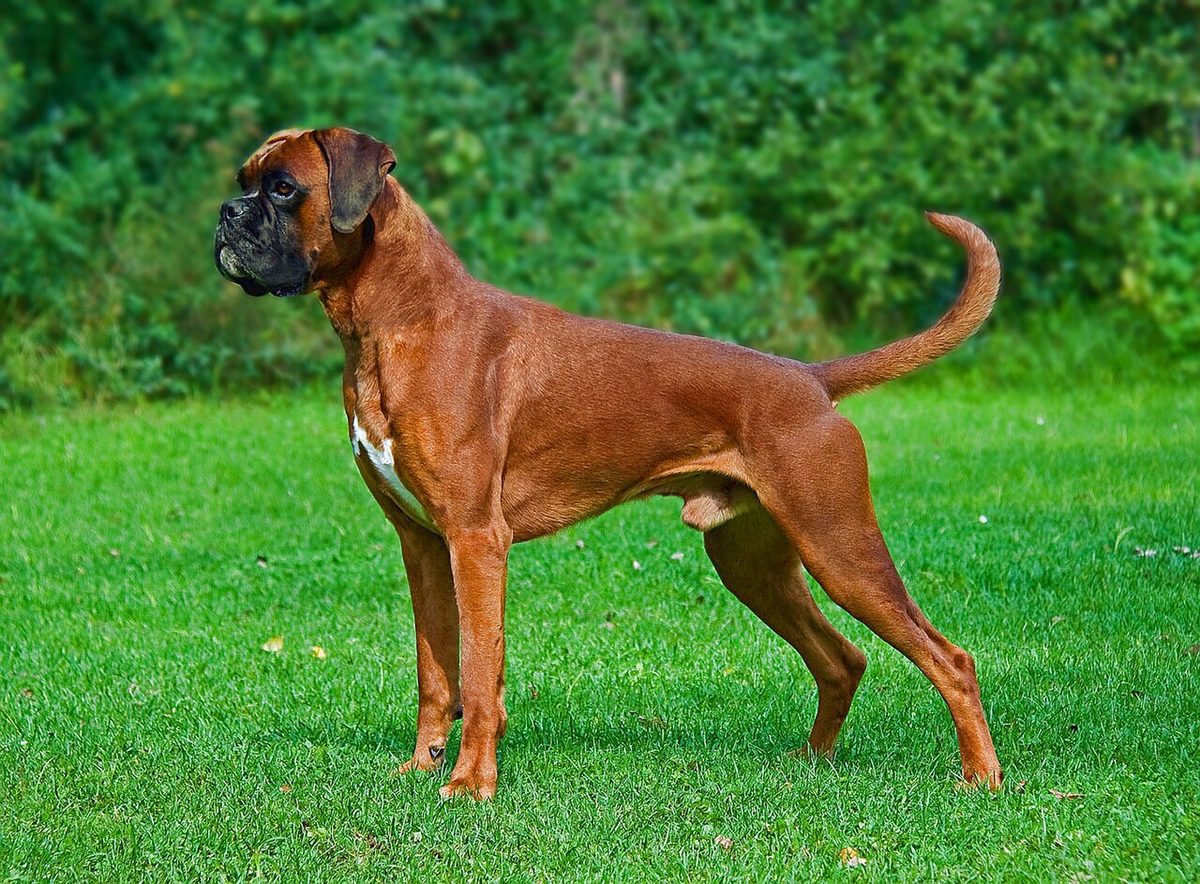

- Origin
- Germany
- Type
- Mastiff
- Size
- Large
- Height
- 53–64 cm (21–25 in)
- Weight
- 25–32 kg (55–70 lb)
- Coat
- Short, smooth, shiny and close-lying
- Colors
- Fawn or brindle, with or without white markings
- Life span
- About 10–11 years
- Status
- Recognised by the FCI, AKC and The Kennel Club
The Boxer is a medium to large, short-haired dog of the mastiff type, developed in Germany in the late nineteenth century. It has a broad, short skull, a square muzzle, an undershot jaw and a very strong bite, all inherited from dogs bred to seize large game and hold on. Today it is mostly a family companion and guard dog.
History
The Boxer was bred from the Bullenbeisser, a German hunting mastiff that is now extinct, and Bulldogs brought from Great Britain. For centuries the Bullenbeisser was used on bear, wild boar and deer, gripping the animal until the hunters came up. A smaller, faster version bred in Brabant is generally accepted as the Boxer’s direct ancestor.
In 1894 three Germans, Friedrich Robert, Elard König and R. Höpner, set out to fix the type. Boxers were shown for the first time in 1896 in Munich, at a show for St. Bernards, and the Deutscher Boxer Club was founded soon after. The club published the first breed standard in 1904, and it has changed little since.
The breed reached the United States around 1900, and the American Kennel Club registered its first Boxer in 1904. During World War I, Boxers served as messenger dogs, pack carriers, and attack and guard dogs. The breed became popular worldwide only after World War II, when returning soldiers brought dogs home.
Appearance
The head is the Boxer’s most distinctive feature. The muzzle should be one third of the length of the head, with folds running down both sides from the root of the nose, and the lower jaw juts past the upper and curves slightly up. The body is square, with strong bone and well-developed muscle.
The coat is short, smooth and tight to the body. It is either fawn, which ranges from light tan to deep deer red, or brindle, meaning black stripes on a fawn ground. Many dogs have a white belly and feet, and white that reaches the neck or face is called flash. Boxers do not carry a gene for solid black. About 20–25 percent of puppies are born mostly white; these are not albinos, and an estimated 18 percent of them are deaf in one or both ears.
Boxers were traditionally docked and cropped. Both practices are now banned in some countries, and The Kennel Club’s standard does not allow them.
Temperament
Boxers are bright, energetic and playful. They tend to be patient and protective with children, loyal to their family and wary of strangers, which makes them good guard dogs. They can seem headstrong, and they respond better to reward-based training than to correction. Without enough exercise they may chew, dig or lick out of boredom.
Care and health
A 2024 study in the United Kingdom found a life expectancy of 11.3 years; a Kennel Club survey gave a median of 10.25 years, with cancer the cause of 38.5 percent of deaths. The breed is particularly prone to mast cell tumors.
Other problems Boxers are prone to include heart conditions such as aortic stenosis and arrhythmogenic right ventricular cardiomyopathy, hypothyroidism, hip dysplasia, degenerative myelopathy and epilepsy. Gastric dilatation volvulus, allergies, entropion, spondylosis, a form of ulcerative colitis, slow-healing corneal ulcers and an inherited juvenile kidney disease are also seen. White Boxers sunburn easily and have a higher risk of skin cancer.
Facts on this page were checked against Wikipedia and may have changed since.